


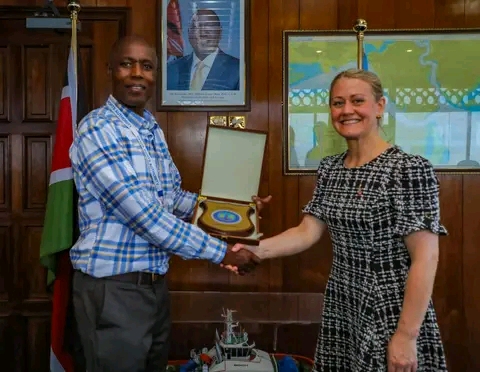
The deepening maritime cooperation between Kenya and the Kingdom of Norway represents more than a diplomatic courtesy; it is a strategic inflection point in Kenya’s ascent as a premier maritime and blue economy powerhouse in Africa. The recent visit of Norway’s Deputy Minister of Foreign Affairs, Ms. Astrid Bergmall, alongside the Norwegian Ambassador to Kenya, H.E. Siv Cathrine Moe, to the Port of Mombasa, underscores the critical role of international partnerships in navigating the complexities of modern ocean governance.
At a juncture where global shipping grapples with unprecedented environmental hurdles, escalating climate risks, and the urgent need for sustainable port operations, the joint commitment by the Kenya Ports Authority (KPA) and Norway to bolster oil pollution preparedness and response is both acutely timely and strategically vital. This collaboration reflects a shared conviction that robust economic growth within the maritime sector must be intrinsically linked to rigorous environmental stewardship.
As the primary gateway for Kenya and the broader East and Central African hinterland, the Port of Mombasa is one of the continent’s busiest arteries of trade. A major pollution incident within Kenyan waters would not be a localized event; it would cascade into a regional catastrophe, threatening marine biodiversity, coastal livelihoods, fisheries, tourism, and the stability of regional supply chains. Consequently, strengthening our response mechanisms is not merely a regulatory checkbox—it is an economic and ecological imperative.
Norway’s global standing as a maritime nation and a pioneer in sustainable ocean management makes it an invaluable partner. The Scandinavian country has long championed environmentally responsible shipping, marine conservation, and cutting-edge offshore technology. Through technical cooperation, capacity building, and targeted knowledge transfer, Kenya is poised to benefit immensely from Norwegian expertise in developing resilient, environmentally sustainable maritime infrastructure.
The discussions at the Port of Mombasa also reaffirm the tangible significance of the bilateral Memorandum of Understanding on Blue Economy Cooperation. Such agreements, however, must transcend ceremonial formalities and evolve into actionable initiatives that deliver measurable dividends for maritime stakeholders, coastal communities, and future generations.
A particularly encouraging aspect of this engagement is the emphasis placed by KPA General Manager of Finance and Commercial Services, Mr. Geoffrey Kavate, on transformative infrastructure projects, including the development of Berth 19B, the Dongo Kundu Industrial Park, and the Dongo Kundu Special Economic Zone. These flagship investments are poised to fundamentally redefine Kenya’s maritime landscape.
The expansion of port capacity through Berth 19B is expected to accommodate surging cargo volumes and significantly improve vessel turnaround times, enhancing the Port of Mombasa’s competitive edge in a region where neighboring ports are aggressively modernizing. In this environment, operational efficiency is the determining factor for success.
Equally significant is the strategic vision driving the Dongo Kundu Industrial Park and Special Economic Zone. These initiatives signal a paradigm shift: moving beyond the traditional perception of ports as mere transit points for imports and exports, and reimagining them as catalysts for industrialization, manufacturing, logistics, and value addition. By creating integrated industrial ecosystems directly linked to port infrastructure, Kenya can unlock new economic frontiers, generate sustainable employment, and attract foreign direct investment.
However, infrastructure alone is insufficient. Sustainable growth within the blue economy demands deliberate investment in human capital, maritime education, environmental governance, marine research, and technological innovation. The true barometer of success will be whether these projects create meaningful opportunities for Kenyan youth, fortify local industries, and foster inclusive economic growth.
Moreover, this partnership offers Kenya a unique platform to accelerate its transition toward green ports and low-carbon shipping. As the international maritime community intensifies efforts to decarbonize, African ports must proactively prepare for a future defined by cleaner fuels, digitalization, and stringent environmental standards. Collaborative initiatives with advanced maritime nations are essential to bridging existing technological and capacity gaps.
Enhanced oil spill preparedness serves as a poignant reminder that maritime development must not come at the expense of marine ecosystems. Kenya’s coastline, home to critical habitats such as coral reefs, mangrove forests, and seagrass beds, sustains thousands of livelihoods. Protecting these resources is fundamental to the long-term viability of the blue economy itself.
The Kenya-Norway partnership should, therefore, be viewed through a broader lens—not merely as bilateral cooperation, but as a blueprint for how developed and developing maritime nations can align to achieve sustainable ocean governance. It demonstrates that environmental protection and economic development are not competing interests but mutually reinforcing pillars of long-term prosperity.
As Kenya solidifies its position as a regional maritime and logistics hub, strategic partnerships of this nature will be instrumental in shaping our maritime destiny. The challenge ahead lies in translating commitments into concrete action, ensuring projects are delivered efficiently, and fostering a maritime sector that is competitive, resilient, environmentally responsible, and inclusive.
Remarks
“Kenya’s blue economy ambitions will be realized not merely through ports and industrial zones, but through partnerships that seamlessly integrate infrastructure, environmental responsibility, innovation, and human capital development.”
“The collaboration between Kenya and Norway sends a powerful message: the future of maritime growth lies in sustainable development, where economic progress and ocean conservation advance hand in hand.”
“The Port of Mombasa is evolving from a traditional gateway into a strategic engine of regional economic transformation. The support of global maritime partners such as Norway will be instrumental in accelerating this transition.”
— Editorial Board Opinion
Maritime Affairs, Blue Economy and Regional Trade Analysis