


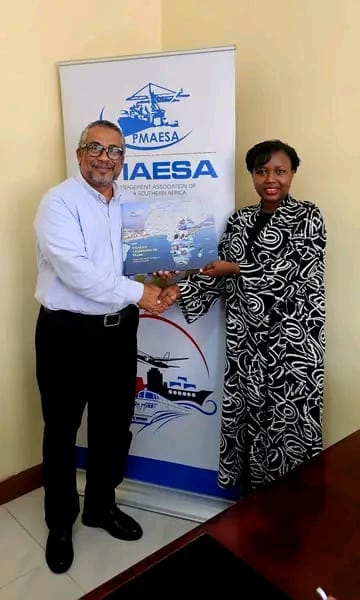
The high-level meeting on July 13 between the Port Management Association of Eastern and Southern Africa (PMAESA) and the Maritime Technology Cooperation Centre (MTCC) Africa was far more than a routine diplomatic engagement. It signalled a pivotal shift in Africa’s maritime trajectory—a clear indication that the continent is embracing a coordinated, forward-looking strategy to confront one of the defining challenges of our time: building a sustainable, low-carbon maritime future.
For decades, Africa’s ports and shipping industry have largely responded to global environmental regulations rather than helping to shape them. As the International Maritime Organization (IMO) accelerates its pathway toward achieving net-zero greenhouse gas emissions from international shipping by approximately 2050, many African countries continue to grapple with limited technical capacity, inadequate emissions monitoring systems, constrained financing, and fragmented regional coordination. The renewed partnership between PMAESA and MTCC Africa—formalized through a refreshed Memorandum of Understanding—represents a determined effort to reverse that trend.
The significance of this collaboration lies not merely in the signing of another agreement but in its strategic focus on institutional alignment and capacity development. PMAESA, established in 1973 under the auspices of the United Nations Economic Commission for Africa, has long served as the premier regional platform for port authorities and maritime stakeholders across Eastern and Southern Africa and the Western Indian Ocean. MTCC Africa, hosted by Jomo Kenyatta University of Agriculture and Technology in Mombasa, has emerged as the continent’s centre of excellence for maritime decarbonization, delivering technical expertise and practical solutions to support climate action across the shipping sector. Together, these institutions are uniquely positioned to bridge the persistent gap between policy ambition and practical implementation.
Perhaps the most transformative outcome of the discussions is the proposed establishment of a Regional Industry Alliance. By bringing together Regional Economic Communities, port authorities, maritime administrations, development partners, research institutions, and private-sector stakeholders, the Alliance promises to move Africa beyond fragmented national initiatives toward a coordinated regional strategy. Such a platform embodies the vision of the IMO’s Global MTCC Network Phase II, which seeks to accelerate the adoption of energy-efficient technologies, strengthen innovation, and foster meaningful public-private partnerships capable of delivering measurable climate outcomes.
The urgency of this agenda cannot be overstated.
International shipping accounts for roughly three percent of global greenhouse gas emissions. Without decisive intervention, those emissions could rise significantly by mid-century as global trade expands. Africa has witnessed a sharp increase in shipping-related emissions over the past decade, while the continent’s growing population, expanding economies, and rising trade volumes will inevitably place even greater demands on maritime transport. Port operations also contribute substantially to environmental pollution, with emissions generated while vessels are berthed having direct consequences for the health of coastal communities and fragile marine ecosystems.
Yet the challenge presents an equally compelling opportunity.
The IMO-European Union Future-Ready Shipping in Africa program, backed by a €5 million investment, is already helping African states strengthen policy frameworks, implement MARPOL Annex VI requirements, and prepare viable investment cases for alternative marine fuels and green port infrastructure. MTCC Africa’s pilot projects in Namibia and Mauritius are demonstrating how practical innovations can improve energy efficiency while reducing emissions. These initiatives illustrate that sustainability and economic competitiveness are not competing objectives. On the contrary, they reinforce one another by creating new investment opportunities, supporting green employment, enhancing energy security, and strengthening the resilience of Africa’s maritime economy.
Equally important is the recognition that decarbonization cannot simply be imported through international regulations—it must be driven by African institutions, African expertise, and African ownership. Sustainable transformation depends on continuous training, technology transfer, collaborative research, and the development of local technical capacity. The renewed partnership between PMAESA and MTCC Africa acknowledges this reality by placing knowledge-sharing, skills development, and institutional strengthening at the centre of its agenda.
Time, however, is not on Africa’s side. The IMO’s mid-term greenhouse gas reduction measures are expected to take effect in 2027, leaving only a narrow window for African governments, ports, and shipping companies to prepare for an increasingly stringent regulatory environment. Waiting until compliance becomes mandatory would be both economically costly and strategically shortsighted.
The PMAESA-MTCC Africa partnership therefore arrives at precisely the right moment. By promoting regional cooperation, technological innovation, climate resilience, and coordinated policy implementation, it provides a practical roadmap for ensuring that Africa is not merely adapting to the global green transition but actively helping to shape it.
What began as a courtesy meeting in Mombasa has evolved into something far more consequential. It represents a declaration that Africa’s maritime sector intends to become an active architect of sustainable shipping rather than a passive recipient of international mandates. If this partnership maintains its momentum and translates vision into measurable action, it could well become one of the defining milestones in Africa’s maritime transformation—strengthening the competitiveness of its ports, safeguarding its marine environment, and positioning the continent as a credible leader in the future of sustainable global shipping.