


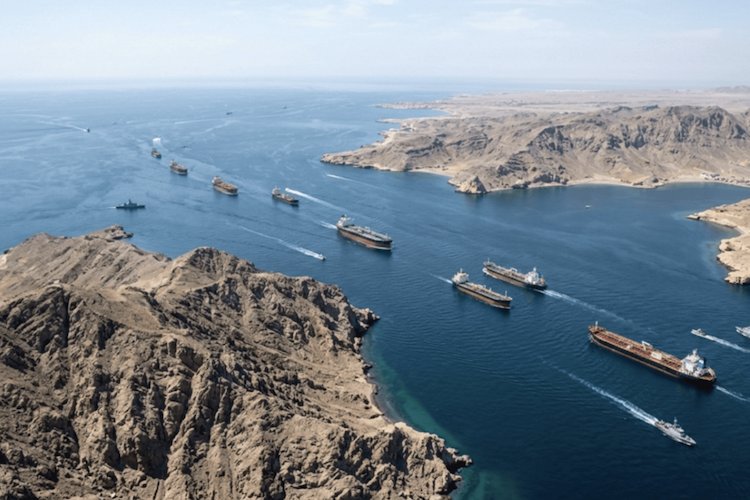
The Strait of Hormuz, as many in the maritime industry know it, is the narrow maritime chokepoint through which roughly one-fifth of the world’s oil and a significant share of its liquefied natural gas has always flowed freely.
Now, it is no longer an open international waterway, because, as of April 12, 2026, it has effectively become Iran’s private toll road.
Even after the fragile U.S.-Iran ceasefire announced in early April, shipping traffic remains severely depressed: only a handful of vessels per day navigate the strait, compared to the normal 130 to 140. Those that do pass must coordinate with the Islamic Revolutionary Guard Corps (IRGC), follow rerouted paths hugging Iran’s coastline, and—according to multiple shipping and intelligence sources—pay substantial fees, often reaching up to $2 million per tanker.
Payments are frequently demanded in Chinese yuan or cryptocurrency to evade sanctions. Industry participants have already dubbed it the “Tehran Toll Booth.” Iranian officials have hinted at formalizing such levies as part of any long-term arrangement, with some suggesting a $1-per-barrel charge.
This practice is illegal under international law. The United Nations Convention on the Law of the Sea (UNCLOS) designates the Strait of Hormuz as an international strait used for global navigation. Ships and aircraft enjoy an unimpeded right of “transit passage” that coastal states may not hamper, suspend, or charge for merely by reason of passage.
Fees are permitted only for specific services rendered—such as pilotage—and must be nondiscriminatory. The International Maritime Organization (IMO) has warned that imposing tolls on ships transiting international straits would “set a dangerous precedent.”
Although neither the United States nor Iran has ratified UNCLOS, the core rules on transit passage reflect longstanding customary international law binding on all states. Iran’s selective enforcement—easier passage for friendly flags, delays or higher costs for others—violates both the letter and spirit of these norms. This is not legitimate regulation; it is coercive extraction.
For eight decades following World War II, the United States and its allies upheld the principle of freedom of navigation on the high seas. This maritime order dramatically lowered the cost of global trade, kept energy affordable, and powered unprecedented economic growth from Nairobi to Shanghai. Reliable shipping lanes meant lower insurance premiums, stable supply chains, and cheaper goods and fuel for billions of people. The system was far from perfect, but it delivered broad-based prosperity by treating the oceans as a global common rather than a series of feudal toll gates.
That era is now unraveling. The immediate economic pain is already evident. Oil and energy prices, though somewhat moderated by the ceasefire, remain elevated. Global shipping rates and insurance costs have surged.
Every additional dollar on a barrel of crude translates into higher fuel prices for transport in Kenya and across Africa, more expensive imported food and medicine, and broader inflationary pressure worldwide. If the toll regime becomes semi-permanent, it risks embedding higher baseline energy and transport costs for years to come—effectively acting as a hidden tax on global commerce.
The longer-term danger lies in precedent. If Iran succeeds in extracting rents from Hormuz after a limited conflict, other powers may be tempted to emulate the model in other strategic waterways: the South China Sea, the Bab el-Mandeb, the Malacca Strait, and beyond. History shows that when chokepoints are politicized and taxed, trade volumes shrink, costs rise, and resentment builds.
The post-1945 open-seas regime, underwritten largely by American naval power, replaced earlier patterns of predation with predictable, low-cost movement of goods. Replacing it with selective coercion would favor the militarily assertive and the politically connected while disadvantaging smaller nations, developing economies, and ordinary consumers everywhere.
The United States now faces a difficult but necessary choice. President Trump has issued warnings to Iran to cease the fees, while also floating ideas of possible U.S.-Iran revenue-sharing arrangements—suggestions quickly criticized by the European Union and others as incompatible with international law.
The desire to avoid another open-ended military commitment in the Middle East is understandable after years of costly engagements. Still, allowing a major chokepoint to operate as a protection racket undermines the very norms that have benefited American and global prosperity alike. Credible enforcement—through sustained naval escorts, diplomatic isolation of the practice, and targeted economic pressure—remains essential.
Practical responses should include accelerating energy diversification, expanding nuclear and renewable capacity, “friend-shoring” critical supply chains, and developing alternative maritime routes where feasible. At the same time, the international community must reject any normalization of transit tolls in international straits. Free navigation is not a luxury; it is a foundational public good that has lifted living standards worldwide.
Iran’s imposition of the Tehran Toll Booth is more than a regional power play. It is a direct challenge to the maritime order that has enriched humanity for generations. If the world accepts this precedent and simply pays up, the cost will not fall only on oil importers or shipping companies.
It will be borne by families across the globe through higher prices for fuel, food, transport, and everyday goods. The choice is clear: defend the principle of free seas that delivered shared prosperity, or watch that prosperity erode under waves of selective extortion and coercion. The stakes are too high for hesitation.