


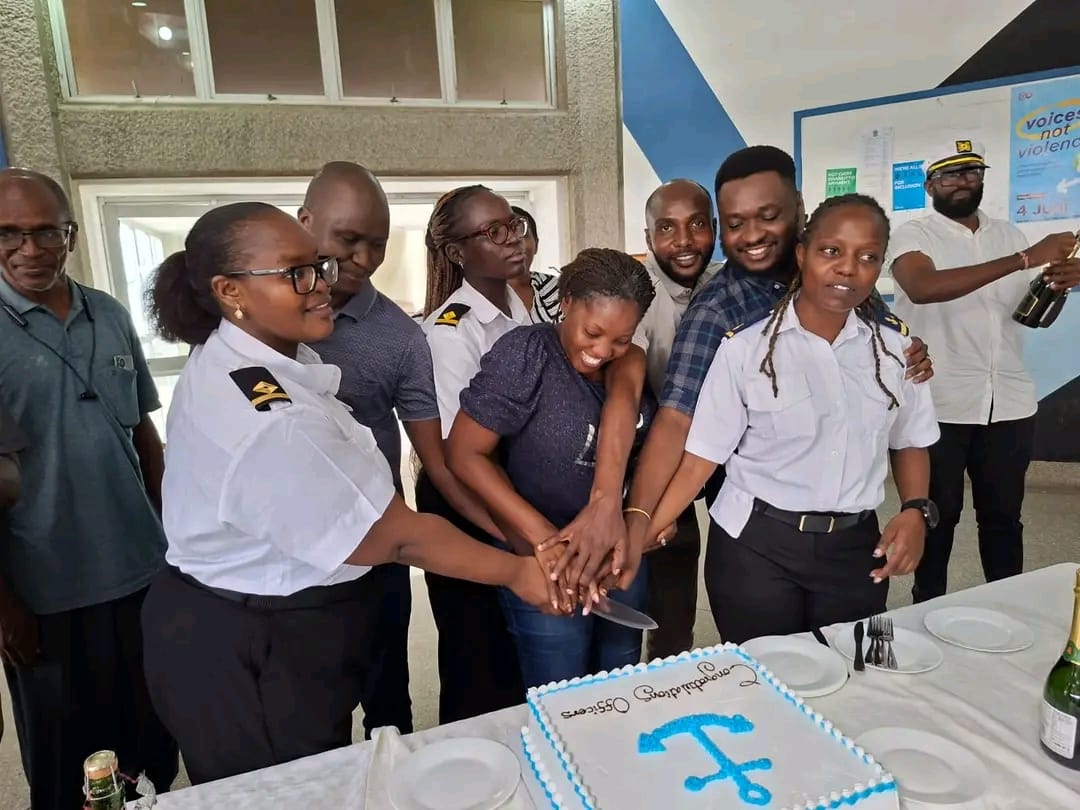
Kenya’s maritime training pipeline has made real progress. Partnerships between Bandari Maritime Academy (BMA) and global carriers such as CMA CGM have delivered what classroom instruction cannot: mandatory sea time. Cadets board CMA CGM vessels, log the required months of practical experience, absorb international safety culture, cargo operations, watchkeeping and technical routines, then return home with sea service that brings them closer to Certificates of Competency.
Yet a quiet crisis follows the celebrations. Once the cadetship ends, many of these young officers-in-waiting discover there are no automatic berths. They are not trainers; nor are there instructor vacancies for them. They stand qualified, experienced and stranded. The question is blunt: what becomes of them, and what must Kenya’s Maritime Education and Training (MET) institutions and government do about it?
The Structural Bottleneck
Sea time is the non-negotiable bridge between academic qualification and employability under the International Convention on Standards of Training, Certification and Watchkeeping for Seafarers (STCW). Kenya has rightly celebrated memoranda of understanding (MoUs) with CMA CGM—targeting dozens of cadets over multi-year programmes—as well as with Maersk, Wilhelmsen, Danica and others. Recent flag-offs of groups of 10–12 cadets for six- or twelve-month voyages are genuine milestones. BMA and other approved MET institutions have expanded their intake. The national seafarer register has grown from roughly 5,000 a few years ago to around 16,000. Kenya remains on the IMO White List, and recognition agreements with open registries such as Panama, Liberia, Palau and Jamaica open theoretical access to thousands of vessels.
The numbers still do not add up. Training berths remain scarce relative to the volume of graduates. Local employment absorption is minimal because Kenya lacks a substantial national merchant fleet. Foreign carriers treat cadetships as corporate social responsibility or limited talent pipelines, not open-ended recruitment commitments. Once the sponsored sea time ends, the cadet competes in a global labour market already supplied by established labour-supplying nations. Without further sea service or a firm contract, progression to officer ranks stalls. Families that invested heavily watch their children return to shore with certificates that are incomplete or under-utilised. Some drift into unrelated work; others become vulnerable to unlicensed agents.
Compounding the problem is the absence of a structured national pathway after cadetship. There is no guaranteed absorption mechanism, no systematic bridging programme into ratings or junior officer roles, and limited capacity inside MET institutions to employ returning cadets as trainers or assessors. Experienced mariners remain under-represented as full-time instructors in many institutions, while the very people who have just completed high-quality sea time find no institutional home.
The Human and Economic Cost
Every stranded cadet represents wasted public and private investment, deferred foreign exchange earnings, and a blow to the credibility of Kenya’s blue-economy ambitions. Global demand for qualified seafarers is projected to remain strong; shortages of officers and ratings are forecast for years. Kenya’s English-proficient, relatively young workforce is well placed to supply that demand—if the final links in the chain are fixed. Failure to do so turns training success into a pipeline of frustrated talent and undermines the case for further expansion of MET capacity.
What MET Institutions Must Do
MET institutions, led by BMA as the flagship, cannot treat sea-time partnerships as the end of their responsibility. They must build post-cadetship pathways.
· Maintain rigorous, transparent alumni-tracking and readiness databases so that every graduate who completes sea time is visible to shipping lines, crewing agents and the regulator. Selection for further opportunities must be merit-based and publicly accountable.
· Develop structured “returnee” programmes: short bridging courses, simulator refreshers and mentorship that keep skills current while cadets seek contracts.
· Create limited but meaningful instructor and assessor pathways. Returning cadets with recent sea time can serve as junior trainers or demonstrators under the supervision of senior mariners, simultaneously easing the chronic shortage of qualified instructors and giving the cadets meaningful work.
· Deepen industry linkages beyond one-off MoUs. Negotiate multi-year frameworks that include preferential consideration for employment after a successful cadetship, not merely training slots.
· Diversify training outcomes. Not every graduate will sail. Strengthen shore-based pathways in port operations, logistics, ship management, marine surveying and maritime administration so that the investment is not lost if seagoing berths remain tight.
· Uphold quality ruthlessly. Consistent STCW compliance, modern simulators and the presence of qualified mariners as full-time staff are non-negotiable if Kenyan certificates are to command respect.
What the Government of Kenya Must Do
Government holds the levers that institutions alone cannot pull.
· Establish a national cadet placement and tracking system under the Kenya Maritime Authority, linked to licensed recruitment and placement services. Transparency in the nomination and allocation of berths must replace opacity and allegations of favouritism.
· Enter into replacement and recruitment agreements with several shipowners and ship-management companies. These structured agreements should go beyond training berths to create predictable pathways for Kenyan cadets and officers into ongoing employment—covering crew-replacement cycles, junior-officer progression and ratings opportunities. By securing multi-year commitments with a diverse portfolio of owners and managers, Kenya can convert successful sea-time experiences into actual jobs rather than leaving graduates to compete unaided in the open market.
· The Seafarers Union of Kenya and the Merchant Navy Officers Association should be roped into these recruitment and replacement deals, not left on the sidelines. Their involvement is essential to protect cadet welfare, enforce fair terms and ensure that placement, progression and replacement are transparent and accountable.
· Accelerate and expand bilateral recognition and labour agreements. Existing arrangements with a handful of open registries and the Korea placement commitment are starting points; they must be scaled and actively marketed.
· Resolve remaining administrative bottlenecks, particularly the efficient issuance of Seafarers’ Identity Documents, so that qualified personnel are not blocked from boarding.
· Invest in a national training vessel or secure long-term dedicated training berths. Dependence on the goodwill of foreign carriers is inherently unstable.
· Fund and professionalise MET instructor development so that returning sea-experienced cadets and senior mariners can be absorbed as trainers rather than left idle.
· Align Vijana Baharia and related programmes with realistic absorption targets. Training thousands is valuable only if sea time and subsequent employment are planned at the same scale.
· Support the growth of domestic shipping capacity—whether through the national carrier, incentives for local ownership, or coastal and regional trades—so that a portion of demand for junior officers and ratings is generated at home.
A Choice, Not a Fate
The cadets who have completed their time on CMA CGM vessels are not failures; the system around them is incomplete. Kenya has built the front end of a maritime labour pipeline with genuine international partnerships and regulatory recognition. The back end—reliable progression from sea time into sustained employment or meaningful shore roles—remains under-engineered.
MET institutions must treat every graduate as a long-term responsibility, not a throughput statistic. Government must convert policy ambition into concrete berths, recognition agreements, documentation efficiency, recruitment and replacement pacts with shipowners and managers, and institutional capacity. Only then will the young Kenyans who sail as goodwill ambassadors return as employed officers, trainers and contributors to the blue economy rather than as evidence of a pipeline that still leaks.
The vessels are already at sea. The question is whether Kenya will build the harbour that receives them.