


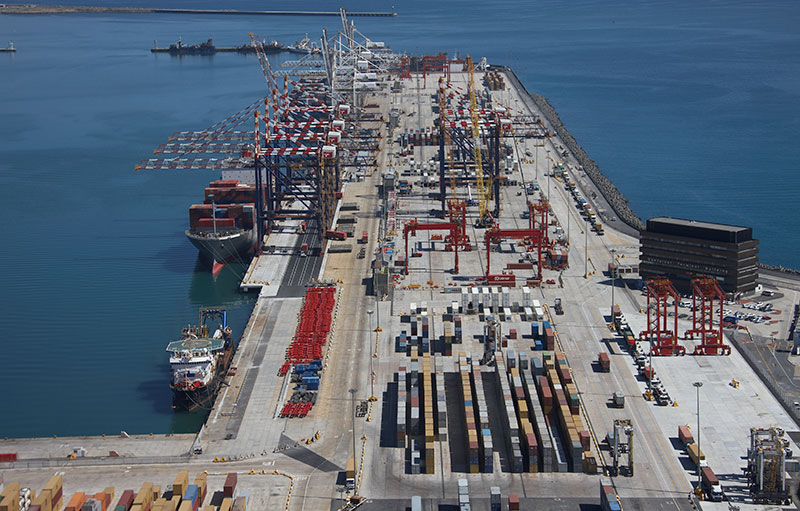
South Africa controls an estimated 70–80% of the world’s known manganese reserves and remains the largest producer and exporter of the ore. Manganese is indispensable for steelmaking and increasingly critical for the battery technologies powering the global energy transition. Yet for years, the country’s ability to monetise this geological advantage has been hamstrung by an ageing, fragmented logistics system. Transnet’s recent launch of a Request for Qualifications (RFQ) for a private-sector partner on the Ngqura Manganese Export Corridor (NMEC) is therefore far more than a routine procurement notice. It is a high-stakes test of whether South Africa can finally align public ownership with private capital and operational discipline to move bulk commodities efficiently.
The project is ambitious in both scale and vision. It centres on an approximately 1,100 km rail corridor linking manganese mines around Hotazel in the Northern Cape to a new, dedicated export terminal at the Port of Ngqura in the Eastern Cape. Indicative investment ranges from R30 billion to R44 billion (roughly $1.8–2.7 billion) over a proposed 25-year partnership. The rough allocations are telling: R10–20 billion for rail rehabilitation and maintenance, approximately R16 billion for the new terminal (with an initial capacity of around 14.7 million tonnes per annum, expandable to 16 Mtpa), and roughly R4 billion for train operations and rolling stock. The corridor itself targets an initial throughput of about 12–12.6 million tonnes a year, with potential growth to 16 Mtpa, and is projected to lift rail-based manganese exports by around 20%.
The structure is deliberately dual-tracked. One company—51% Transnet-owned and 49% private consortium—would develop and operate the terminal, manage rail freight services, rolling stock, and customer relationships. A second company, wholly owned by the private partner, would finance, rehabilitate, and maintain the rail infrastructure under a performance-based availability agreement with Transnet’s Rail Infrastructure Manager. Strategic assets remain in state hands, while operational risk, capital mobilisation, and day-to-day efficiency are shared. Applications for the RFQ close on 26 February 2027, with an optional briefing scheduled for late October 2026.
This design responds directly to the failures of the status quo. Current manganese exports are fragmented across facilities in Port Elizabeth (Gqeberha) and Ngqura. Significant volumes still move by road, driving up logistics costs, increasing congestion and safety risks, generating dust and other environmental impacts, and imposing social costs on surrounding communities. Transnet’s rail network has suffered from years of underinvestment, locomotive shortages, maintenance backlogs, and operational inefficiencies—problems that have constrained mineral exports across all commodities. Consolidating flows onto a rehabilitated, dedicated corridor and a modern terminal at Ngqura is intended to reverse that trajectory: lower unit costs, higher reliability, reduced road haulage, and a cleaner environmental footprint.
The strategic case is compelling. Global manganese demand is supported by traditional steel markets and the structural growth of electric-vehicle and stationary storage batteries. South Africa’s reserve base gives it a natural long-term competitive position, provided the ore can reach markets at a competitive cost and with predictable lead times. For Northern Cape producers—among them major players such as South32, Anglo American, Assmang, and Tshipi é Ntle—reliable, high-capacity rail access is existential. Without it, expansion plans stall, mine economics deteriorate, and the country risks stranding value underground while competitors in Australia, Gabon, and Brazil capture market share. The corridor is therefore not merely infrastructure; it is commercial leverage over an entire provincial export stream for a generation.
Yet execution risk is substantial. Transnet’s track record on major projects and private-sector participation has been mixed. Past attempts at reform have been slowed by governance challenges, fiscal constraints, labour dynamics, regulatory complexity, and the sheer scale of the network’s deferred maintenance. Attracting a consortium capable of mobilising tens of billions in capital—while meeting technical, operational, and socio-economic development criteria—will require credible, bankable terms. Bidders for the terminal component are expected to demonstrate financing commitments of at least R10 billion. Socio-economic benefits and local community impact will also be scrutinised; communities along the corridor and around the port will rightly demand tangible local content, jobs, skills transfer, and environmental safeguards.
The dual-company structure attempts to balance competing imperatives: retaining public ownership of strategic rail and port assets while injecting private capital, expertise, and performance incentives. Success hinges on clear risk allocation, transparent performance metrics, predictable regulatory treatment, and political continuity across electoral cycles. Any perception of policy uncertainty, preferential treatment, or weak contract enforcement will deter the very international and domestic investors the project needs. Conversely, a well-executed partnership could serve as a template for other bulk corridors—iron ore, coal, chrome—and for broader Transnet reform.
There are broader national stakes. South Africa’s logistics performance has become a binding constraint on growth, export earnings, and industrial competitiveness. Fixing one high-value corridor will not solve every problem on the network, but it can demonstrate that public-private models can deliver results when incentives are properly aligned. It can also reduce the fiscal burden on the state by shifting capital and operational risk to parties better equipped to manage them. Failure—through delayed procurement, inadequate bidders, protracted negotiations, or under-delivery—would reinforce the narrative of institutional incapacity and further erode confidence among both miners and global capital.
The RFQ process itself is only the opening act. Shortlisted parties will move to a detailed request-for-proposals stage. The quality of the eventual partners, the robustness of the commercial and technical agreements, and the discipline with which performance is monitored will determine outcomes. Mining houses and logistics operators are watching closely; several major manganese producers have already signalled interest. The window is open, but it will not remain so indefinitely. Global capital has alternatives, and commodity cycles do not wait for domestic institutional reform.
South Africa’s manganese endowment is a generational asset. Converting geological wealth into sustained economic value requires logistics that work. The Ngqura Manganese Export Corridor partnership is one of the clearest opportunities in years to prove that the country can still execute at scale. Getting the structure, incentives, and governance right is not optional—it is the difference between capturing the upside of the energy transition and watching it pass by on more reliable rails elsewhere.