


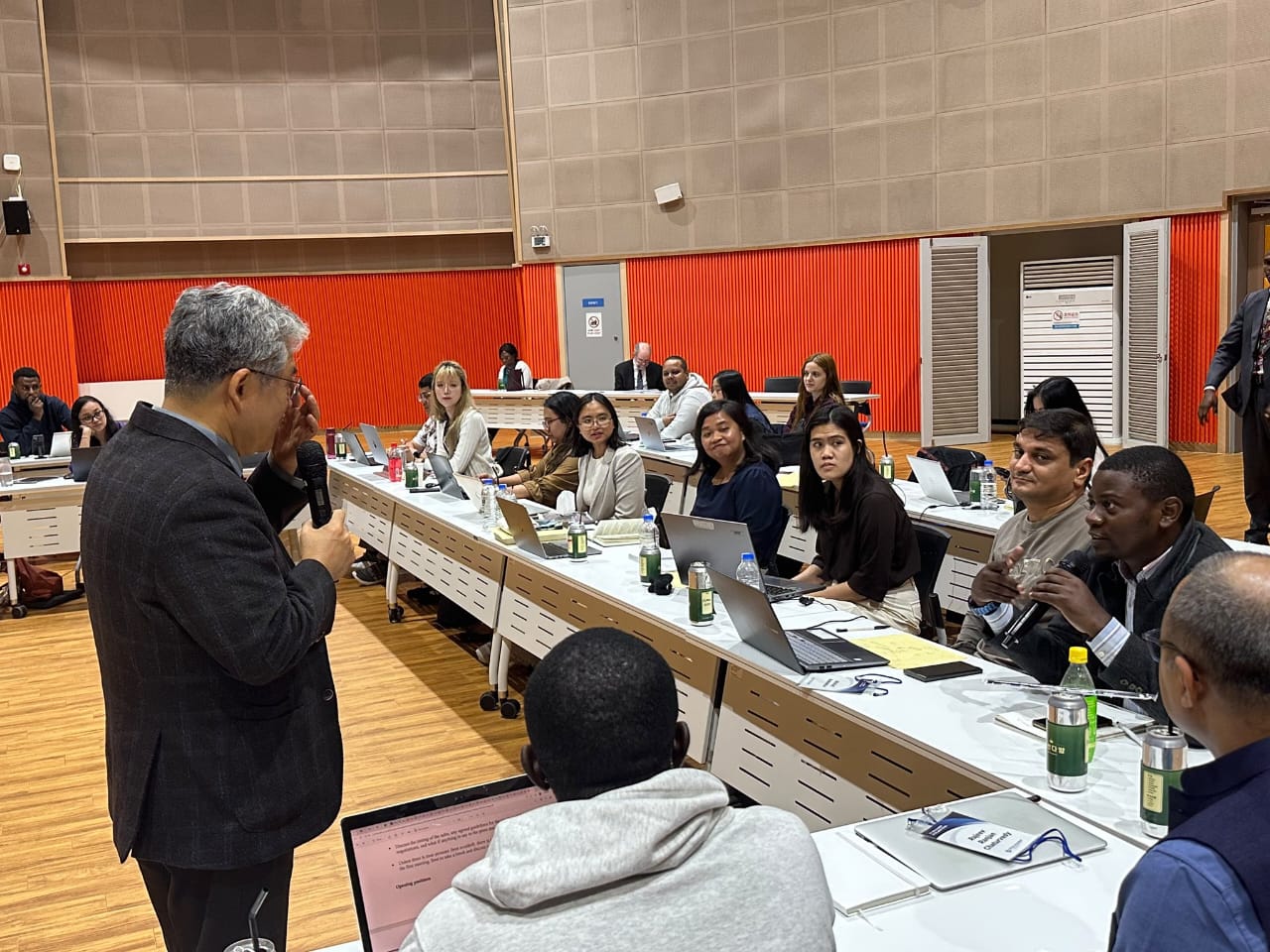
Fred Kung’u’s recent announcement of his graduation from the 13th Session of the Yeosu Academy of the Law of the Sea captures far more than a personal milestone. It highlights a quiet but strategic form of international cooperation that rarely makes headlines yet shapes how coastal developing states navigate the intensifying pressures on the world’s oceans.
The two-week intensive programme, hosted by the Korea Maritime Institute and the Ministry of Oceans and Fisheries of the Republic of Korea, brings together professionals from developing countries for rigorous training in the United Nations Convention on the Law of the Sea (UNCLOS) and contemporary ocean challenges. Participants study the history of the law of the sea—including Kenya’s contributions during the original negotiations—maritime boundary delimitation, international fisheries law, maritime security and hot pursuit, the ITLOS advisory opinion on climate change, deep-seabed mining and submarine cables, Maritime Autonomous Surface Ships (MASS), marine environmental protection, the BBNJ Agreement, and ocean governance more broadly. Field visits, including to the Korea Coast Guard Training Centre, ground the theory in practice.
This is no abstract academic exercise. For a participant with a science-policy background from Kenya—a country with significant Indian Ocean interests, a busy port at Mombasa, ongoing continental shelf considerations, and exposure to illegal, unreported and unregulated (IUU) fishing, maritime crime, and climate impacts—the curriculum maps directly onto real policy needs. Kenya’s own history with UNCLOS, its maritime boundary agreements, and its role in regional security cooperation make such training immediately relevant.
Why the Yeosu Academy Matters
The Yeosu Academy is an Official Development Assistance initiative rooted in the spirit of Expo 2012 Yeosu and the Yeosu Declaration. It aims to build the capacity of government officials, researchers, and emerging professionals from developing states so they can better address ocean-related challenges. Over the years it has trained hundreds of participants from dozens of countries, earning recognition in United Nations General Assembly resolutions as a contribution to capacity-building under the law of the sea.
Three features stand out. First, the faculty: ITLOS judges and leading scholars such as James Kraska, Clive Schofield, Robert Beckman, Donald Rothwell, and Kentaro Nishimoto, among others. Exposure to practitioners who shape doctrine and jurisprudence is rare and valuable. Second, the peer network: classmates from Africa, Asia, Latin America, and the Pacific create lasting professional ties that outlive the classroom. Third, the timing. The programme coincides with the entry into force of the BBNJ Agreement, accelerating deep-seabed mining discussions at the International Seabed Authority, growing interest in MASS regulation, and the practical implications of the 2024 ITLOS climate change advisory opinion. Each of these developments demands sophisticated legal and policy expertise. Developing states that lack deep benches of specialised lawyers and policy officials risk being rule-takers rather than rule-shapers.
The Larger Stakes
Ocean governance is no longer a niche legal domain. It intersects with food security (fisheries), energy and minerals (the continental shelf and the Area), climate resilience (sea-level rise, marine protected areas), digital connectivity (submarine cables), and national security. For many developing coastal and island states, the gap is not primarily one of political will but of technical capacity: few specialists who can draft legislation, negotiate boundaries, participate effectively in international forums, or assess the legal implications of new technologies.
Programmes such as Yeosu, the Rhodes Academy, and the International Foundation for the Law of the Sea summer courses help close that gap. They do not replace domestic investment in legal education or institutional strengthening, but they provide high-quality, focused training and networks that many national systems cannot yet replicate at scale. When participants return home and apply the knowledge—whether in ministry briefings, boundary negotiations, climate litigation strategy, or BBNJ implementation—they multiply the investment.
Kenya’s own trajectory is instructive. Its active role during the Third UN Conference on the Law of the Sea, its subsequent maritime legislation, its continental shelf submission, and its contributions to regional maritime security demonstrate what sustained engagement can achieve. Yet the complexity continues to grow. Climate-driven sea-level rise raises questions about baselines and maritime zones. Autonomous vessels challenge traditional notions of flag-state responsibility and hot pursuit. The BBNJ regime will require national legislation and institutional arrangements for area-based management tools and benefit-sharing. Deep-seabed mining, if it proceeds, will demand scientific, legal, and environmental expertise that many states are still building.
A Call for Sustained Investment
Capacity-building in the law of the sea should not be treated as a periodic courtesy. Donor states and institutions that fund such academies should view them as long-term strategic investments in a rules-based ocean order. Recipient states should treat returning alumni as assets: create clear pathways for them to contribute to policy, legislation, and international representation, and pair external training with domestic institutional development.
For individuals like Fred Kung’u, the diploma is a milestone. For the broader community of practice, each graduating cohort is a small reinforcement of the system that has governed the oceans for four decades. In an era of intensifying geopolitical competition over marine resources and accelerating environmental stress, that reinforcement is not optional. It is essential.
The oceans will not wait for perfect capacity. The states that invest in people who understand both the letter of UNCLOS and the emerging challenges of the 21st century will be better positioned to protect their interests and contribute to collective ocean governance. The Yeosu Academy is one concrete expression of that logic. More such efforts—and deeper follow-through at home—are needed.