


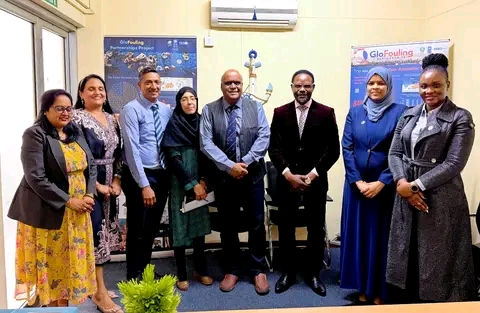
On the sidelines of the 9th Association of African Maritime Administrations Conference in Kampala, a handshake took place that will not make headlines in Nairobi, Lagos, or Cape Town. The Secretary General of the Maritime Organisation for Eastern, Southern and Northern Africa (MOESNA), Kassim Kaziba Mpaata, met with IMO Secretary General Arsenio Dominguez to “explore strategic opportunities for advancing Africa’s maritime sector.”
It was a photograph, a press release, and a few lines of diplomatic pleasantries. But beneath that anodyne language lies a pivotal question: after nearly six decades of regional maritime cooperation, does MOESNA finally have the institutional weight to convert Africa’s demographic and geographic advantages into actual maritime power—or is it destined to remain a talking shop while the continent’s shipping interests are decided in Brussels, London, and Singapore?
The answer matters more than most Africans realize.
From ISCOS to MOESNA: A Long Road, Uneven Progress
MOESNA’s lineage is respectable. It began in 1967 as the Intergovernmental Standing Committee on Shipping (ISCOS), formed by Kenya, Tanzania, Uganda, and Zambia to combat unregulated freight costs . For decades, it operated as a technical advisory body, producing studies and convening meetings while the real decisions about African shipping were made elsewhere.
The transformation came in stages. A 2006 protocol expansion brought multimodal logistics and private-sector engagement into the fold. By 2024, the rebranded MOESNA had attracted 22 signatory countries from Eastern, Southern, and Northern Africa, linked by the Western Indian Ocean, South Atlantic, and Red Sea . Namibia is now moving toward full membership, with its Works and Transport Minister explicitly citing the benefits of policy harmonization, maritime domain awareness, and positioning Walvis Bay as a regional logistics hub .
This is genuine progress. But the gap between aspiration and execution remains vast.
The Hard Truths Africa’s Maritime Sector Faces
Consider what MOESNA and its members are actually up against.
Infrastructure deficits are structural, not incidental. Over 70 percent of African ports lack alternative fuel bunkering, onshore power supply, or green infrastructure . Africa controls less than 2 percent of global tonnage, meaning the continent has virtually no negotiating power over freight rates or shipping capacity . The World Bank’s Container Port Performance Index consistently ranks most Sub-Saharan African ports beyond 300th globally, with only a handful—Tanger Med, Port Said—approaching world-class efficiency .
The policy incoherence trap is real. A 2026 study in the WMU Journal of Maritime Affairs identified a “polycentric incoherence trap” in African maritime governance, where frameworks for innovation, sustainability, and trade liberalization develop in isolation, creating regulatory fragmentation and implementation gaps . Africa’s maritime policies, in other words, do not talk to each other. MOESNA’s mandate to harmonize them is precisely the right task—but mandate is not capacity.
Climate rules threaten to deepen dependency. The IMO’s proposed net-zero framework is being negotiated without meaningful African input. Although Africa holds 44 of the IMO’s 176 member votes, only 18 have ratified MARPOL Annex VI, making them eligible to vote on emissions policies . The EU’s emissions trading system is already generating revenue for Europe’s green transition with little or no financial recycling to Africa. Without a unified strategy, African ports risk becoming less attractive to compliant shipping lines, leaving the continent dependent on foreign-owned vessels and foreign-decided rules .
The human capital paradox persists. Africa has the world’s youngest population and growing interest in maritime education, yet African seafarers account for only about 4 percent of the global workforce . The constraint is not aptitude but access: limited quality Maritime Education and Training, weak industry linkages, and a structural disconnect between training systems and labor market integration.
What MOESNA Can Actually Do
Against this bleak backdrop, the Kampala meeting offers a glimmer of strategic possibility—but only if MOESNA sheds its advisory-only posture and becomes an operational force.
First, it must become Africa’s unified voice at the IMO. The 18-country ratification gap on MARPOL Annex VI is an embarrassment. MOESNA should make fast-track ratification and voting eligibility a condition of active membership, then coordinate a common African position on carbon pricing, revenue recycling, and technology transfer. The continent contributes least to global emissions but faces the greatest constraints; it cannot afford to be a rule-taker in the decarbonization transition .
Second, it must tackle the hydrographic and safety deficit. MOESNA’s own documentation acknowledges “outdated or lack of nautical charts,” insufficient aids to navigation, and limited human resources capacity across member states . These are not abstract concerns—they are the difference between safe navigation and catastrophe. Joint surveys of Lake Victoria and Tanganyika, coordinated capacity building for hydrographic offices, and shared technical missions with the International Hydrographic Organization are concrete steps MOESNA has already identified . The question is funding and political will.
Third, it must bridge the port-investment gap. The global shipping disruptions of recent years have accelerated interest in African port infrastructure, but feasibility does not equal bankability. As one finance expert put it, the challenge is “turning them into structures that are financeable at an acceptable cost of capital” . MOESNA can serve as a convening platform for member states, development finance institutions, and private operators to standardize concession frameworks, reduce perceived risk, and pool technical expertise. It cannot build ports, but it can make them easier to build.
Fourth, it must confront the uncomfortable question of ownership. As Captain Ladi Olubowale of Nigeria’s Seamate Maritime has argued, “ports alone do not create maritime power” . Africa is building deep seaports from Nigeria to Namibia, but without investment in vessels, coastal shipping systems, offshore support fleets, and integrated logistics networks, these ports risk becoming “sophisticated gateways operated largely for the benefit of foreign shipping and logistics interests” . MOESNA’s mandate includes promoting shipping and maritime interests, not just port infrastructure. It should use its convening power to catalyze indigenous fleet development, perhaps through pooled procurement or joint ventures among member states.
The Alternative Is Irrelevance
The Kampala meeting between Mpaata and Dominguez was cordial and forward-looking. But cordiality will not feed a continent that imports the vast majority of its goods by sea, that pays some of the world’s highest logistics costs, and that remains a marginal player in the industry that carries over 90 percent of its trade .
MOESNA’s history demonstrates that African states can cooperate when the incentive is clear. The original ISCOS was born from frustration with unregulated freight costs—a concrete economic grievance. Today’s grievances are no less concrete: climate rules written without African input, infrastructure gaps that deter investment, and a shipping industry that remains externally controlled.
The handshake in Kampala will be judged not by the communiqué it produced, but by whether MOESNA can transform itself from a consultative body into an operational one. The IMO will engage with whoever shows up with a coherent position and the capacity to implement it. Africa has the numbers—22 signatory states, a youthful workforce, and a coastline that carries a growing share of global trade. What it lacks is the institutional machinery to convert those assets into influence.
That machinery will not build itself. And the window for building it is narrowing.
Andrew Mwangura is a commentator writing on African maritime affairs and regional integration.