


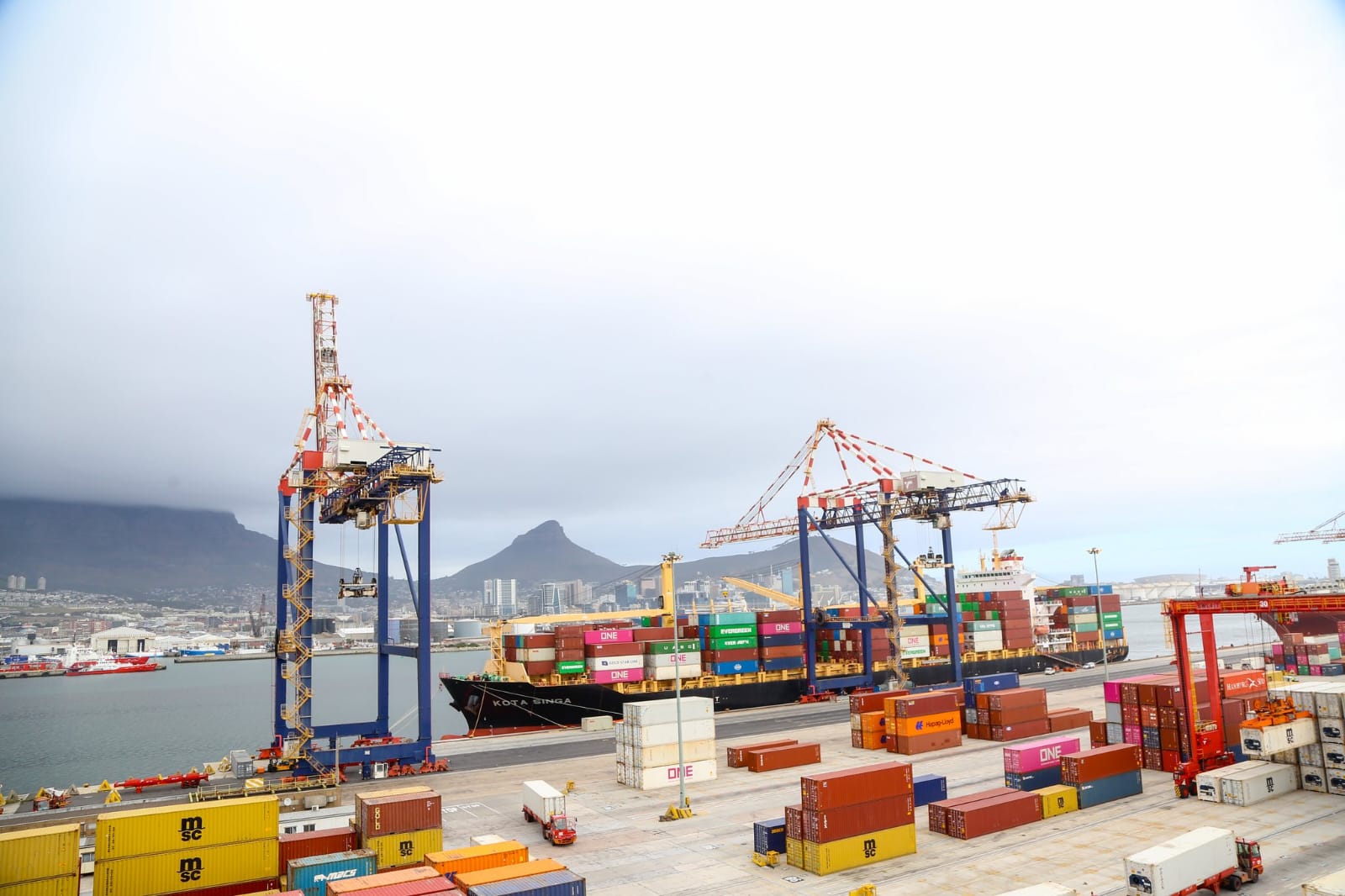
When Transnet handed operational control of Durban Container Terminal Pier 2 to International Container Terminal Services Inc. (ICTSI) in January 2026, it came armed with a defence. The parastatal pointed to improvements achieved during 2025 and an equipment investment of approximately R1.5 billion—roughly US$85.7 million at prevailing exchange rates—before the handover. New cranes. New straddle carriers. New machinery. The implicit message was clear: we fixed the equipment, now the private sector can fix the performance.
But as veteran maritime journalist Terry Hutson asked in a pointed analysis this week, haven’t we heard this before? Each time Durban’s container terminals have descended into crisis, the explanations have centred on ageing equipment, unreliable machinery, and maintenance failures—followed by promises that new equipment would turn performance around. Now, despite the substantial investment, many of the same explanations are being heard again. What happened to that equipment? Is it being properly maintained and utilised? And are we addressing the deeper problem of terminal productivity?
These are not academic questions. They cut to the heart of South Africa’s economic competitiveness, and they deserve answers that go beyond the next press release.
The Numbers Tell a Story of Persistent Failure
Durban may have been the most improved port in the 2025 World Bank Container Port Performance Index—and that is worth acknowledging. But it nevertheless remained ranked 398th out of 400 ports worldwide. Cape Town, at the bottom, ranked 399th. Let that sink in. The two major container gateways of Africa’s most industrialised economy sit in the bottom three of a global ranking of 400 ports.
Improvement from a very poor starting point that leaves the country languishing at the bottom should not be mistaken for international competitiveness. The CPPI measures vessel time in port, and South Africa’s performance remains a deterrent to shipping lines, a tax on exporters, and a drag on the entire Southern African region that depends on Durban as its primary gateway.
The economic cost is staggering. South Africa’s exporters—from citrus farmers to automotive manufacturers—have repeatedly absorbed demurrage charges, missed seasonal windows, and lost contracts because cargo cannot move through Durban reliably. The country’s ambition to be a logistics hub for Sub-Saharan Africa rings hollow when its flagship port cannot crack the bottom percentile of global performance.
The Machinery Excuse: A Recurring Narrative
Hutson’s observation is devastating precisely because it is so simple: the explanations keep changing hands, but they never change substance. When equipment is old, the problem is age. When new equipment arrives, the problem becomes maintenance, utilisation, or “teething issues.” The common thread is that the problem is always technical, always external, never managerial.
This is a familiar pattern in state-owned enterprises across sectors. It is also a form of institutional avoidance. If the problem is machinery, the solution is procurement. If the problem is productivity, management, and operational accountability, the solution is far more uncomfortable: it requires confronting work practices, incentive structures, skills development, and—most difficult of all—consequences for underperformance.
The R1.5 billion (US$85.7 million) equipment investment is welcome. But capital expenditure without operational reform is simply expensive theatre. The question that Transnet has not answered, and that ICTSI must now confront, is whether the equipment is being sweated—used intensively, maintained rigorously, and deployed according to global best practice. Or whether it is joining a graveyard of underutilised assets that look good in procurement announcements and rust in the Durban humidity.
The ICTSI Handover: Opportunity and Risk
The Durban Gateway Terminal partnership with ICTSI represents the most significant private-sector injection into South African port operations in decades. ICTSI is a global operator with a track record in Manila, Buenos Aires, and elsewhere. Its arrival was meant to be a turning point—a signal that South Africa was finally willing to import operational excellence rather than merely procure it.
But private operation of a terminal within a state-owned port system is not a magic bullet. ICTSI can improve crane productivity and yard planning. It cannot unilaterally fix the rail connections to the hinterland, the customs processes that delay clearance, or the road infrastructure that bottlenecks cargo flow. It cannot conjure skilled technicians if the local labour market lacks them. And it cannot overcome a regulatory environment that may resist the very changes it was hired to implement.
The risk is that ICTSI becomes the latest scapegoat in a long line of explanations. If performance does not improve quickly, the narrative may shift from “old equipment” to “private operator failed to deliver.” That would be a profound disservice to the truth, which is that terminal performance is a system-wide problem requiring system-wide accountability.
The Harder Questions
Hutson’s call to “look beyond the machinery” is the right one. The harder questions are these:
Who is accountable for maintenance? New equipment degrades without preventive maintenance schedules, spare parts inventories, and skilled technicians. If the R1.5 billion (US$85.7 million) investment is not matched by operational expenditure on maintenance, the equipment will fail—and the explanations will revert to form.
How is productivity measured and managed? Global terminal operators use sophisticated metrics: moves per crane per hour, berth utilisation, truck turn times, rail dwell. Are these being tracked in Durban? Are they being published? Are managers held to them?
What is the labour relations environment? South African ports have histories of industrial action that disrupt operations. Productivity improvements require cooperation from organised labour, which requires trust, which requires transparent engagement. Is that happening?
What is the role of the regulator? The Ports Regulator of South Africa has a mandate to ensure efficiency and fair pricing. Has it scrutinised the ICTSI partnership for its likely impact on productivity and costs? Has it set benchmarks that the operator must meet?
What happens if performance does not improve? Contracts between Transnet and ICTSI presumably contain performance clauses. Are they meaningful? Are they enforceable? Or are they aspirational language that will be quietly forgotten if the political winds shift?
A National Imperative
Durban’s container terminal crisis is not a niche maritime concern. It is a national economic emergency dressed in bureaucratic language. South Africa’s unemployment crisis, its manufacturing decline, and its fiscal fragility are all linked to the country’s inability to move goods efficiently. Every day that Durban underperforms is a day that South African exporters lose money, that foreign investors lose confidence, and that the country’s promise as an African gateway loses credibility.
The equipment investment and the ICTSI partnership are genuine steps. They deserve a fair chance. But they must be accompanied by an honest reckoning with the management, maintenance, and accountability failures that have persisted across governments, across parastatal leadership teams, and across equipment cycles.
The shipping and logistics industry has heard the explanations for years. The people delivering them may change, but the explanations remain remarkably similar. It is time to look beyond the machinery and ask whether Durban’s recurring terminal problems are finally being addressed at their root—or whether we are simply waiting for the next equipment procurement cycle and the next set of familiar excuses.
The bottom of the global rankings is not a place from which to build a logistics hub. It is a place from which to start asking uncomfortable questions. The answers will determine whether Durban’s latest improvement is a genuine turning point or simply the latest chapter in a long, frustrating story.
Andrew Mwangura is a commentator writing on African logistics, port economics, and trade competitiveness. Exchange rate reference: US$1 ≈ R17.50 (November 2026).