


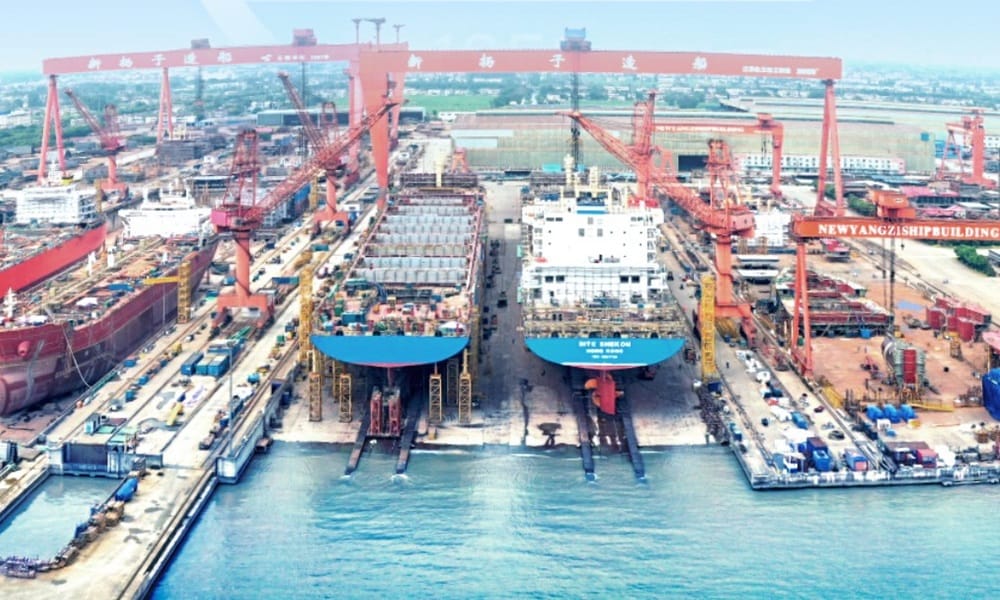
Drawing on observations by Capt. Philip Mathews, LOTS Shipping, from the Yangtze shipbuilding corridor, November 2026
There is a particular kind of vertigo that comes from returning to a place after twenty years. Between 1995 and 2005, Capt. Philip Mathews was a regular visitor to Shanghai. He watched Pudong’s skyline rise from marsh and mudflat into the gleaming, confident geometry of the Oriental Pearl Tower and the towers that now crowd around it. But the more telling picture on his return is not the skyline. It is what is happening on the river and inside the factories and shipyards that line the Yangtze.
That contrast matters enormously for India—and for every maritime nation watching from the sidelines. China’s industrial depth, infrastructure, technology and confidence have moved well beyond the ambition to become a manufacturing power. It is a country that competes at the very top. And in the Yangtze shipbuilding corridor, Mathews saw both the scale of what China has built and the precise nature of the opportunity India is currently squandering—while another bus is already pulling out of the station.
The Scale and Sequence of the Shipbuilding Machine
Mathews visited three shipyards in a single week; another three were scheduled the following week. The yards range from builders of vessels around 3,000 DWT to facilities capable of constructing ships of 100,000 DWT. Their annual output varies widely, from around ten vessels to fifty or more. The Yangtze River corridor alone has a remarkable concentration of major shipbuilding capacity.
The figures often quoted for China’s shipbuilding base need context. At the industry’s peak around 2010, China reported more than 3,000 shipyards of varying sizes. The sector has since consolidated, with environmental enforcement and the closure of non-compliant or low-tier facilities. One cleanup initiative near Nanjing removed 38 illegal or low-tier yards. The precise number of operating yards changes with definitions and consolidation, but the broader lesson is clear: China allowed an industrial ecosystem to develop at scale and progressively tightened standards as the sector matured.
That sequence matters profoundly. An industry needs room to start, experiment, build skills, find customers, and achieve scale. Regulation is essential—but if the cost and complexity of compliance are imposed before an industry has had a chance to establish itself, regulations become a barrier to entry rather than a framework for safe and sustainable growth.
Automation Is No Longer a Demonstration; It Is Production
On the river, Mathews photographed an old tanker barge, probably around thirty years old, with very little freeboard, operating under a non-IACS classification regime. It is an interesting contrast: an ageing, modest vessel moving in the foreground of one of the world’s most accomplished urban and industrial landscapes. It also raises a question for India about how it approaches the development of its own inland and coastal fleets.
One factory visit was to a plant dedicated to manufacturing watertight doors and portlights. The production floor was highly automated, with robotic systems carrying out much of the work. He was told that a watertight door could be completed in about an hour. Fifteen machines were reportedly producing around 200 doors in a fourteen-hour shift. The factory applies a similar production model to portlights.
This is not automation as a showcase or pilot project. It is automation embedded in a repeatable manufacturing process, producing standard marine equipment at industrial volumes. It is the combination of purpose-built machinery, process discipline, trained operators, supply chains, and sustained demand that makes the model effective. The factory is also a reminder that a densely populated country can become a world leader in automation. The decisive factors are sustained industrial policy, infrastructure, scale, skills, investment, execution, and the willingness to build complete ecosystems.
India Has Missed the Bus—But Not Every Opportunity
The uncomfortable conclusion from these visits is that India has missed the bus on the first major wave of industrial scale and manufacturing automation. Trying to catch China by replicating its present model, yard for yard and machine for machine, is likely a losing proposition. China has decades of accumulated investment, supplier networks, production experience, infrastructure and scale behind it. No country can close that gap simply by importing a few machines or assembling equipment locally.
Importing and assembling may have a role as a starting point, particularly where it helps build local capability. But it cannot be the strategy in itself. Unless India develops domestic design, engineering, manufacturing, service support, and a dependable market, it will remain dependent on imported technology while the real value is created elsewhere. The response should be to look for a leapfrog opportunity—something disruptive that allows India to compete on a different curve rather than chase the one China has already mastered.
Remember Y2K
India has done this before. Around the turn of the millennium, the Y2K problem created a global demand for software assessment, remediation and systems work. India was able to seize that opportunity. It had a deep pool of intellectual talent, problem-solving ability and, crucially, English-language skills that allowed professionals to work directly with clients and systems around the world. For a period, India acquired a reputation as a global computing powerhouse—a reputation recognised well beyond its own shores.
Language skills no longer provide quite the same advantage. Artificial intelligence is rapidly changing that equation. But India’s intellectual capital, technical aptitude and entrepreneurial energy have not disappeared. The next disruption may emerge from AI, advanced engineering, new materials, clean energy, digital manufacturing or an entirely different field. The point is not to predict the exact sector today. It is to identify the opportunity early, mobilise talent and capital, and execute with focus.
The Regulatory Burden: Getting the Sequence Wrong
The same lesson applies to shipbuilding, inland waterways and coastal shipping. In India, policymakers often seem to place the regulatory framework ahead of the industry itself. Mathews remarked that the country’s ‘regulatory GDP’ appears to be growing faster than its GRT GDP. It should be the other way around.
Safety, environmental protection, seaworthiness and competent oversight are non-negotiable. The argument is not for weak standards or the abandonment of regulation. It is for proportionate, risk-based regulation and a sensible sequence. A nascent sector needs a practical pathway to enter the market, learn, invest and improve. Standards can and should rise as capability, scale and institutional maturity develop.
China’s experience suggests that industrial capacity can grow from a diverse base of small and large operators, followed by consolidation and stronger enforcement. India should take the lesson seriously, while adapting it to its own safety, environmental and institutional requirements. This applies equally to inland vessels and coastal shipping. No meaningful fleet can emerge if every small operator faces the same compliance burden, cost structure and approval process as a mature, large-scale enterprise. Nor can a shipbuilding ecosystem be built without a market for the vessels, repair facilities, component suppliers, trained people and accessible finance that sustain it.
The Choice Before Us
India still has enormous strengths: a large domestic market, engineering talent, a young workforce, entrepreneurial capacity and an established presence in technology and services. But strengths do not automatically become industrial advantage. They need direction, continuity and an environment in which businesses can take risks, build capacity and grow.
The country should stop measuring its ambition by how quickly it can catch up with China in yesterday’s technologies. It should learn from what China has built, identify where the next disruption will create a new opening, and position itself to lead in that space. At the same time, it must make it easier—not harder—for essential industries such as shipbuilding, inland water transport and coastal shipping to take root and expand.
Returning to the Bund after nearly twenty years was a striking experience for Mathews. The China he visited regularly between 1995 and 2005 was a country on the way up. The China he saw in 2026 is accomplished, confident and operating at a very different level. It is a sobering comparison, but it should also be a call to action.
The bus India missed cannot be brought back. But there will be another one. The question is whether India will recognise it in time, get its priorities right and have the confidence and discipline to board it—or whether it will once again be distracted while others move ahead.
Andrew Mwangura is a maritime journalist. This analysis draws on observations by Capt. Philip Mathews of LOTS Shipping from the Yangtze shipbuilding corridor, November 2026.