


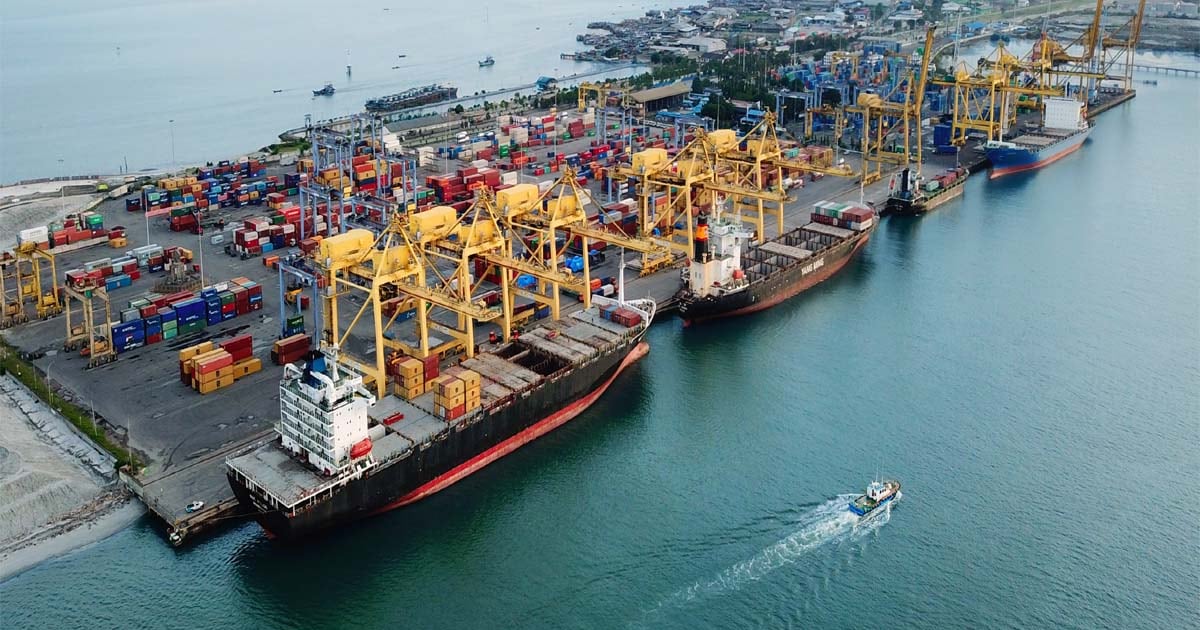
When you think of maritime nations, what comes to mind? Perhaps, Singapore’s gleaming hub? Rotterdam’s automation? However, here is a surprise for you: Indonesia operates more ports than any other country on Earth — roughly 670 of them, scattered across an archipelago of over 17,000 islands.
If you compare that with United States’ 300 ports, or United Kingdom’s 120, there is no doubt that Indonesia is in a class of its own as a maritime nation. Africa’s Madagascar has 17 commercial ports.
Indonesia doesn’t have the luxury of road or rail networks connecting its far-flung regions. For this nation of 280 million people, ports are so critical as infrastructure that they’re the literal glue holding the country together.
Take Tanjung Priok in Jakarta, for instance. This single facility handles over 50% of Indonesia’s transshipment cargo and moves roughly 8 million TEUs annually, which would translate to nearly eight times of what Kenya’s Mombasa Port handles per year.
Tanjung Priok facilitates trade worth an estimated USD 300 billion per year. Then there’s Tanjung Perak in Surabaya, processing another 4 million TEUs, and Belawan in Medan, the busiest port outside Java.
Altogether, Indonesia’s ports move over 1 billion tons of cargo annually.
Coordination challenge
But here’s where it gets complicated. How do you coordinate 670 ports spread across an area larger than the European Union?
The answer lies in Indonesia’s National Port Master Plan (NPMP), a USD 47 billion investment roadmap through 2030 that divides ports into hierarchical clusters, namely international hubs, main collectors, and local feeders. The government has also designated eight ports as international gateways to lower logistics costs and boost export competitiveness.
Still, much remains to accomplish in terms of coordination. A 2025 academic review of Indonesian port governance published in Collaborative Governance in Port Management found that while public-private partnerships are growing, “persistent systemic obstacles — such as fragmented regulations, inherent disparities in power among stakeholders, and limitations in institutional capabilities” continue to hamper effective management.
The dark side
Having 670 ports sounds like a blessing. But it comes with serious challenges. One critical aspects is infrastructure gaps. Outside Java, port quality drops dramatically. Research on eastern Indonesian ports published in the Asia-Pacific Journal of Convergent Research Interchange found that low efficiency in ports like East Halmahera and Tidore “can disrupt the distribution of goods between islands, resulting in higher logistics costs”.
Another critical issue is the dwell time problem. Indonesia’s national average container dwell time sits at about 2.88 days — an improvement, but still a source of variability that frustrates supply chain planning.
Third critical issue is regulatory fragmentation. According to SSEK Law Firm’s analysis of Indonesian shipping law, authority is split between harbor masters, the Ministry of Transportation, and multiple regulatory bodies — creating compliance complexity for international operators.
Indonesia’s resilience
It is intriguing that despite its port infrastructure challenges, Indonesia ranks as a global maritime powerhouse.
The IMEMO Index of Maritime Might for 2025 places Indonesia as the 7th most powerful maritime nation in the world — ahead of France, India, and the United Kingdom. That ranking reflects not just naval strength but the sheer volume of maritime activity: trade flows, strategic waterways control, and coastal presence.
Indonesia commands three of the world’s most critical chokepoints — the Straits of Malacca, Sunda, and Lombok — through which passes up to one-third of global maritime trade.
The bottom line
Indonesia’s 670 ports are both its greatest asset and its most persistent challenge. They enable a sprawling archipelago to function as a single economy. But they also expose every weakness in coordination, investment, and regulation.
For maritime professionals, the message is clear that “Indonesia isn’t Singapore”. You can’t expect hub-and-spoke efficiency here. But with the right local intelligence and patience, this fragmented port network offers access to one of the world’s largest and fastest-growing consumer markets.
Just don’t expect it to be easy. With 670 ports, it never is.