


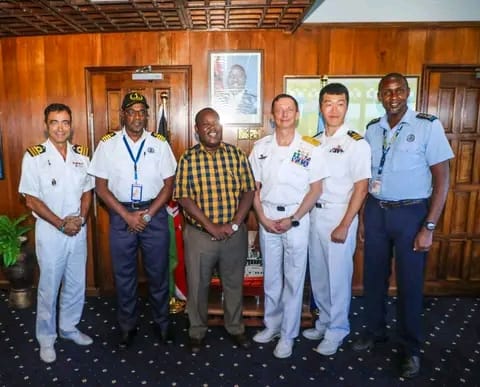
In the quiet choreography of global trade—where steel hulls glide across vast oceans, carrying the lifeblood of economies—security is often taken for granted, until it falters. The recent commendation of the Kenya Ports Authority (KPA) by EUNAVFOR Operation Atalanta is therefore more than a routine diplomatic courtesy.
It is a reminder of a fragile yet essential architecture underpinning maritime stability in the Western Indian Ocean, and a timely affirmation that Kenya—through its principal maritime gateway at the Port of Mombasa—remains a pivotal actor in securing one of the world’s most strategic sea lanes.
When Rear Admiral Daniele Martinuzzi, commanding the 52nd rotation of Operation Atalanta, acknowledged KPA’s sustained cooperation—particularly in inter-agency information sharing—it was a reminder that maritime security is not won solely on the high seas. It is forged just as decisively onshore, in ports and control rooms, and through the invisible but critical exchange of intelligence between civilian and military institutions.
The Western Indian Ocean has long been a theater of both opportunity and risk. It is a corridor through which a significant portion of global commerce flows, linking Asia, the Middle East, Africa, and Europe. At the same time, the region has, in recent decades, been threatened by piracy, trafficking, and maritime terrorism.
The peak of Somali piracy in the late 2000s exposed how quickly insecurity at sea can ripple through global supply chains—inflating insurance premiums, rerouting vessels, and threatening livelihoods far beyond the coastline.
It was in response to this crisis that the European Union launched Operation Atalanta with mandate to deter, prevent, and repress piracy while protecting vulnerable vessels. It has since evolved into a broader mission encompassing maritime situational awareness and capacity building. What has made Atalanta effective is, besides its naval assets, the network of partnerships it has cultivated with littoral states like Kenya.
Kenya’s role in this ecosystem is both strategic and practical. The Port of Mombasa is not just a national asset; it is a regional hub serving landlocked countries across East and Central Africa. Any disruption to its operations reverberates across borders, affecting trade corridors that stretch deep into the continent.
By working closely with Operation Atalanta, KPA ensures that security measures at sea are reinforced by robust systems on land. Information sharing—often dismissed as a technical detail—is in fact the backbone of modern maritime security, enabling early warning, coordinated responses, and the ability to distinguish legitimate commerce from illicit activity.
Dr Sudi Mwasinago, speaking on behalf of KPA’s leadership, rightly underscored the importance of this long-standing partnership. His acknowledgment that European naval forces remain essential in safeguarding maritime trade routes is both pragmatic and revealing. It speaks to a recognition that while regional states must build their own capacities, international collaboration remains indispensable in addressing transnational threats.
Kenya’s engagement with Operation Atalanta emphasizes on inter-agency information sharing signals a recognition that silos are the enemy of security. It also points to the growing sophistication of Kenya’s maritime governance structures, which are increasingly aligned with international best practices.
Maritime security in the Western Indian Ocean cannot be the preserve of a few states and external partners; it must be a collective endeavor. Regional organizations, coastal states, and private sector stakeholders all have a role to play. Kenya, by virtue of its position and experience, is well placed to lead in fostering this broader coalition.
As the crisis Hormuz Strait has shown, security is most critical aspects in maritime business and global trade.