


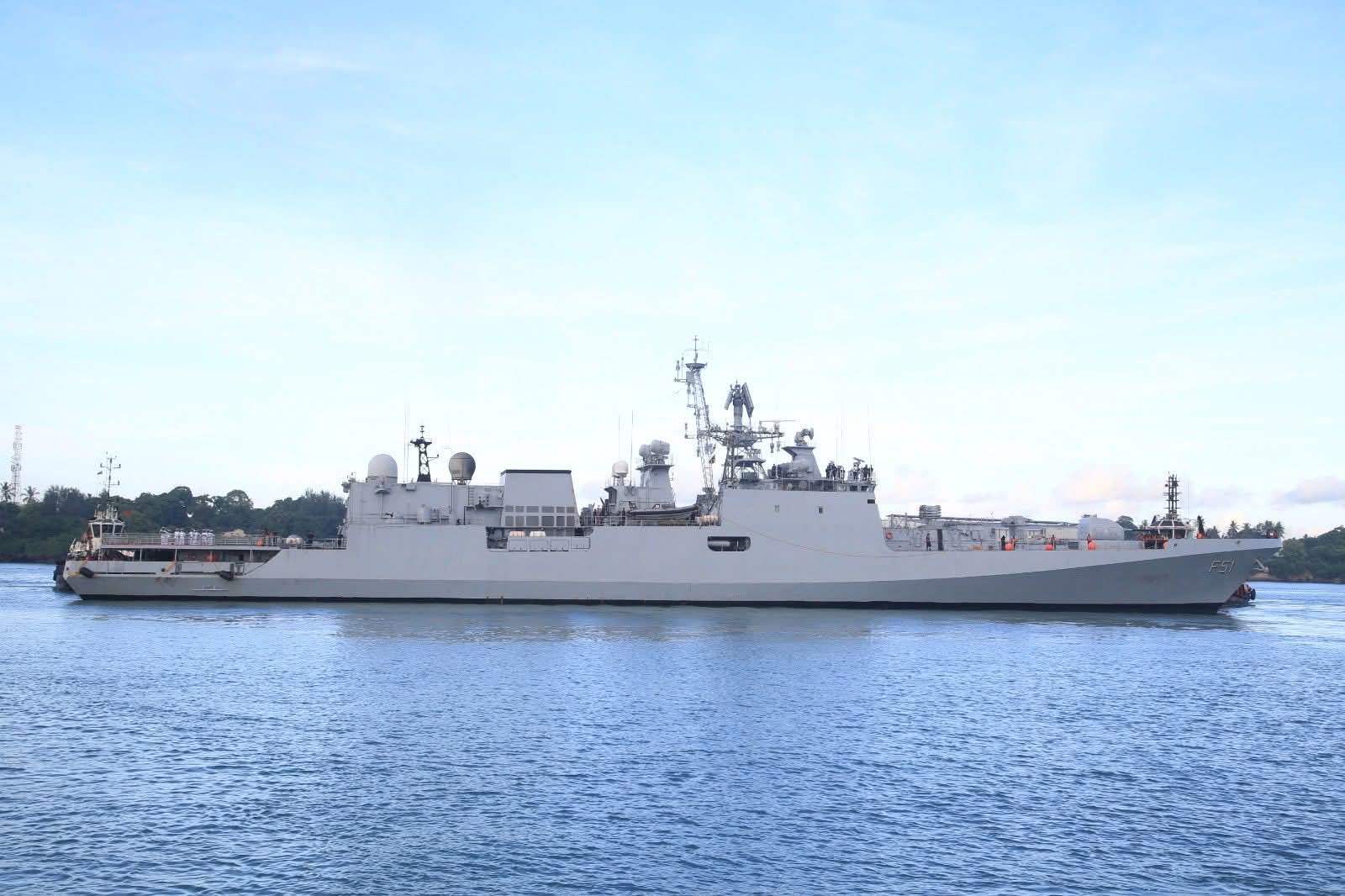
An Indian Naval Ship INS Trikand has visited the Port of Mombasa from April 7 for a scheduled four-day stay before leaving on April 10, 2026.
INS Trikand, a frontline guided-missile frigate of the Indian Navy, represents far more than steel and firepower. It embodies India’s steadily evolving maritime doctrine—increasingly outward-looking and assertively engaged beyond the subcontinent.
Its presence in Mombasa aligns with New Delhi’s broader maritime outlook under the MAHASAGAR vision, an articulation of India’s ambition to serve as a net security provider across the Indian Ocean. While the terminology may be diplomatic, the implications are strategic: India is no longer content with passive participation in regional security. It seeks active partnership, influence, and presence.
For Kenya, the significance of this visit lies not only in bilateral relations but in its positioning within a rapidly shifting maritime order. The Western Indian Ocean has become a theatre of converging interests—commercial, security, and geopolitical. From anti-piracy operations off Somalia to the safeguarding of critical sea lanes that carry global trade, the stakes have never been higher. In this context, naval engagements such as the one between INS Trikand and the Kenya Navy are not symbolic niceties; they are operational necessities.
The scheduled Passage Exercise (PASSEX) following the port call is particularly noteworthy. Such exercises, often understated in public communication, are the building blocks of interoperability. They test communication protocols, manoeuvre coordination, and tactical alignment between navies that may one day find themselves operating side by side in crisis scenarios.
For the Kenya Navy, engagement with a technologically advanced force like India’s offers exposure to best practices, systems integration, and operational doctrines that would otherwise remain distant. For India, it provides familiarity with regional partners, local maritime conditions, and the opportunity to anchor its presence in cooperative frameworks rather than unilateral projection.
Yet this growing engagement must be understood within a broader geopolitical mosaic. The Indian Ocean is no longer a quiet backwater of global politics; it is a contested space. China’s expanding naval footprint, Gulf states’ increasing investments in port infrastructure, and Western powers’ enduring security interests have collectively transformed the region into a dynamic arena of influence. Against this backdrop, India’s outreach to East African nations—including Kenya—serves as both a counterbalance and a partnership strategy.
What distinguishes India’s approach, at least in its stated policy, is its emphasis on shared security and mutual growth rather than dominance. The language of “Security and Growth for All in the Region” is deliberately inclusive, seeking to resonate with coastal states wary of becoming pawns in great-power rivalries. Whether this vision translates into equitable partnerships will depend not on rhetoric but on sustained engagement, capacity building, and respect for local priorities.
Kenya, for its part, must approach such engagements with strategic clarity. The benefits are evident: enhanced maritime security cooperation, access to training and technical expertise, and the strengthening of diplomatic ties with a major global actor. However, there is also a need for balance. As multiple powers court the region, Kenya must avoid over-dependence on any single partner while leveraging these relationships to build its own maritime capacity. Sovereignty, after all, is best preserved not through isolation but through informed and diversified partnerships.
The Port of Mombasa itself serves as a fitting stage for this evolving narrative. As East Africa’s principal maritime gateway, it is both an economic lifeline and a strategic asset. The presence of foreign naval vessels—whether from India, Europe, or elsewhere—reflects its importance not just as a commercial hub but as a node in the global security architecture. Each port call adds a layer to its identity, transforming it from a transit point into a locus of maritime diplomacy.
There is also a softer dimension to consider. The interactions between the crew of INS Trikand and their Kenyan counterparts—professional exchanges, joint activities, and informal engagements—help build trust at the human level. These are the intangible yet enduring elements of naval diplomacy. Hardware may change, doctrines may evolve, but relationships forged through direct interaction often outlast the immediate strategic calculations that bring ships to port.
Still, one must resist the temptation to romanticise such visits. They are, at their core, instruments of state policy. Every handshake on the quarterdeck, every coordinated manoeuvre at sea, serves a national interest. For India, the interest is clear: to secure sea lanes, expand influence, and position itself as a key player in the Indo-Pacific continuum. For Kenya, the challenge is to ensure that such engagements translate into tangible gains—improved maritime surveillance, stronger deterrence capabilities, and a more resilient blue economy.
The timing of this visit is also instructive. As global trade patterns continue to shift and maritime risks evolve—from piracy resurgence to trafficking and illegal fishing—the need for coordinated naval presence becomes more urgent. No single nation can secure the vast expanse of the Indian Ocean alone. Collaborative frameworks are not optional; they are imperative. In this regard, India’s outreach, exemplified by INS Trikand’s deployment, contributes to a broader architecture of shared responsibility.
Ultimately, the port call of INS Trikand to Mombasa should be read as both an opportunity and a reminder. An opportunity for Kenya to deepen its maritime partnerships and enhance its naval capabilities; a reminder that the waters it borders are no longer peripheral but central to global strategic calculations. The Western Indian Ocean is rising in importance, and with it, the need for coastal states to assert their agency.
As the frigate departs Mombasa after its operational turnaround, leaving behind the echoes of drills and diplomatic exchanges, one of the questions will be this: Will this engagement lead to sustained cooperation, joint initiatives, and capacity development? Or will it remain another fleeting episode in the long logbook of naval visits?
The answer lies not in New Delhi or aboard INS Trikand, but in Nairobi—in the policy choices Kenya makes as it navigates an increasingly complex maritime future.