


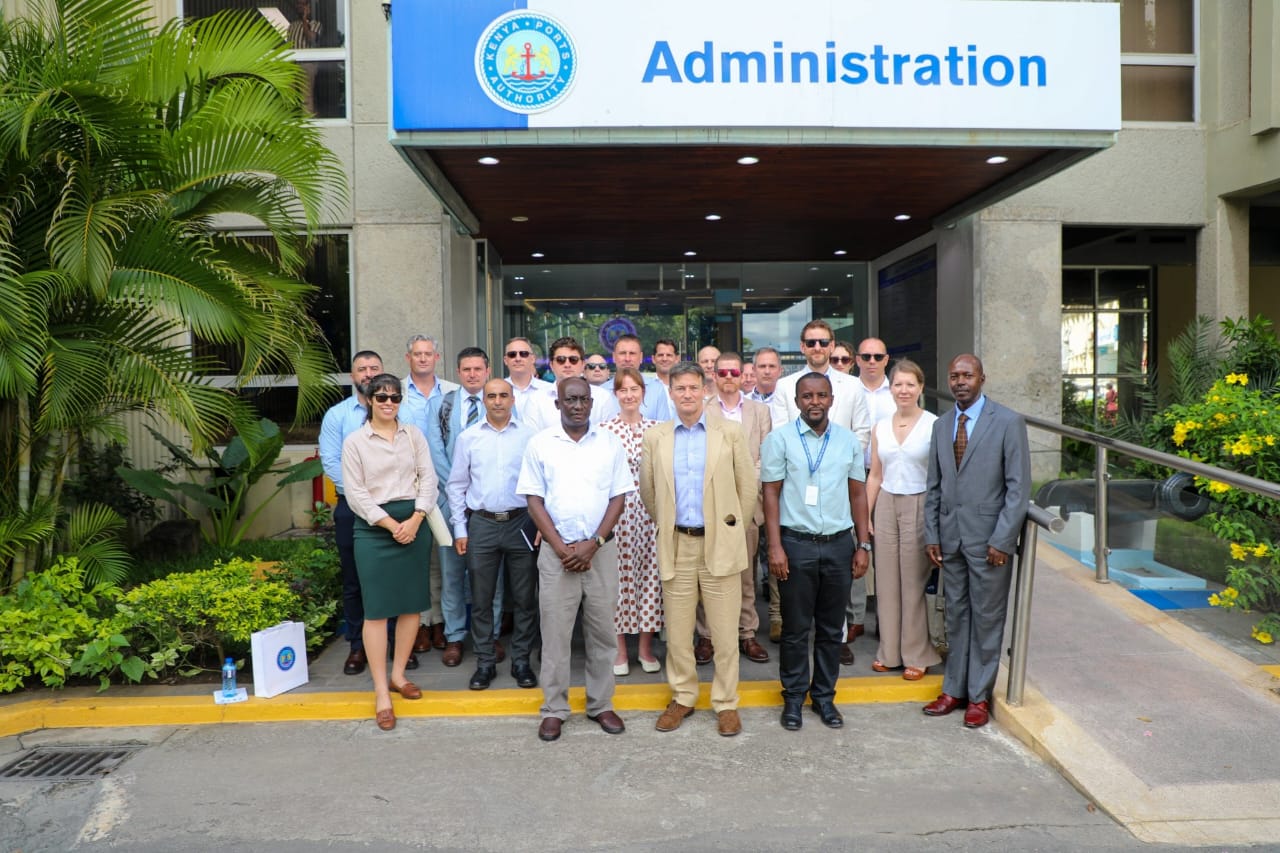
The recent high-level engagement between the Kenya Ports Authority (KPA) and a delegation from the United Kingdom’s Defence Academy is far more than a routine diplomatic courtesy. It is a timely acknowledgment that the Port of Mombasa is steadily emerging as one of Africa’s most strategically significant maritime gateways—at a moment defined by geopolitical competition, shifting trade corridors, and soaring demand for resilient logistics infrastructure.
At the heart of these discussions lies an undeniable reality: Kenya is positioning the Port of Mombasa not merely as a national seaport, but as a regional economic engine for East and Central Africa’s hinterland. KPA’s ambitious infrastructure expansion plans reflect growing confidence in the port’s future and a clear recognition that maritime infrastructure will determine economic competitiveness in the decades ahead.
KPA General Manager for Infrastructure Development, Eng. Mathews Amuti, has announced the construction of Berth 19B and Berths 23 and 24—a development of great significance. These are not simply additions of docking space; they are strategic investments designed to future-proof the port against rising cargo volumes, larger vessels, and intensifying competition from regional rivals.
Today, the Port of Mombasa stands at a critical crossroads. Across Africa, ports are racing to modernize in response to the African Continental Free Trade Area (AfCFTA), realignments in global shipping, and the growing importance of the Indian Ocean maritime corridor. Tanzania continues to expand Dar es Salaam, while Djibouti, Durban, and emerging Red Sea logistics hubs are aggressively pursuing regional dominance. Kenya cannot afford complacency.
What makes Mombasa particularly invaluable is its geographical advantage. It serves as the principal gateway for Uganda, Rwanda, South Sudan, the eastern Democratic Republic of Congo, and parts of northern Tanzania. Any improvement in efficiency at Mombasa directly uplifts the economies of the wider region. Faster cargo clearance, expanded berthing capacity, modernized inland container depots, and better multimodal connectivity are not merely operational upgrades—they are catalysts for regional economic transformation.
KPA’s emphasis on modernizing inland container depots is equally commendable. Congestion remains one of Africa’s biggest trade bottlenecks, driving up cargo dwell time and business costs. By strengthening inland logistics infrastructure, Kenya is embracing an integrated supply chain model that links maritime transport with rail, road, and dry port systems—precisely what modern global trade demands.
Yet infrastructure alone is insufficient without institutional coordination and maritime security. Major General Felix Gedney OBE of the UK Defence Academy underscored an often-overlooked dimension: security stability is inseparable from commercial success. Global shipping now operates in an environment increasingly shaped by maritime insecurity, cyber threats, piracy risks, smuggling networks, and geopolitical tensions along critical sea lanes. The western Indian Ocean remains strategically sensitive, especially given recurring instability in the Red Sea and Gulf of Aden. In this context, Mombasa’s ability to maintain operational continuity, secure cargo movement, and foster inter-agency coordination enhances Kenya’s credibility as a dependable maritime partner.
The United Kingdom’s interest in the Port of Mombasa should thus be viewed within the broader framework of maritime geopolitics. Major global powers increasingly recognize that ports are no longer just commercial facilities—they are strategic assets that influence trade security, military logistics, energy supply chains, and diplomatic influence. Mombasa’s rising profile naturally attracts international partners seeking stable and efficient maritime corridors in East Africa.
However, Kenya must also confront lingering structural challenges if the port is to realize its full ambitions. Infrastructure expansion must go hand in hand with continued reforms in customs efficiency, cargo handling systems, digitization, workforce training, and anti-corruption safeguards. Delays in cargo clearance, bureaucratic inefficiencies, and logistical inconsistencies can quickly undermine gains from expensive infrastructure projects.
There is also a pressing need to invest in maritime human capital. A modern port cannot function optimally without highly trained marine engineers, port operators, logistics specialists, seafarers, and maritime security professionals. Kenya’s maritime institutions must align training programs with the evolving demands of global shipping and port management technologies.
Environmental sustainability must equally become central to future expansion strategies. The global maritime industry is transitioning toward greener shipping practices, decarbonization targets, and climate-resilient infrastructure. As Mombasa grows, Kenya must ensure that expansion does not come at the expense of marine ecosystems, coastal communities, or long-term environmental health.
Still, the broader trajectory remains encouraging. The Port of Mombasa is no longer merely a cargo-handling facility; it is evolving into a sophisticated regional logistics ecosystem. That transformation carries profound implications for trade, employment, industrialization, and Kenya’s geopolitical standing within Africa and the Indian Ocean region.
The engagement with the UK Defence Academy therefore symbolizes more than diplomatic goodwill. It reflects growing international recognition that the Port of Mombasa is becoming a strategic pillar of East Africa’s economic future. The challenge for Kenya now is to sustain momentum, deepen reforms, and ensure that Mombasa’s modernization translates into inclusive economic growth for the entire region.
If managed wisely, the Port of Mombasa could become not only East Africa’s busiest maritime gateway, but one of the defining logistics hubs of the Global South in the 21st century.