


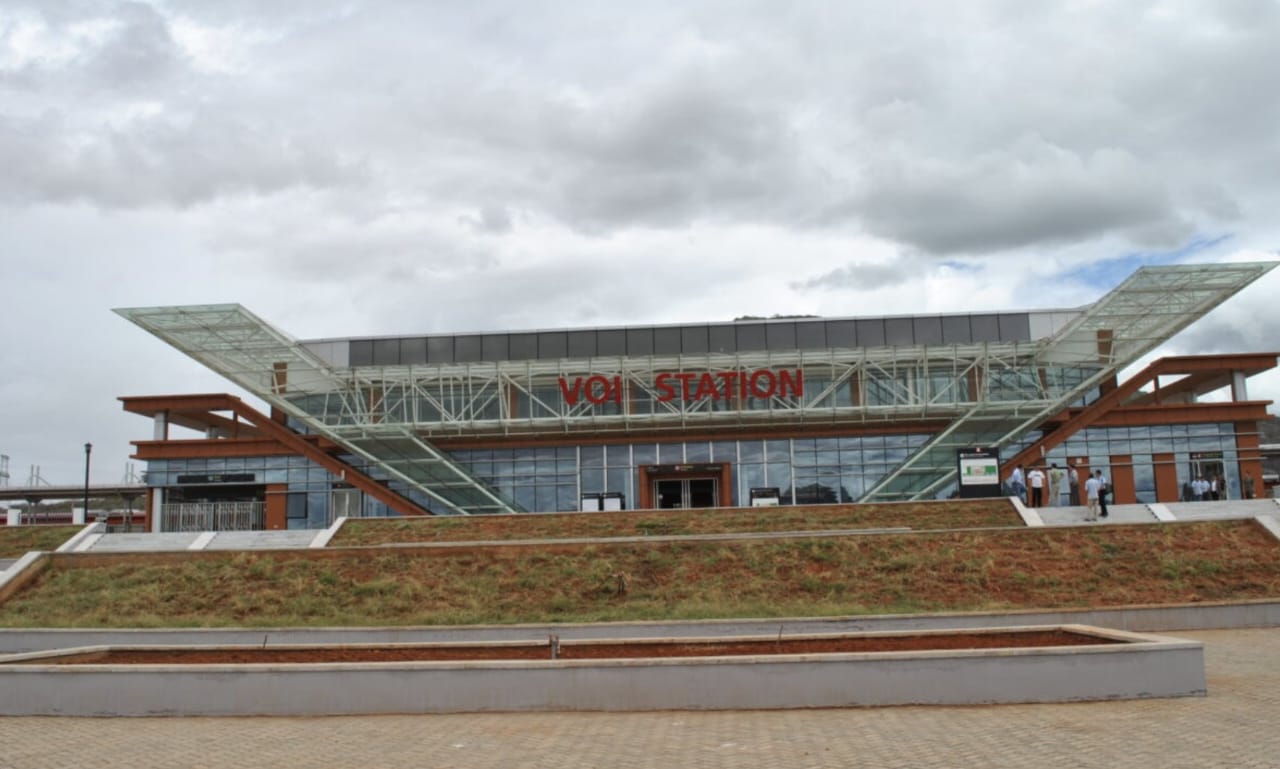
Some infrastructure projects merely move goods. Others reshape geography, revive forgotten corridors, and redefine a nation’s role in regional trade. The revitalization of the Voi–Taveta metre-gauge branch line firmly belongs in the latter category.
Long abandoned and often overlooked in national transport discourse, this 127–130 kilometre metre-gauge railway is now emerging as one of the most strategic missing links in Kenya’s transport architecture. It speaks directly to the ambitions of the African Continental Free Trade Area (AfCFTA) and the broader integration of the Northern and Central Corridors.
To grasp its importance, we must first return to its historical and geographical logic. Built between 1914 and 1918, the Voi–Taveta metre-gauge branch line linked the inland rail network at Voi to Taveta on the Kenya–Tanzania border. Voi was born as a railway town—a key junction on the old Kenya–Uganda Railway (also metre-gauge) and a natural gateway between coast and hinterland. Taveta, meanwhile, sits at a critical border crossing, serving as a vibrant hub of cross-border trade and human movement.
For decades, however, this link fell into disrepair and eventual abandonment, overtaken by road transport and policy inertia. Its dormancy mirrored a broader neglect of metre-gauge infrastructure across East Africa, even as trade volumes swelled and regional integration deepened. Today, its revival is no nostalgic exercise—it is an economic imperative.
At the heart of this imperative lies the AfCFTA, Africa’s most ambitious trade framework, which depends on seamless cross-border movement, fewer non-tariff barriers, and efficient logistics chains that can compete globally. Railways are central to that vision. They offer cost-effective, high-volume transport that road networks simply cannot match over long distances.
Once rehabilitated, the Voi–Taveta metre-gauge branch line will reconnect Kenya directly to northern Tanzania by rail, extending to Moshi and beyond. This is not merely a bilateral link; it is a continental bridge. Critically, it enables the establishment of a dry port at Voi town—a multimodal logistics hub that will link the Port of Mombasa directly to the Central Corridor, serving Tanzania, Rwanda, Burundi, and Uganda.
The dry port will transform Voi from a railway junction into a strategic multimodal gateway, allowing cargo to clear customs and transfer seamlessly between the Standard Gauge Railway (SGR), the revived metre-gauge line, and road networks. This will reduce congestion at Mombasa and cut transit times to the hinterland.
Here the strategic genius of the project becomes clear. The Northern Corridor has long been Kenya’s economic lifeline, anchoring Mombasa as the gateway to East and Central Africa. But over-reliance on a single corridor breeds inefficiency, congestion, and vulnerability. Diversifying trade routes is not a luxury—it is a necessity.
The Voi–Taveta metre-gauge line delivers exactly that diversification. By creating a southern outlet into Tanzania, it effectively links the Northern Corridor with the Central Corridor (running through Dar es Salaam into the heart of the continent). With the proposed dry port now located at Voi, cargo originating from Mombasa can be railed directly to Voi, cleared there, and then transported via the rehabilitated metre-gauge line to Taveta and across the border into Tanzanian rail (extending from Moshi) and road networks to Rwanda, Burundi, and Uganda—offering a competitive alternative to the traditional Northern Corridor through Nairobi.
Rather than treating these corridors as rivals, the railway enables a complementary system where cargo can be routed dynamically based on cost, destination, and congestion.
This inter-corridor connectivity is the missing piece in East Africa’s logistics puzzle. It transforms a collection of parallel trade routes into an integrated network. For landlocked countries such as Burundi, Rwanda, and Uganda, that means greater choice and potentially lower transport costs. For Kenya, it means retaining and expanding its share of transit cargo—a share that has shown signs of decline in recent years.
Equally important is the railway’s integration with existing infrastructure. Voi is already a critical node on the Standard Gauge Railway (SGR), which connects Mombasa to Nairobi. With the dry port now located in Voi, this town becomes the central transshipment hub between the standard-gauge and metre-gauge systems. This hybrid model—leveraging both new and legacy infrastructure—represents a pragmatic, cost-effective approach to railway development.
Beyond freight, the implications for local economies are profound. Taita Taveta County, often overshadowed by coastal and urban centres, stands to become a logistics and industrial hub—with Voi as its anchor. The dry port and associated cargo handling facilities at Voi will bring port services closer to producers and traders, reducing the distance—and cost—of doing business.
Moreover, the railway can unlock sectors long constrained by poor connectivity. Mining, agriculture, and tourism all stand to benefit. The region is rich in minerals and agricultural produce, yet high transport costs have limited their competitiveness. Cheaper, more reliable rail transport can fundamentally change that equation.
Tourism offers a particularly compelling case. The corridor passes through some of Kenya’s most iconic landscapes, including the Tsavo ecosystem and the foothills of Mount Kilimanjaro. A functional rail link could support passenger services connecting tourists directly from Mombasa or Nairobi to these destinations, enhancing accessibility while reducing road congestion and environmental impact.
But perhaps the most compelling argument for the Voi–Taveta metre-gauge revival lies in its symbolism. It represents a shift in how Kenya—and indeed Africa—approaches infrastructure. Instead of focusing solely on flagship mega-projects, there is growing recognition of the value of rehabilitating and integrating existing assets. It is about building networks, not monuments.
This shift is especially relevant given fiscal constraints and rising debt levels. Large-scale greenfield projects, while transformative, are expensive and time-consuming. By contrast, rehabilitating an existing metre-gauge branch line offers a quicker, more affordable path to impact—and ensures that past investments are repurposed, not wasted.
Of course, revitalisation alone is not enough. Success will depend on how well the railway is integrated into broader logistics systems. That means efficient border management at Taveta/Holili, harmonised customs procedures with Tanzania, and development of complementary infrastructure such as roads, warehouses, and digital tracking systems—all anchored by a fully functioning dry port at Voi.
Institutional coordination will also be key. Railways do not operate in isolation; they are part of a complex ecosystem involving ports, customs authorities, logistics companies, and regional bodies. Ensuring these actors work in sync will determine whether the railway becomes a true trade corridor or merely a rehabilitated track with limited impact.
There is also a geopolitical dimension. In an era where regional influence is increasingly tied to infrastructure, the ability to offer efficient, reliable trade routes confers significant strategic advantage. By strengthening its southern link to Tanzania via this metre-gauge branch line and establishing a dry port at Voi, Kenya not only secures its position in regional trade but also reinforces its role as East Africa’s logistics hub—capturing transit traffic to Rwanda, Burundi, and Uganda that might otherwise flow through Dar es Salaam.
Ultimately, the revitalisation of the Voi–Taveta metre-gauge railway is about more than steel rails and locomotives. It is about reconnecting Kenya to its region, unlocking economic potential, and aligning national infrastructure with continental ambitions. It is about ensuring that the promise of the AfCFTA is not undermined by the reality of poor connectivity.
In the quiet towns of Voi and Taveta, one can already glimpse the contours of that future—a future where trains once again carry not just goods, but opportunity, integration, and growth across borders. The task now is to ensure this vision is fully realised, and that the railway does not simply return, but returns with purpose.