


Few places on the global map illustrate the power of geography as decisively as Djibouti. Perched at the southern gateway to the Red Sea and astride the Bab el-Mandeb chokepoint, the country has long understood that its comparative advantage lies not in size or population, but in its ability to convert location into leverage.
The recent high-level visit by Jérôme Bresson, Ambassador of the French Republic, offers more than ceremonial diplomacy—it provides a window into a deliberate, disciplined strategy: infrastructure as statecraft.
What emerges from the tour of Djibouti’s maritime and energy assets is a deliberate move to enhance the role of the country as a hub for logistics, repair, energy, and transshipment for the Horn of Africa and beyond.
In an era where global shipping lanes are increasingly contested and supply chains frequently disrupted, Djibouti is making a calculated bet: that control over high-quality maritime infrastructure can translate into long-term geopolitical and economic influence.
The visit’s starting point—the Djibouti Ship Repair Yard (DSRY)—is emblematic of this ambition. Valued at €107.5 million and developed in partnership with Invest International, the facility represents a decisive move up the maritime value chain.
For decades, African ports have largely functioned as transit points—handling cargo but rarely capturing the higher-value services associated with shipping, such as maintenance, repair, and retrofitting. DSRY disrupts that pattern.
With its floating dock—among the largest in the Red Sea and Gulf of Aden—capable of handling vessels up to 20,100 tonnes, Djibouti is positioning itself as a regional service center. This matters.
Every ship that enters a repair yard generates not just docking fees but a web of economic activity, which include skilled labor, technical expertise, supply chains for parts and materials, and the accumulation of maritime know-how.
In a region where such capabilities are scarce, DSRY is both an economic asset and a strategic signal: Djibouti intends to compete, not merely participate.
Yet ship repair alone does not define a maritime hub. The second leg of the visit—to the Damerjog Liquid Bulk Port—reveals a parallel strategy centered on energy logistics. Located within the Djibouti Damerjog Industrial Park, the port is a study in scale and foresight.
Its 2.5-kilometer oil jetty and annual handling capacity of 25 million tonnes position it as a critical node in regional fuel distribution. The ability to manage multiple cargo streams—from diesel and jet fuel to liquefied petroleum gas and edible oils—adds a layer of operational versatility rare in the region.
In practical terms, this transforms Djibouti from a mere transit point into a buffer, a storage hub, and a redistribution center. For landlocked neighbors such as Ethiopia, whose economic lifelines depend on reliable access to fuel and imports, this infrastructure is indispensable.
For global energy traders, it offers a strategic foothold along a volatile but vital corridor. And for Djibouti itself, it cements a role that extends beyond ports into the broader energy economy.
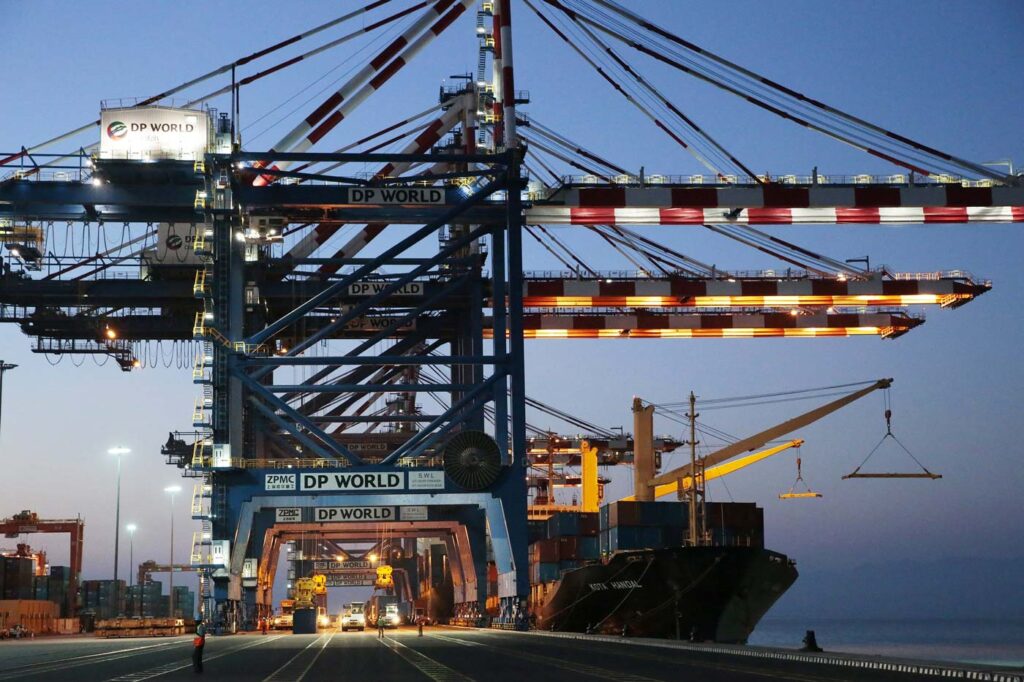
The visit to the Doraleh Multipurpose Port underscores another dimension of this strategy: integration. Ports do not operate in isolation; their efficiency is only as strong as the networks that feed and evacuate them.
The operationalization of the Ethiopian-Djibouti Railway is therefore a critical piece of the puzzle. By linking Doraleh directly to Ethiopia’s industrial and commercial centers, Djibouti has effectively extended its hinterland deep into East Africa.
This is where the country’s vision becomes most apparent. Rather than competing with larger economies on production, Djibouti is embedding itself into the logistics backbone of regional trade. Containers that move through Doraleh are not just cargo—they are indicators of a system working as intended: efficient, connected, and increasingly indispensable.
The final stops—Horizon Djibouti Terminals Limited and the Société de Gestion du Terminal Pétrolier de Djibouti—complete the picture. These downstream petroleum facilities handle the storage, management, and distribution of refined products, ensuring that the upstream capabilities of Damerjog translate into real-world supply chain resilience.
Together, they form the quiet backbone of Djibouti’s energy ecosystem, underpinning both domestic consumption and regional exports.
What is striking about this integrated approach is its clarity. Djibouti is not attempting to do everything; it is focusing on doing a few things exceptionally well. Maritime services, energy logistics, and trade facilitation are not disparate sectors but interlocking components of a single national strategy. Each investment reinforces the others, creating a network effect that amplifies the country’s overall competitiveness.
The presence of the French Ambassador in this context is also significant. France, with its historical ties to Djibouti and enduring strategic interests in the region, remains an important partner. But the broader implication is that Djibouti’s infrastructure is attracting attention from a diverse set of global actors—European, Asian, and Middle Eastern alike. This multiplicity of partnerships is both an opportunity and a challenge. While it brings capital and expertise, it also requires careful navigation to avoid overdependence or geopolitical entanglement.
Therein lies the delicate balance Djibouti must maintain. Infrastructure can be a powerful tool of sovereignty, but it can also become a vector of external influence if not managed prudently.
Financing arrangements, operational control, and long-term concessions must be structured in a way that preserves national interests while remaining attractive to investors. The success of Djibouti’s model will depend not only on the quality of its assets but on the governance frameworks that underpin them.
For the wider region, Djibouti’s rise carries important lessons. In an African maritime landscape often characterized by underinvestment and inefficiency, it demonstrates what is possible when strategy, geography, and execution align. Yet it also raises questions about competition and complementarity. Neighboring ports—from Mombasa to Berbera—must now contend with a Djibouti that is not just a gateway but a full-spectrum maritime hub.
Ultimately, the significance of this visit lies not in the itinerary but in what it reveals. Djibouti is building more than ports and terminals; it is constructing a narrative of relevance in a rapidly changing world. By investing in infrastructure that serves both regional needs and global flows, it is positioning itself as an indispensable link in the chain of international trade.
In the crowded waters of the Red Sea and the Gulf of Aden, where geopolitics and commerce intersect with increasing intensity, Djibouti’s strategy stands out for its coherence and ambition. The question now is not whether the country can build world-class infrastructure—it clearly can—but whether it can sustain, govern, and leverage these assets to secure long-term prosperity.
If it succeeds, Djibouti will not merely be a waypoint on the map. It will be a pivot—an anchor of stability and a driver of economic integration in one of the world’s most strategically significant regions.