


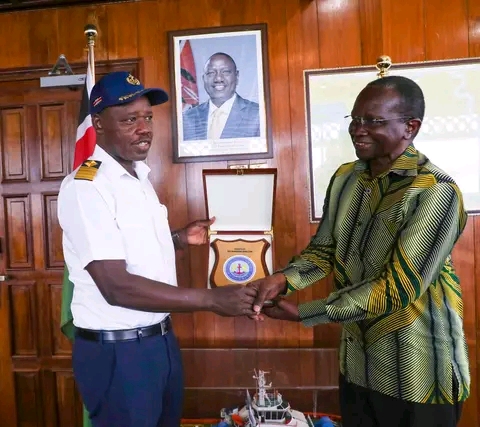
Uganda Railway Corporation (URC) Board recently visited to the Port of Mombasa which goes a long way toward enhancing regional trade integration and efficiency of the Kenya-Uganda transport and logistics.
During the visit, URC Board Chairman Hon. Daudi Migereko commended the ongoing modernization and infrastructure expansion at the Port of Mombasa. He confirmed that Uganda will continue routing the bulk of its cargo through Mombasa, citing the port’s proven efficiency and reliability.
KPA Managing Director Captain William K. Ruto welcomed the delegation and highlighted the deep partnership between the two nations. He reaffirmed KPA’s commitment to facilitating seamless trade for Uganda-bound cargo, which accounts for the largest share of transit cargo handled annually at the Port of Mombasa.
In his remarks, Captain Ruto stated: “We value the existing partnership between our two great nations, and I want to assure you that we will continue strengthening this mutual relationship with the aim of facilitating trade.”
This mutual recognition underscores that the Northern Corridor’s success rests not only on physical infrastructure but also on trust, policy alignment, and sustained political commitment.
Trade corridors endure through confidence. Uganda must trust Kenya’s systems to deliver efficiency, security, and predictability. Kenya, in turn, must treat the preservation of that trust as central to Mombasa’s regional primacy.
The recent groundbreaking for the Standard Gauge Railway (SGR) extension between Kenya and Uganda is therefore historic. If executed effectively, it promises to reduce transport costs, shorten transit times, ease road congestion, and enhance supply chain reliability across the region. This is not merely a transport project—it is an instrument of economic transformation.
Efficient rail connectivity has historically powered industrial growth. A modern railway linking Mombasa to Kampala and onward to the Great Lakes region could unlock manufacturing, agriculture, mineral exports, petroleum logistics, and intra-African trade under the AfCFTA.
East Africa has long talked about integration. The renewed momentum on the Kenya-Uganda SGR offers a chance to shift from rhetoric to tangible results. However, infrastructure alone is insufficient.
Success also requires: customs harmonization; digital cargo tracking; effective port community systems; efficient border management; axle load control; security coordination; and elimination of corruption along the corridor
A high-speed railway will deliver little value if cargo remains stuck in bureaucratic delays.
Kenya must sustain momentum at Mombasa while addressing institutional bottlenecks. In an increasingly competitive African port landscape, victory will go to the gateway offering the best combination of speed, transparency, digitalization, and predictability.
Uganda’s continued preference for the Northern Corridor is a powerful endorsement. In a region where corridors compete aggressively for cargo, Kampala’s confidence bolsters Mombasa’s position against emerging rivals. That confidence must be actively earned and preserved.
The Kenya-Uganda relationship has always transcended neighbourly diplomacy. It is a deep economic interdependence shaped by geography and shared interests. Developments at Mombasa reverberate in Kampala, and Uganda’s economic performance directly influences Mombasa’s throughput.
The URC Board’s visit sends a clear message to the wider region: East Africa’s integration agenda remains alive. Its success, however, will be determined by the ability of governments to translate political symbolism into consistent operational excellence.
Today, the Port of Mombasa represents more than a Kenyan asset—it embodies a regional promise. The challenge ahead is to fulfill that promise through world-class infrastructure, seamless rail integration, and unwavering commitment to cooperative trade facilitation.
If Kenya and Uganda get this partnership right, the Northern Corridor could emerge as one of Africa’s most dynamic economic arteries. Failure would consign East Africa to the familiar trap of unrealized potential—where grand visions exist more in speeches than in transformed realities.