


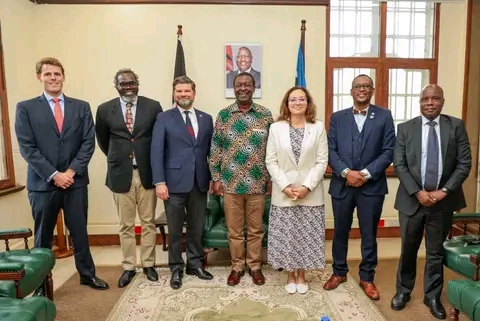
Last Saturday’s high-level maritime summit in Nairobi was more than just another diplomatic engagement. When the Kenya Ships Agents Association (KSAA), global shipping giants like Maersk, and international bodies such as the World Shipping Council,International Chamber of Shipping and FONASBA sat down with Prime Cabinet Secretary Musalia Mudavadi, they were putting the spotlight on a sector that is too often taken for granted. Given the stakes, the message was clear: Kenya can no longer afford to treat its ports as mere points of entry, but as strategic assets requiring world-class efficiency, predictability, and investment.
The Port of Mombasa is the economic artery of East Africa, handling over 95% of Kenya’s international trade and serving the vast hinterland that includes Uganda, Rwanda, and the DRC . The numbers are staggering. The port recorded a 14.2% growth in cargo handling in 2024, with over 2 million TEUs moved, and transit cargo surging by 17.4% . Yet, as KSAA CEO Elijah Mbaru has rightly warned, this progress is fragile. The recent congestion that saw over 20 ships queuing offshore resulted in losses estimated at $60,000 per vessel per day, a financial hemorrhage that threatens Kenya’s competitiveness .
The summit’s focus on a “balanced, predictable, and investment-friendly regulatory environment” is therefore not just bureaucratic jargon—it is an existential necessity.
Cutting the Red Tape
While the government is pushing for port modernization, including the recent $820 million deal with CMA CGM and the development of the Dongo Kundu port, these physical upgrades must be matched by policy reforms . The industry’s recent clash with the Kenya Plant Health Inspectorate Service (Kephis) over contentious container cleaning charges serves as a cautionary tale. The sudden imposition of fees—without clear operational capacity and risking duplication of services—was rightly opposed by KSAA and the Kenya Maritime Authority . Arbitrary charges undermine investor confidence and can easily divert trade to competing regional ports . If we are to attract the global lines and partners that the KSAA delegation brought to the table, Kenya must ensure that regulatory agencies are facilitators, not obstacles .
Embracing the Blue Economy
Furthermore, the discussions on sustainability, capacity building, and youth employment are where the long-term vision lies. As global shipping giants such as Maersk pivot toward decarbonization and digitalization, Kenya must position its workforce to meet this demand. The ongoing construction of the Sh1.8 billion Regional Flagship Maritime Training Centre in Kwale is a positive step, but it must be complemented by a sustained focus on digital skills and modern technical expertise to meet global shipping standards .
Kenya has the potential to be a supreme maritime hub, but it requires a “whole-of-government” approach that aligns infrastructure development with regulatory efficiency. The engagement by Mudavadi sends a signal that the government is listening. Now, it must act. The partnership between KSAA and its global counterparts offers a roadmap for prosperity on the high seas—provided we have the political will to navigate the turbulent waters of bureaucracy and inefficiency.