


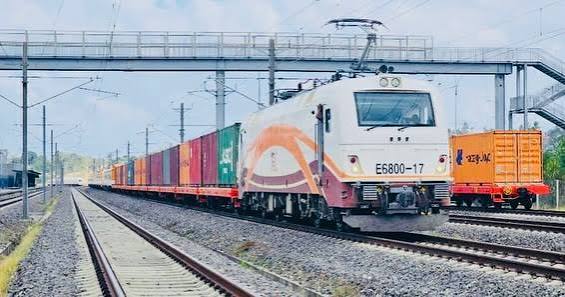
The 430-kilometer electrified rail section between Makutupora and Isaka is not merely a domestic transport project. It is a geopolitical instrument. It is a logistics revolution. Most importantly, it is a declaration that East Africa intends to compete globally not as fragmented economies, but as an integrated commercial bloc.
For generations, the economies of Rwanda, Burundi, Uganda, and the eastern Democratic Republic of the Congo have paid a punitive “geography tax.” Being landlocked meant dependence on slow road freight, border bottlenecks, fuel volatility, corrupt checkpoints, cargo theft, and crippling logistics costs to reach Indian Ocean trade routes.
That reality is now beginning to change.
Rail infrastructure alters economics in ways roads never can. Roads distribute traffic; rail corridors reorganize civilizations. Once completed, this electric railway will compress transport timelines from weeks into days, slash freight costs, stabilize supply chains, and create predictable commercial movement between Africa’s interior and the Port of Dar es Salaam. That predictability alone attracts industrial investment.
Factories do not emerge where transport is uncertain. Manufacturing does not thrive where cargo delays are normal. Regional trade blocs cannot function efficiently when trucks spend days stranded at borders. Efficient rail changes all of that.
The operational Dar es Salaam–Dodoma section is therefore far from symbolic. Nearly six million passengers have already used the service. Fuel consumption has fallen by 17 million liters. Carbon emissions have reportedly dropped by more than 50 percent. These are not aspirational policy statements drafted by consultants. They are measurable outcomes from functioning infrastructure.
That distinction matters.
Across much of Africa, infrastructure discourse remains trapped in ceremonial politics—launch events, memoranda of understanding, donor conferences, and artist impressions of projects that never leave the page. East Africa, by contrast, has increasingly shifted toward execution. Ports are expanding. Railways are being electrified. Energy interconnections are growing. Aviation hubs are scaling. Digital payment systems are integrating across borders.
The region is building incrementally, but consistently.
And that consistency explains why East Africa is increasingly outpacing every other African region in infrastructure-led economic integration.
Unlike resource-dependent economies that rely heavily on commodity exports, East Africa’s growth model is becoming corridor-based. It invests in systems that connect economies rather than simply extracting raw materials. This distinction is fundamental. Infrastructure integration creates multiplier effects across agriculture, manufacturing, logistics, tourism, mining, and services simultaneously.
The strategic vision is becoming visible.
The Port of Dar es Salaam is positioning itself as the maritime gateway to Central Africa. Tanzania’s SGR is designed to feed that gateway inland. Kenya continues expanding the Port of Mombasa and its transport corridors. Regional energy projects are linking national grids. Cross-border trade agreements are deepening commercial interdependence. Collectively, these investments are transforming East Africa from a collection of adjacent states into an emerging economic ecosystem.
This is not accidental. It reflects political recognition that infrastructure is power.
The countries that control logistics corridors ultimately shape regional commerce. They influence supply chains, determine freight costs, attract industrial parks, and command strategic leverage over trade flows. Historically, this model elevated global powers such as Singapore, the Netherlands, and the United Arab Emirates. East Africa appears increasingly aware that the same logic applies here.
But the region’s success also exposes uncomfortable truths about the broader continent.
Why has East Africa advanced faster while other regions continue struggling?
Part of the answer lies in political continuity. Infrastructure requires long-term state discipline extending beyond election cycles. Railways are not completed within campaign timelines. Ports and industrial corridors demand decades of planning, financing, and execution. Too many African states remain trapped in short-term political cultures where each administration abandons its predecessor’s projects.
Another obstacle is institutional fragility. Infrastructure financing at this scale demands credibility—not merely ambition. International financiers support projects when procurement systems, legal frameworks, repayment structures, and governance mechanisms appear stable enough to protect capital. East Africa, despite its imperfections, has increasingly demonstrated greater institutional predictability than regions plagued by coups, conflict, regulatory instability, or chronic policy reversals.
The third barrier is fragmentation.
Africa still suffers from colonial-era economic geography, where national economies were designed to export raw materials outward rather than trade inward with one another. Many governments continue prioritizing national prestige projects over regional integration infrastructure. Yet modern competitiveness belongs to connected economic blocs, not isolated states.
East Africa is beginning to understand this reality better than most.
There are, of course, legitimate concerns. Large-scale financing raises debt sustainability questions. Governance oversight remains essential. Environmental and community impacts must be monitored carefully. Rail infrastructure alone cannot guarantee industrial transformation without complementary investments in manufacturing, customs harmonization, energy reliability, and security.
But these criticisms should refine the project—not diminish its strategic significance.
Because beneath the steel tracks and financing structures lies something far larger: a contest over Africa’s economic future.
For decades, Africa has largely exported raw commodities while importing finished goods, foreign expertise, and external development models. What is emerging in East Africa suggests a different possibility—one where African states build integrated trade systems capable of driving internal industrialization and regional prosperity.
Quietly, East Africa is constructing the physical architecture of economic sovereignty.
And perhaps that is the most important lesson for the rest of the continent: development is not produced by speeches, summits, or slogans. It is built corridor by corridor, port by port, rail by rail, transmission line by transmission line.
The regions that understand this first will define Africa’s next century.