


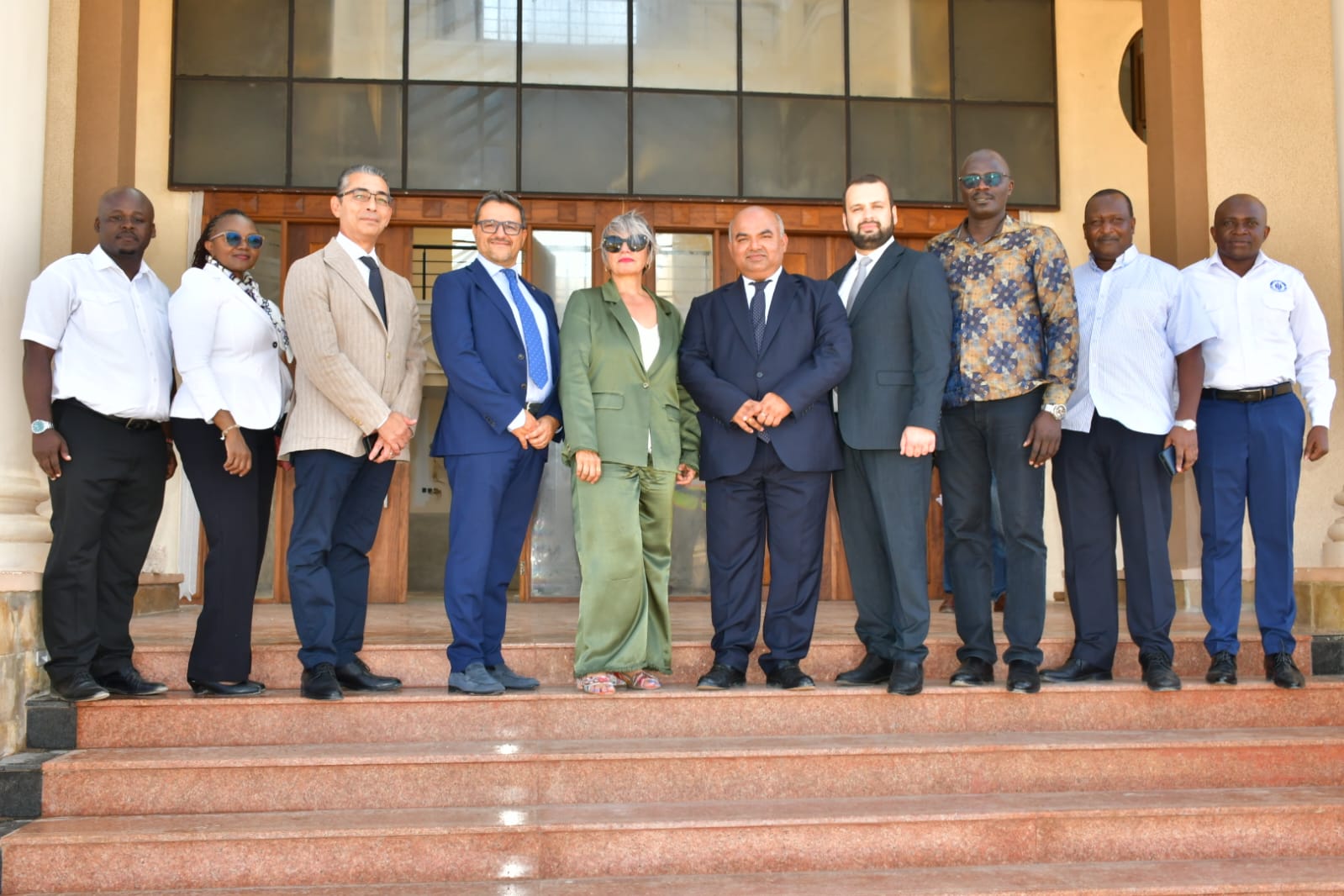
The quiet arrival this morning of an MSC technical team at Kenya Utalii College’s Kilifi Campus marks more than a routine institutional courtesy call. Accompanied by MSC Regional Manager Capt. Fiorenzo Castelano, the Director General of the Kenya Maritime Authority CPA Omae Nyarandi, and Bandari Maritime Academy CEO Dr. Eric Katana, the delegation’s presence underscores a deliberate alignment of global cruise expertise with Kenya’s unfolding blue-economy and tourism ambitions. That the team also held a brief consultative meeting with Principal Secretary for Tourism Mr. Julius Bitok and Cabinet Secretary for Tourism Rebecca Miano elevates the engagement from technical inspection to policy-level signalling. Kenya is no longer content to remain a passive destination; it is positioning itself as a serious partner in cruise hospitality training and infrastructure.
During that consultative meeting, CS Miano went further than polite diplomatic language. She directly urged the MSC technical team to fast-track the Memorandum of Understanding before the delegation departs for Geneva. The request carries weight. It signals that the Kenyan government views this engagement not as an exploratory conversation but as a time-sensitive opportunity that must be secured while decision-makers are still on Kenyan soil. In the competitive world of international cruise partnerships, such urgency from a Cabinet Secretary is both rare and revealing: Nairobi understands that momentum, once lost, is difficult to recover.
The significance of the meeting was compounded by a telephone intervention from Geneva itself. Shipowner Mr. Diego Aponte spoke directly to the head of the MSC technical team and gave an unambiguous undertaking: 100 percent of the pioneer cohort of students at Kenya Utalii College Kilifi will be recruited to work aboard MSC cruise ships. For an institution that has already registered 510 pioneer students for the September intake against a designed capacity of 1,000, this is not a vague expression of interest. It is a concrete employment guarantee from the very top of one of the world’s largest cruise operators. Few training institutions in Africa, or indeed anywhere, receive such a categorical commitment at so early a stage.
It was also revealed during the same consultative meeting that President William Ruto will soon visit the institution for its official opening ceremony. The impending presidential presence transforms the narrative once more. What began as a technical assessment by an international cruise operator is rapidly becoming a nationally prioritised project, complete with the highest political endorsement. An official opening by the Head of State will not only confer prestige on the Kilifi Campus; it will publicly lock the government into the venture’s success and signal to investors, students, and the wider industry that this institution occupies a strategic place in Kenya’s tourism and blue-economy agenda.
Kenya Utalii College’s Kilifi Campus arrives at this moment with tangible momentum. The early enrolment of more than half its projected capacity reflects both demand for specialised hospitality skills and confidence in the college’s coastal location. Kilifi’s proximity to the Indian Ocean coastline places the campus at the natural interface of land-based tourism and the emerging cruise economy. The planned installation of a cruise-ship simulator for hospitality students is therefore more than an equipment upgrade. It is a pedagogical statement: Kenyan trainees will practise in environments that approximate the operational realities of modern cruise vessels rather than generic hotel settings. With MSC’s recruitment promise now on the table, that simulator becomes an essential bridge between classroom and ship deck.
The reported willingness of MSC to consider an investment on the order of USD 300 million, contingent on satisfactory progress, remains the headline figure. Combined with the 100 percent recruitment pledge, the Cabinet Secretary’s insistence on accelerating the MoU, and the forthcoming presidential opening, the package on offer is unusually comprehensive. It points toward curriculum co-design, industry-aligned standards, faculty development, and preferential career pathways—elements that can transform a national training institution into a genuine feeder for the global cruise industry.
Yet editorial honesty requires that optimism be tempered by realism. A multi-hundred-million-dollar commitment and a blanket recruitment guarantee will not materialise solely on the strength of a campus tour led by Kenya Utalii College CEO and Principal Mark Ogendi, however thorough that tour may have been. Delivery will depend on demonstrable institutional capacity, transparent governance, sustained government co-investment in supporting infrastructure, and the college’s ability to produce graduates who meet international standards of service, safety, and cultural fluency. The presence of both KMA and Bandari Maritime Academy leadership in the visiting party is therefore significant: it signals that the maritime regulatory and training ecosystems are being brought into the same conversation. Fragmentation between tourism and maritime authorities has previously diluted Kenya’s blue-economy efforts; coordinated engagement is a prerequisite for any large-scale external partnership to succeed.
There are broader national implications. A successful MSC collaboration would strengthen Kenya’s claim as a regional hub for cruise-related hospitality training, potentially attracting students and industry interest from neighbouring coastal states. It would also complement existing efforts to grow Mombasa and Lamu as more regular cruise ports of call. Training alone does not create demand, but the absence of trained personnel can certainly constrain it. By securing both capital investment and guaranteed sea-time employment, Kenya improves its negotiating position for longer port stays, higher passenger spend, and eventual home-porting possibilities.
The combination of CS Miano’s insistence on fast-tracking the MoU, Mr. Aponte’s direct recruitment pledge, and the revelation of an impending presidential opening ceremony transforms what might have been a promising visit into a defining moment. The technical team has seen the facilities. The political leadership has demanded speed. The shipowner has given his word on employment. The Head of State is preparing to lend his personal authority to the institution’s launch. The opportunity is genuine and unusually complete. The responsibility—to convert inspection, political urgency, verbal commitment, and presidential endorsement into a signed, funded, and operational partnership—now rests squarely with the Kenyan stakeholders who received the MSC team. If they move with the same clarity and urgency displayed in today’s meeting, Kilifi may yet become the place where Kenya’s cruise hospitality future truly begins.