


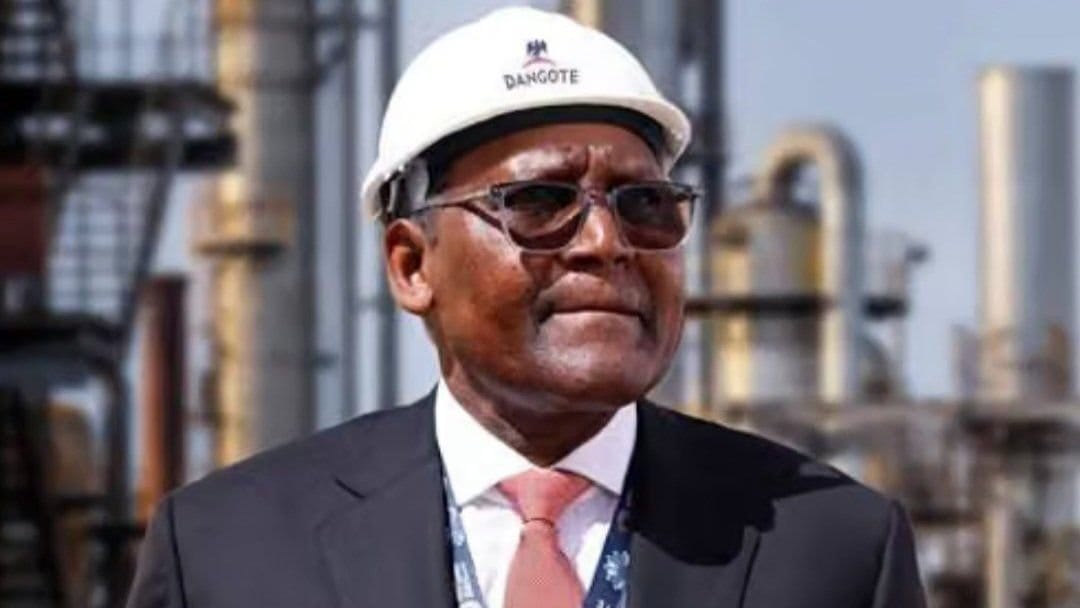
Dangote’s vessel push is a symptom of Nigeria’s deeper maritime failure
Africa’s richest man could not find a single ship to move 1,000 tonnes of cement from Nigeria to neighbouring Ghana. Stated plainly by Sada Ladan-Baki, Head of International Trade and Export at Dangote Cement, this is not a minor operational complaint. It is a sharp diagnosis of a structural disease: Nigeria has built industrial capacity far faster than it has built the ability to move what it produces.
Dangote Industries is now preparing to acquire its own vessels for regional exports across West and Central Africa. The decision is rational. Overland transport through Benin, Togo and beyond imposes successive 18% VAT charges and other fees that erode competitiveness long before the cement reaches its destination. Sea transport should be the cheaper, more efficient alternative for bulk cargo. Yet for a short coastal voyage carrying a volume small enough for ordinary traders, no vessel was available.
This is not an isolated Dangote problem. BUA Group acquired vessels years ago for sugar exports. Dangote already operates port terminals at Onne and Apapa and built a jetty at Lekki for its refinery. When the commercial shipping market fails to supply capacity, companies with capital simply integrate vertically. The pattern is clear: private industrialists are compensating for a public and market failure in logistics.
Industrial Scale Meets Logistics Scarcity
The pressure is intensifying. Dangote Cement has expanded export volumes and already moves clinker by sea to Ghana, Cameroon and other markets. Its $20 billion Lekki refinery has transformed Nigeria’s petroleum-product exports, with seaborne volumes rising sharply since 2023. Group executives now project vessel calls rising from roughly 300 toward as many as 1,800 annually as refining, fertiliser, cement, sugar and related businesses grow. The group is turning to Chinese shipyards—the world’s largest—for new tonnage, with initial deliveries possibly arriving around 2029.
Owning vessels would give Dangote greater control over freight costs, schedules and reliability. It would also allow the group to capture more of the value chain that currently accrues to foreign shipowners. Yet this private solution only underlines the public shortfall. Nigeria possesses production capacity, port infrastructure, a maritime regulator and a dedicated financing instrument. What it lacks is a functioning commercial shipping sector capable of serving regional trade at scale and at competitive cost.
The Cabotage Fund That Would Not Move
At the centre of the policy failure sits the $700 million Cabotage Vessel Financing Fund. Created under the 2003 Cabotage Act to help Nigerian operators acquire and build vessels, the fund accumulated a 2% levy for more than two decades with little meaningful disbursement. An application portal opened in January 2026 with promises of processing within roughly 90 days. Months later, progress remains painfully slow. Dozens of applications have been lodged; only a fraction have advanced through primary lending institutions. Credit assessments, cargo guarantees and procedural hurdles have left most applicants waiting. As of mid-September 2026, actual disbursements remain scarce.
The fund’s inertia is emblematic. Nigeria has repeatedly announced maritime revival plans, expanded the list of participating banks and issued directives for faster processing. Results lag. Indigenous shipowners continue to struggle with access to long-term, affordable capital, credible cargo aggregation and the ship-management capacity required to keep vessels employed. Foreign operators continue to dominate, capturing freight revenue while Nigerian industry absorbs higher costs and reduced competitiveness.
Implications for AfCFTA and Regional Integration
The African Continental Free Trade Area is meant to deepen intra-African commerce. Cement, fertiliser, refined products and other bulk goods are natural candidates for regional supply chains. Yet if the continent’s largest industrial conglomerate cannot secure a vessel for a short coastal haul, smaller exporters face even steeper barriers. Road corridors remain burdened by multiple border taxes, delays and infrastructure deficits. Without reliable, competitively priced coastal and short-sea shipping, the economic logic of AfCFTA weakens for heavy industry.
Production without logistics is incomplete economics. Nigeria can manufacture and refine, but if it cannot move the output efficiently, it captures only part of the value. Freight paid to foreign operators does not recycle into Nigerian shipyards, crews, equipment suppliers or maritime services. Blue-economy rhetoric rings hollow when basic coastal capacity is missing.
What Must Change
Dangote’s decision to buy ships is rational self-help. It should not become the default model. Nigeria needs a functioning indigenous fleet that can serve both large industrial cargoes and the smaller parcels that keep regional trade fluid. That requires more than announcements:
· Credible, accelerated disbursement of the CVFF, with realistic yet disciplined credit and cargo criteria.
· Policies that encourage cargo aggregation, longer-term contracts and professional ship management so that vessels find viable employment.
· Investment in supporting infrastructure, training and regulatory efficiency so that new tonnage can be crewed, maintained and operated competitively.
· A hard examination of whether cabotage rules, port processes and administrative practices actively enable or inadvertently hinder local operators.
Private capital will continue to fill gaps where the state and market fail. Conglomerates with deep pockets can own terminals, build jetties and order ships. Most Nigerian exporters cannot. The result is a two-tier logistics system that disadvantages smaller players and limits the broader industrial multiplier.
Aliko Dangote’s inability to find a ship for 1,000 tonnes of cement is not merely a story of one company’s frustration. It is a mirror held up to Nigeria’s maritime sector. Until the country builds commercial shipping capacity to match its manufacturing and refining ambitions, industrial success will remain only half-realised, and the promise of deeper African trade will stay constrained by the absence of vessels on short, vital routes. The private sector is already acting. The question is whether policy and institutions will finally catch up.