


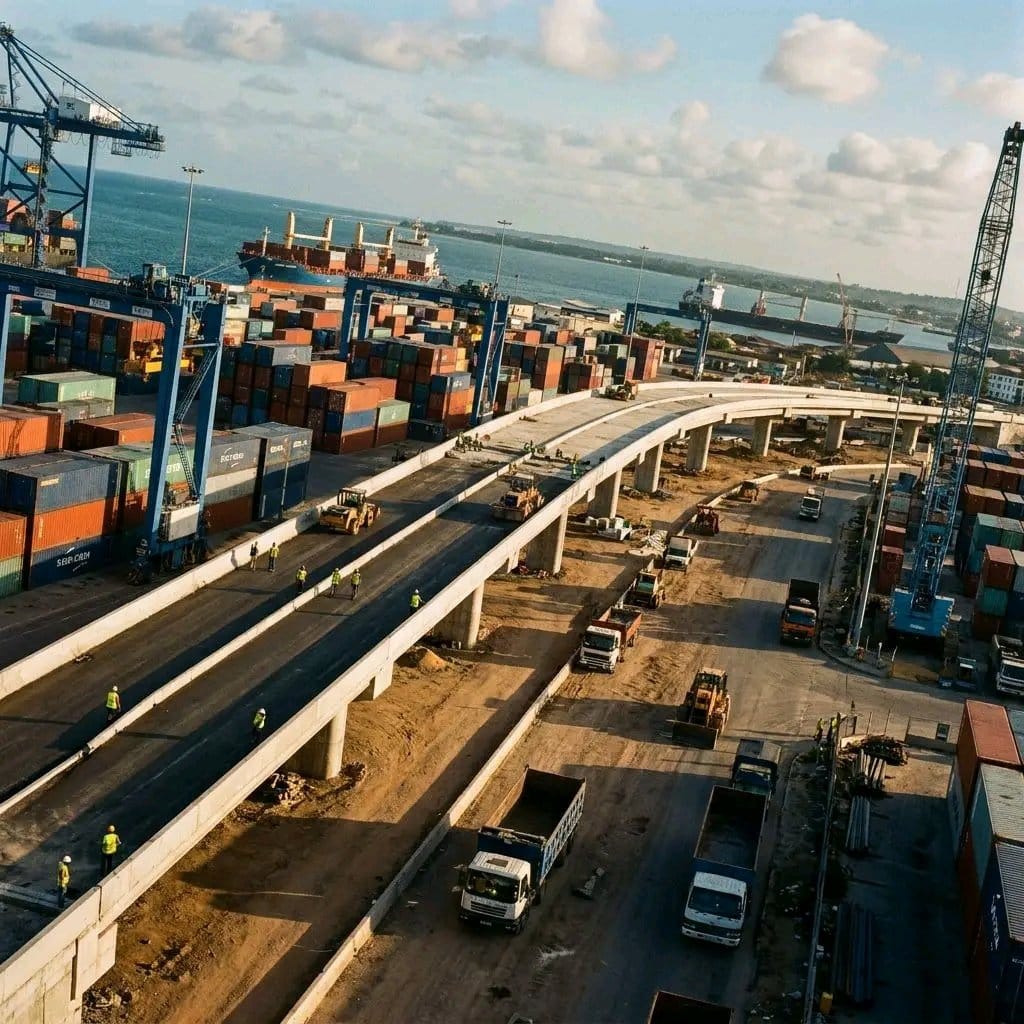
In the crowded theatre of East African logistics, all eyes usually fix on Dar es Salaam and Mombasa. Congestion, dredging dramas, and regional rivalry dominate headlines. Yet a quieter transformation on Tanzania’s northern coast deserves closer attention. Tanga Port has just quadrupled its annual cargo capacity—from roughly 0.75 million tonnes to 3 million tonnes—after a government-funded expansion exceeding TZS 429 billion (about $170 million).
A new 456-metre berth, a deepened entrance channel and turning basin (now reaching about 13 metres), and upgrades to the original berths (previously totalling around 450 metres) have turned a historically constrained facility into one capable of receiving larger ocean-going vessels directly from international markets. No more routine transshipment via Dar es Salaam for northern Tanzania traffic. A further 300-metre berth is already planned, with longer-term ambitions to push capacity higher still.
This is not merely an infrastructure upgrade. It is a strategic rebalancing of East Africa’s maritime geography.
From Barge Dependency to Direct Calls
For decades Tanga operated as a secondary, almost residual port. Shallow drafts forced larger ships to anchor offshore and lighter cargo by barge—an inefficient, costly process that limited scale and raised handling fees. The recent works, executed in phases and involving China Harbour Engineering Company (CHEC) among others under the broader Belt and Road framework, eliminated that bottleneck. Large vessels from the United States, China, and elsewhere can now berth directly. Turnaround times have fallen sharply—reports cite drops from eight to ten days toward three to five days in some accounts—and throughput has surged. In the 2025/26 financial year the port handled roughly 1.7 million tonnes and 616 vessels, far exceeding earlier targets, with revenue collections rising dramatically.
Rail links that had been dormant for two decades have also resumed, improving connectivity to inland Tanzania and neighbours. The port now serves not only northern Tanzania’s agricultural and mineral belts—Kilimanjaro, Arusha, and Manyara—but increasingly acts as an alternative gateway for Uganda, Rwanda, Burundi, parts of the DRC, and even Malawi fuel imports seeking to avoid congestion elsewhere.
The Regional Implications
East Africa’s trade corridors have long been dominated by two axes: Mombasa for the northern corridor and Dar es Salaam for the central corridor. Capacity constraints, rising costs (including security levies at times), and occasional political friction have encouraged diversification. Tanga’s expansion inserts a third, underutilised option precisely where demand is growing—northern Tanzania’s agricultural exports, potential energy logistics linked to the East African Crude Oil Pipeline (EACOP), and transit cargo seeking lower congestion premiums.
For supply-chain planners the lesson is practical. Congestion is often the binding constraint, not absolute distance. Secondary ports with spare capacity and improving hinterland links can deliver faster, more predictable door-to-door times even if the maritime leg is marginally longer. Tanga’s growth also strengthens Tanzania’s bargaining position in regional logistics competition and supports the country’s broader push to become a multi-port hub rather than a single-port dependency.
Government funding of the expansion—rather than heavy reliance on pure private concession models—reflects a deliberate public-sector bet on strategic infrastructure. Early returns in revenue and vessel calls appear to validate the outlay, prompting plans for additional berths and dry-port development to absorb the next wave of volume. Projections under Tanzania Ports Authority plans point toward 4.5 million tonnes by 2030/31 if growth continues.
Risks and Realities
Capacity on paper is not the same as sustained, competitive throughput. Success will depend on hinterland infrastructure—roads, the planned Tanga–Arusha–Musoma standard-gauge railway segments, efficient customs, and reliable power and labour. Dry ports and private-sector storage partnerships will be essential to prevent the new berths from simply shifting congestion from quay to gate. Regional politics and competing investments at Mombasa and Dar will continue to shape cargo routing decisions. And while Chinese contractors delivered the physical works efficiently, long-term operational excellence, maintenance discipline, and commercial marketing of the port remain Tanzanian responsibilities.
There is also the classic secondary-port risk: underutilisation if shipping lines and inland transport operators do not fully adapt networks. Early data showing sharp increases in vessel calls and cargo suggest that adaptation is already underway, but the real test comes when global trade cycles soften or when Dar and Mombasa complete their own expansions.
A Broader Lesson
Tanga’s story is a reminder that logistics advantage often accrues to the ports that escape the glare of intense attention. While Dar and Mombasa fight for regional primacy with multi-billion-dollar programmes, a $170-million focused investment in a quieter location has delivered a fourfold capacity jump and opened new routing possibilities for northern Tanzania and its landlocked neighbours. In an era of supply-chain resilience and corridor diversification, such moves matter.
East Africa’s trade map is no longer a simple two-port contest. Tanga has inserted itself as a credible third node. Whether it becomes a sustained alternative or merely a useful overflow facility will depend on execution over the next five years—further berth construction, rail reliability, digital cargo systems, and aggressive commercial outreach. For now, the quiet expansion on Tanzania’s northern coast is one of the more consequential logistics developments in the region, precisely because so few were watching.
Andrew Mwangura is a maritime safety analyst and editor of the Maritime Business Review.