


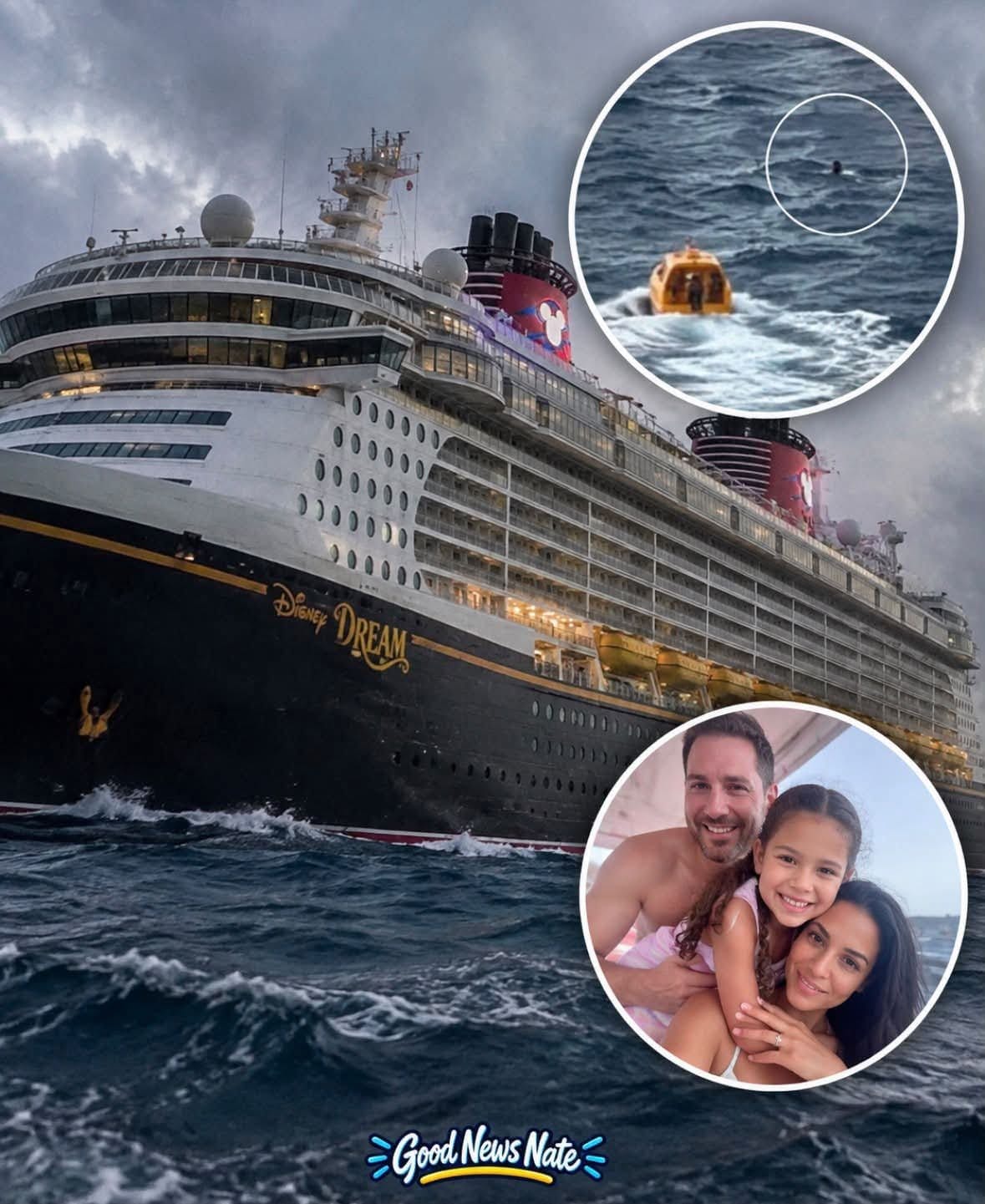
On a bright Sunday morning in late June 2025, a five-year-old girl fell nearly fifty feet from the fourth deck of the Disney Dream into the open ocean. Her father jumped after her. For roughly twenty minutes they treaded water as a massive cruise ship turned around. Both survived. The father suffered two spinal fractures. The mother, who had encouraged the child to pose on a railing for a photo, faced investigation but no charges.
The story is true, dramatic, and already the stuff of viral inspirational posts. It also reveals something deeper and less comfortable about parental judgment, cruise-ship design, and a culture that prioritizes the perfect picture over the ordinary duty of care.
The sequence is now established by police reports, security footage, and passenger accounts. The family was on Deck 4—a promenade with a jogging track, shuffleboard, and open portholes—while the ship steamed from the Bahamas toward Port Everglades. The mother directed her daughter onto the railing. The child sat, lost her balance, and fell backward through the opening. The father, about ten feet ahead, did not see the fall. He heard his wife scream, spotted the child in the water, and approximately forty-five seconds later jumped. He lost visual contact amid the waves, called her name, found her by her replies, and held her afloat until a rescue tender reached them. The girl’s slight frame had not triggered the ship’s man-overboard sensors; the father’s jump did.
Disney’s crew performed competently. The ship slowed, turned, launched a tender, and recovered both within minutes of the father’s entry into the water. That efficiency deserves recognition. Modern cruise ships are engineered with high railings, glass barriers in many areas, and trained response teams precisely because falling overboard is almost always fatal. This rescue was the rare exception. Yet competence after the fact does not erase the conditions that made the fall possible.
Deck 4 on the Disney Dream contains open porthole-style openings that are not uniformly protected by the same barriers found elsewhere on the vessel. The mother later told investigators she assumed they were enclosed like other photo spots she had used. That assumption proved catastrophic. Cruise lines market themselves as floating family fortresses. They sell the illusion of controlled magic. When a five-year-old can climb onto a railing and drop forty-nine feet because a parent wanted a photograph, the illusion cracks. The industry’s safety protocols are robust once someone is in the water; they are less rigorous about preventing the moment of temptation itself.
The father’s action was extraordinary. Leaping nearly fifty feet into open ocean without flotation, without certainty of finding the child, and with full knowledge of the physical risk is the definition of parental courage. He fractured his spine doing it. Most people would freeze. He did not. That instinct deserves unambiguous praise. At the same time, the episode forces a harder question: how many near-tragedies are required before parents internalize that a cruise ship is not a playground, and a railing is not a prop?
Social media has trained a generation to treat every scenic moment as content. The desire for the “perfect shot” has repeatedly placed children in precarious positions—on cliffs, on ledges, on the edges of moving vehicles. In this case the platform was a Disney cruise, an environment marketed as safe enough for the most risk-averse parents. The gap between marketing and reality is not merely cosmetic. It is a design and cultural failure. When a mother can place her child on an open railing without immediate correction from nearby adults or crew, the culture of the ship has already drifted.
Prosecutors correctly declined to charge the mother with child neglect. The act was reckless but not malicious, and the family had already paid a steep price in trauma and physical injury. Criminalizing every parental misjudgment would be both unjust and impractical. Yet declining charges should not be mistaken for absolution. The fall was avoidable. A five-year-old does not belong on a ship railing. The mother’s decision created the hazard; the father’s courage mitigated it. Both truths can coexist.
Broader implications follow. Cruise lines should re-examine every open aperture accessible to children and install physical barriers that make posing on railings mechanically difficult. Parents should treat “just one photo” as the first step toward a potential catastrophe rather than an innocent request. And the rest of us should resist the urge to flatten this story into pure heroism. The father’s leap was heroic. The conditions that required the leap were not inevitable. They were the product of design choices, parental judgment, and a cultural preference for the image over the risk.
In the end, two people came home. That is the only outcome that truly matters. But the next family on Deck 4 will face the same railings, the same open views, and the same temptation to capture the moment. Whether they treat that moment with greater caution will determine if this story remains a singular miracle or becomes a cautionary template. The ocean does not negotiate. Neither should we.
Andrew Mwangura is a maritime safety analyst and editor of the Maritime Business Review.