


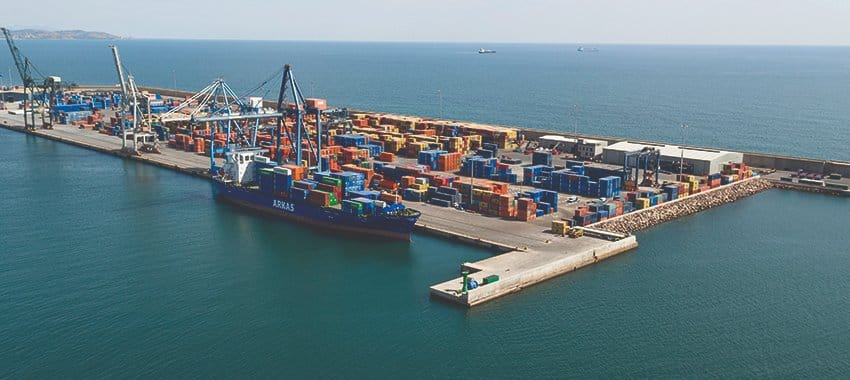
In late October 2026, Congo Terminal completed structural works on a major new refrigerated container yard at the East Mole platform in Pointe-Noire. The facility adds 24 reefer gantries and 1,680 power connections, lifting the terminal’s total reefer capacity from 1,869 to 3,549 plugs. On its face, this is a technical upgrade—more sockets for temperature-controlled containers. In reality, it is a strategic statement about the future of trade, food security, and regional logistics in Central Africa.
Congo Terminal, the exclusive container and ro-ro operator at the Autonomous Port of Pointe-Noire and a subsidiary of Africa Global Logistics (AGL), has steadily transformed the port since taking the concession in 2009. Throughput has grown from roughly 200,000 TEU in the early years of the concession to more than 1.2 million TEU by 1 October 2026—an increase of about 11 percent year-on-year—with a full-year target of 1.3 million TEU. Three new regular services from Maersk, CMA CGM, and MSC have deepened connectivity, and the terminal routinely handles large vessels at rates around 27 moves per hour. The East Mole project, a 750-metre fully electric quay expected in 2027, is designed to roughly double overall capacity. The reefer expansion is not a side project; it is an integral part of positioning Pointe-Noire as a genuine regional hub capable of serving the Democratic Republic of Congo, Cameroon, Angola, Gabon, and beyond.
Why Reefer Capacity Matters More Than Headline TEU Numbers
Refrigerated and frozen cargo—poultry, fish, meat, dairy, pharmaceuticals, and certain agricultural products—is among the fastest-growing and highest-value segments of African trade. Demand for imported frozen protein has risen sharply across Central Africa as urbanization, rising incomes, and changing diets outpace local production and cold-chain infrastructure. Importers and distributors have repeatedly pointed to plug shortages as a constraint; earlier expansions in 2025 already pushed Congo Terminal toward the largest reefer park on the West African coast. The latest jump to 3,549 connections directly addresses that bottleneck and signals that Pointe-Noire intends to capture a larger share of temperature-sensitive flows rather than merely handling dry containers.
Effective cold-chain management is not glamorous, but it is decisive. Temperature excursions destroy product value, raise food-safety risks, and erode trust among importers and retailers. By expanding dedicated reefer infrastructure at the port itself, Congo Terminal reduces dwell times, improves reliability, and lowers the effective cost of bringing perishable goods into the region. Operations Director Emmanuel Addo has framed the investment as a direct response to evolving sub-regional needs and a reinforcement of the terminal’s role in the cold chain. That assessment is accurate. Ports that treat reefer capacity as an afterthought lose high-value traffic to better-equipped competitors; those that invest early lock in long-term relationships with shipping lines and cargo owners.
The Broader Strategic Context
Pointe-Noire’s geography is both opportunity and constraint. As Congo’s primary deep-water gateway and a natural transshipment point for landlocked or poorly connected neighbors, the port sits at the intersection of Atlantic shipping lanes and Central African demand. Yet the region’s logistics remain fragmented, with weak hinterland connections, limited inland cold storage, and competition from other West and Central African ports that are also modernizing. Congo Terminal’s successive investments—hundreds of millions of euros since 2009 in equipment, training, and now the East Mole—reflect a deliberate bet that reliability, scale, and specialized capacity (including reefers and eventually shore power and electric operations) will differentiate Pointe-Noire.
The timing is favorable. Global shipping lines continue to deploy larger vessels on Africa services and seek efficient hubs that can turn ships quickly while offering ancillary services. A port that can reliably power and handle large numbers of reefers becomes more attractive for both direct calls and transshipment. At the same time, African governments and private operators are under pressure to improve food security and reduce post-harvest and post-import losses. Cold-chain infrastructure at the port is one of the highest-leverage interventions available.
Risks and Realities
Capacity expansion alone does not guarantee success. The new plugs must be matched by reliable power supply, efficient yard management, skilled labor, and seamless integration with the still-under-construction East Mole quay. Hinterland logistics—road, rail, and inland depots—remain weaker than the maritime interface. If cargo cannot move efficiently out of the terminal, the expanded reefer park risks becoming a high-cost parking lot. Governance, customs efficiency, and political stability in the broader corridor will also determine whether Pointe-Noire captures the full potential of its investments or merely accommodates existing traffic at higher cost.
Competition is real. Other ports along the Atlantic coast are expanding, and shipping lines retain significant bargaining power. Congo Terminal’s exclusive position gives it leverage, but exclusivity also concentrates risk. Sustained performance on productivity, transparency, and customer service will matter as much as steel and sockets.
A Quiet but Consequential Signal
Infrastructure stories in Africa are often told in grand terms of transformation. Congo Terminal’s reefer expansion is quieter and more incremental: another set of gantries, another tranche of plugs, another step in a multi-year modernization program. Yet incremental capacity of this kind compounds. Each additional reliable reefer connection lowers friction for importers of protein and pharmaceuticals, strengthens the business case for regular liner services, and reinforces Pointe-Noire’s claim as Central Africa’s most capable container hub.
The completion of structural works in October 2026 is therefore less a finished achievement than a marker. It shows that the operator continues to match ambition with capital and execution. If the East Mole arrives on schedule in 2027 and the expanded cold-chain capacity is fully utilized and efficiently managed, Pointe-Noire will have materially improved its competitive position. In a region where reliable cold chains remain scarce, that is no small contribution to trade, food security, and economic integration.
The real test will not be the number of plugs commissioned, but whether cargo owners, shipping lines, and neighboring economies treat Pointe-Noire as the preferred gateway for temperature-sensitive trade. On present evidence, Congo Terminal is doing the hard, unglamorous work required to make that outcome more likely.
Andrew Mwangura is a maritime analyst and editor of the Maritime Business Review .