


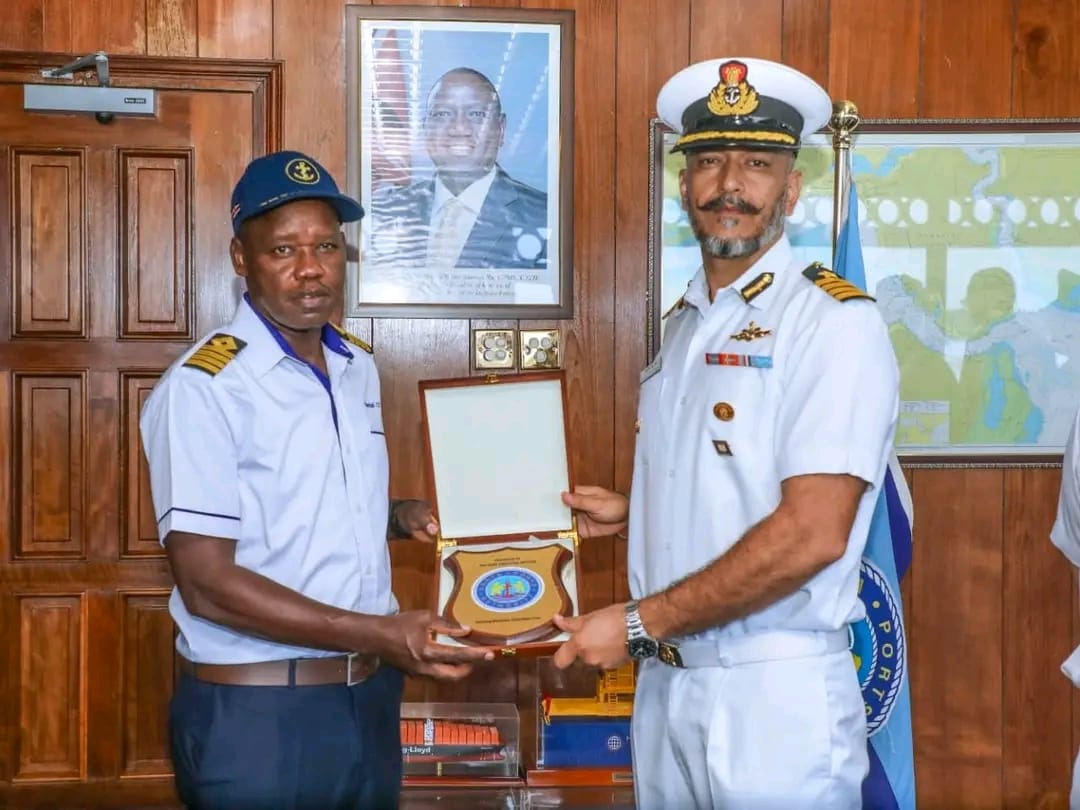
When a delegation from the Indian Coast Guard, led by Commandant Ramanjeet Singh Rana of ICGS Varaha, visited the Port of Mombasa and publicly commended its strategic role in trade facilitation and maritime security along the Indian Ocean coast, the moment was more than diplomatic protocol. It reflected a sustained, practical deepening of India–Kenya engagement that has accelerated in recent years through repeated ship visits, joint exercises, capacity-building initiatives, and high-level staff talks.
The statements made during the visit—reaffirming India’s commitment to joint exercises and knowledge-sharing, underscoring Kenya’s growing importance for regional stability, and expressing mutual interest in training, technology transfer, investment, and institutional development—capture the essence of a relationship that has moved beyond symbolism into operational substance.
The Port at the Centre
The Port of Mombasa is not merely a Kenyan asset; it is the premier maritime gateway for East and Central Africa. It links Kenya to a vast hinterland that includes Uganda, Rwanda, Burundi, South Sudan, eastern Democratic Republic of Congo, and parts of Ethiopia and northern Tanzania. Cargo volumes have climbed steadily, with the port handling record throughput in recent years—over 45 million metric tonnes in 2025 and container traffic exceeding 2 million TEUs—while serving as a critical node for regional trade amid shifting global shipping patterns, including Red Sea disruptions.
Its strategic value lies in both economics and security. Efficient, secure port operations enable trade that sustains millions of livelihoods and underpins regional economic integration. At the same time, the Western Indian Ocean remains exposed to residual piracy risks, illegal fishing, trafficking, and the broader challenges of maritime domain awareness. A well-functioning Mombasa contributes directly to the security of sea lanes that carry a substantial share of global commerce and energy supplies.
From SAGAR to MAHASAGAR
India’s approach to this theatre has evolved from the 2015 SAGAR doctrine—Security and Growth for All in the Region—to the broader MAHASAGAR vision: Mutual and Holistic Advancement for Security and Growth Across Regions. The shift expands both the geographic and thematic aperture, encompassing capacity building, technology sharing, blue-economy cooperation, and partnerships across the Global South, while retaining a core focus on a rules-based, inclusive maritime order in the Indian Ocean.
Kenya sits at a natural intersection of these priorities. As a maritime neighbour and a key East African partner, it offers both operational relevance and political alignment. Repeated Indian Navy and Coast Guard port calls in Mombasa—ICGS Varaha in 2024; ICGS Sachet and the First Training Squadron in 2025; and INS Trikand and INS Tarkash in 2026—have been accompanied by Passage Exercises (PASSEX), professional exchanges, pollution-response demonstrations, cultural outreach, and tangible support such as equipment handovers and medical capacity projects. The inauguration of India–Kenya Navy Staff Talks further institutionalises the relationship.
These interactions build interoperability and trust. They also signal that India views Kenya not as a peripheral partner but as a central node in its Western Indian Ocean engagement.
Mutual Interests, Shared Dividends
For Kenya, the partnership delivers practical gains: training opportunities, exposure to advanced operational practices, potential technology and investment flows into port and maritime infrastructure, and an enhanced ability to secure its own maritime zones and contribute to regional stability. The Kenya Ports Authority’s interest in collaborative capacity-building and professional development aligns directly with these offers.
For India, a stable and capable Kenya strengthens the security of critical sea lanes, diversifies partnerships beyond traditional island states, and advances the MAHASAGAR objective of holistic engagement that links security with economic growth. A prosperous, secure East African littoral benefits Indian trade, diaspora interests, and broader strategic positioning in an increasingly contested Indian Ocean.
The economic dimension is already visible. Bilateral trade, while imbalanced, is significant, and recent customs cooperation agreements aim to improve information exchange and supply-chain efficiency. Port modernisation, Special Economic Zones, and logistics corridors create openings for Indian investment and technology in areas ranging from digitalisation to skills development.
Strategic Context Without Overstatement
Major-power competition in the Indian Ocean is real. China’s presence through commercial and infrastructure engagements, including interest in East African ports, forms part of the background. Yet framing every Indian ship visit primarily as counterbalancing risks reducing a multifaceted relationship to zero-sum logic. India–Kenya cooperation is driven first by shared functional interests—trade security, capacity gaps, and the practical benefits of interoperability—rather than solely by external rivalry. The emphasis on knowledge-sharing, joint training, and institutional development is consistent with a partnership model that prioritises mutual capability over exclusive alignment.
Challenges remain. Sustaining momentum requires consistent political attention, adequate resources for training and equipment, and careful management of domestic priorities on both sides. Port efficiency gains must be matched by hinterland connectivity and governance improvements if regional benefits are to scale. Environmental pressures on the coastal and marine ecosystem also demand attention as cargo volumes rise.
Looking Ahead
The Indian Coast Guard’s recognition of Mombasa’s dual role in trade and security is accurate and timely. It points to a partnership that has matured from occasional goodwill visits into a pattern of regular, purposeful engagement. If both sides continue to translate high-level statements into concrete programmes—expanded training pipelines, joint maritime domain awareness initiatives, blue-economy projects, and deeper commercial linkages—the relationship can deliver durable dividends for regional stability and prosperity.
In an Indian Ocean that is simultaneously a highway of commerce and a theatre of strategic competition, practical cooperation between India and Kenya at places like Mombasa offers a constructive model: one rooted in shared geography, complementary strengths, and a common stake in safe, open, and productive seas. The commendation delivered on the quayside was not the end of the story; it was another marker on a longer voyage.