


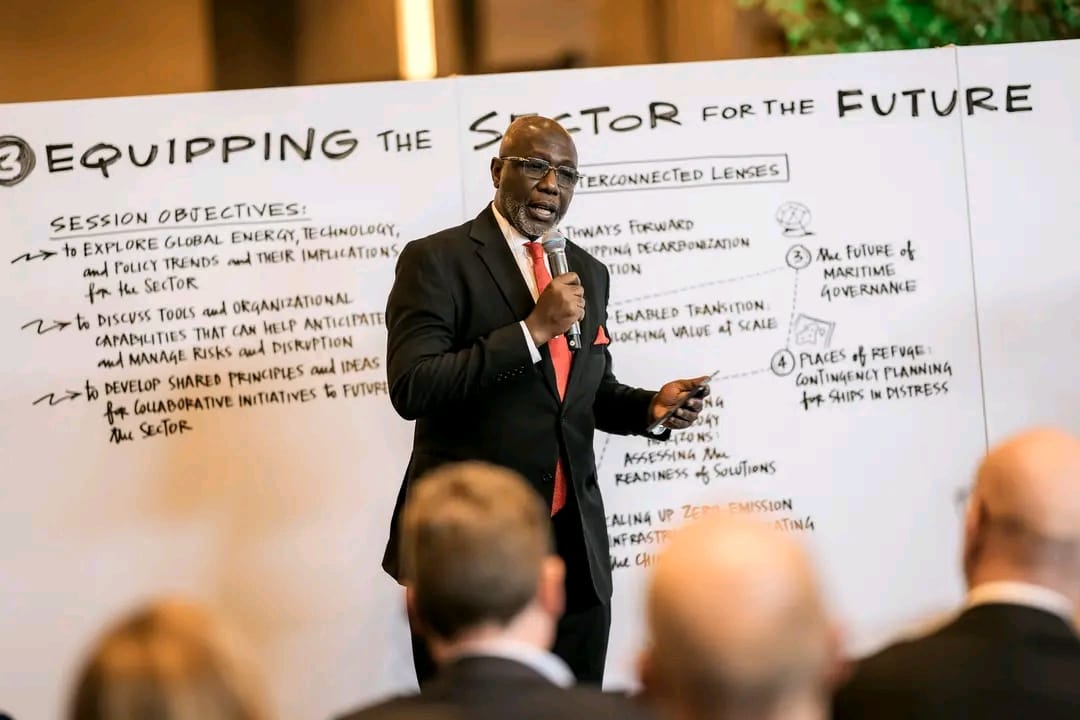
The Global Maritime Forum’s Annual Summit 2026 has just concluded in Shanghai—the first time the gathering has been held on the Chinese mainland. Under the theme “Shared Seas, Shifting Horizons,” roughly 200 senior decision-makers from shipping, ports, energy, finance, insurance, shipbuilding, and regulation convened to confront a sector under simultaneous pressure from geopolitical rupture, macroeconomic uncertainty, and the unfinished business of decarbonisation.
Among the participants was Dr. Kamal-Deen Ali, Director-General of the Ghana Maritime Authority (Naval Captain Rtd., PhD). The Authority’s post-summit message captured the essential takeaway: strategic dialogues with the Getting to Zero Coalition, discussions on the regulatory frameworks needed to drive shipping toward net-zero, and the strengthening of international alliances that align global policy with regional implementation. The closing note was unambiguous—“Dialogue is essential, but execution is everything.” Ghana, the Director-General affirmed, remains committed to converting these conversations into concrete, measurable action for sustainable global trade.
That formulation is not diplomatic boilerplate. It is the central tension facing the maritime industry today.
A Sector at a Crossroads
The summit took place against a backdrop of regulatory delay. The International Maritime Organization’s Net-Zero Framework—intended to give the industry a predictable investment signal toward its 2050 goal—has faced postponement and continued negotiation. Progress reports from the Getting to Zero Coalition and its partners show the industry is off-track for 2030 interim targets on scalable zero-emission fuels.
Green shipping corridor initiatives have expanded, now numbering more than 80 globally, with growing participation from China, India, Brazil, and African countries including Ghana. Yet many remain stuck behind a “feasibility wall” created by the cost gap between conventional and zero-emission fuels. First-mover activity continues, but systemic scale requires a policy certainty that has not fully materialised.
China’s role as host was deliberate—and consequential. The country accounts for a dominant share of global shipbuilding and operates some of the world’s largest ports, with Shanghai Port itself retaining its position as the busiest container port for consecutive years. The summit’s location therefore reflected both commercial reality and the recognition that any credible global transition must engage Chinese industry, finance, and policy at scale. Sessions on re-energising green corridors explicitly examined China’s capacity to build infrastructure quickly and at volume, alongside the need for international first-movers to maintain momentum.
Yet the deeper value of the gathering lay in its cross-geography character. African maritime authorities, including Ghana’s, sat at the same tables as European, Asian, and American counterparts. For developing maritime nations, the stakes are distinct: the energy transition cannot become another layer of exclusion. Ports, fleets, and coastal economies in West Africa must be equipped to participate in, rather than merely adapt to, the emerging low- and zero-emission order. That requires technology transfer pathways, financing instruments sensitive to different capital costs, and regulatory frameworks that do not inadvertently penalise smaller operators or less mature markets.
Ghana’s Position and the Implementation Imperative
Dr. Ali’s presence and the Authority’s subsequent messaging reflect a consistent national posture. In the weeks surrounding the summit, the Ghana Maritime Authority has been driving practical work on Maritime Single Window implementation and the integration of existing digital systems—customs, vessel traffic, and port community platforms—across West and Central African partners. The emphasis has been on moving beyond ratification of international instruments toward measurable operational improvement: faster vessel clearance, reduced transaction costs, and better coordination among agencies. This is the same logic applied to decarbonisation: international commitments matter only insofar as they produce visible results in ports, on ships, and in the livelihoods of seafarers and coastal communities.
Ghana’s maritime administration has long treated security, trade facilitation, and environmental stewardship as interconnected. The Blue Economy agenda, maritime domain awareness, and alignment with IMO conventions have been pursued in parallel. The Shanghai discussions on zero-emission pathways and regulatory design therefore fit a broader pattern: African states must shape the rules and the partnerships rather than receive them as finished products.
What Execution Requires
Several concrete implications follow.
First, the Getting to Zero Coalition and similar multi-stakeholder platforms must translate corridor concepts into bankable projects that include African ports and routes. Green corridors that stop at major Asian or European hubs will leave the continent’s trade arteries on conventional fuels longer than necessary and will concentrate the economic benefits of new fuel production and bunkering infrastructure elsewhere.
Second, the eventual IMO framework—whatever its final shape—must be designed for global inclusivity. Predictable carbon pricing or fuel-intensity measures, reward mechanisms for early movers, and equitable transition support are not optional add-ons; they determine whether capital flows to the entire value chain or only to the best-resourced segments.
Third, national authorities in Africa need to treat digitalisation, safety, and decarbonisation as a single operational agenda. Integrated Maritime Single Windows, modern vessel traffic systems, and port community platforms are enablers of both trade efficiency and emissions monitoring. Countries that build these systems now will be better positioned to participate in green corridor schemes and to meet future reporting and compliance requirements.
Fourth, the industry’s own first-movers must maintain pressure for policy clarity while continuing commercial deployments. Delay at the regulatory level does not suspend the physical reality of fleet turnover cycles or the growing preference of some cargo owners for lower-emission transport options. The risk is a fragmented landscape of regional measures that raises costs without delivering equivalent environmental gains.
Shared Seas, Uneven Horizons
The Shanghai summit’s theme captured the moment accurately. The seas remain shared; the horizons are shifting at different speeds depending on geography, capital access, and institutional capacity. Dialogue among C-suite leaders and policymakers is necessary to surface these differences and to design collaborative responses. But as the Ghana Maritime Authority correctly insists, dialogue without execution is theatre.
Ghana’s commitment to measurable action is therefore more than a national statement. It is a test of whether the global maritime community can move from high-level consensus in conference halls to operational reality in African ports and along the trade routes that connect the continent to the world. The next phase of the energy transition will be judged less by the quality of the conversations in Shanghai and more by the presence or absence of zero-emission vessels, green bunkering infrastructure, and functioning digital systems in places like Tema, Takoradi, and the wider West African maritime domain.
Execution is everything. The industry now has to prove it can deliver.