


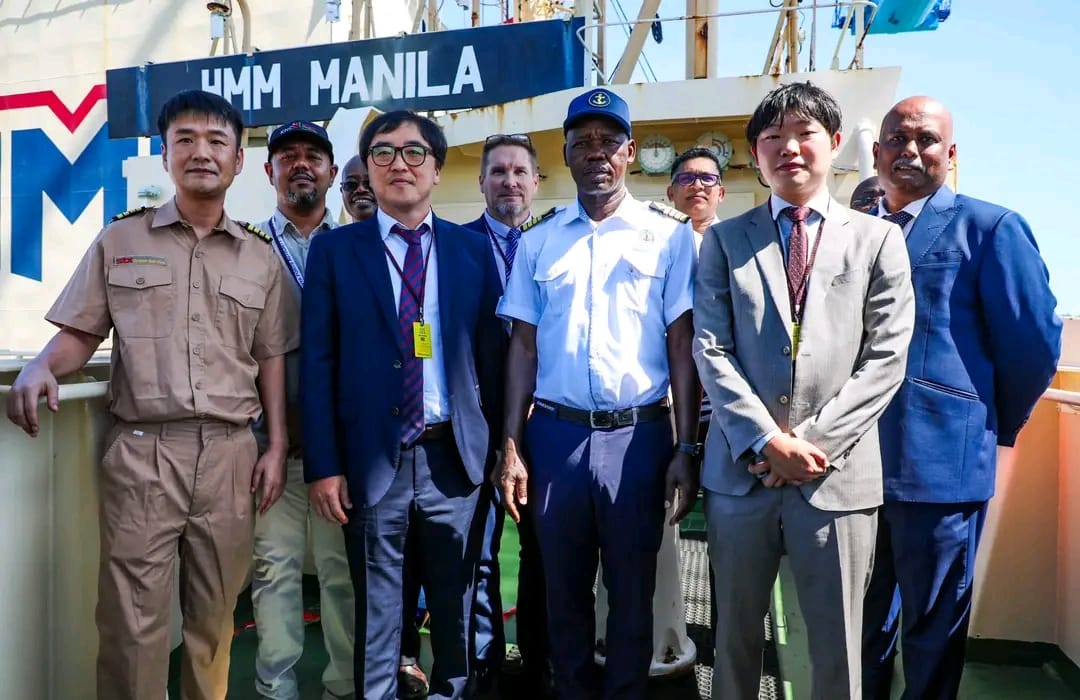
On Wednesday, the Kenya Ports Authority (KPA-PLC) marked more than the arrival of another container ship. The maiden call of HMM Company Limited’s vessel under the Gulf India Africa (GIA) Service served as a public signal that one of the world’s major carriers is once again betting on the Port of Mombasa. In an industry that votes with schedules and capacity, that decision carries weight.
The vessel’s weekly rotation—Nhava Sheva–Mundra–Mombasa—joins five other partner lines on the Asia–East Africa corridor. Captain William Ruto, KPA-PLC’s chief executive, used the occasion to present a commemorative plaque to the ship’s master, Captain Cha Myeong Cheol, and to frame the call in strategic terms: confidence in Kenya’s role as a regional trade and logistics hub, and the strengthening of commercial ties linking Asia, the Middle East and East Africa. Those are not empty phrases. They point to the quiet contest among Indian Ocean ports for the next decade of Asian and Middle Eastern cargo bound for the continent’s fastest-growing markets.
Why This Call Matters
Shipping lines do not add or restore services out of sentiment. They do so when volumes justify the commitment, when dwell times and berth productivity are predictable, and when hinterland connections—road, rail and inland container depots—can move boxes inland without turning the port into a costly warehouse. HMM’s return under the GIA service suggests that Mombasa has improved enough on these metrics to compete for Asia–East Africa traffic that might otherwise divert to Dar es Salaam, Djibouti or even further afield.
The service’s design is revealing. By anchoring the rotation on India’s two largest container ports and terminating in Mombasa, it directly serves the growing India–East Africa trade while offering Kenya and its neighbours additional capacity and schedule reliability. For importers of machinery, chemicals, textiles and consumer goods, and for exporters of tea, coffee, horticulture, minerals and re-exports, another weekly string is not a luxury. It is a hedge against congestion, a source of competition that can discipline freight rates, and a practical contribution to the volumes needed to keep the Standard Gauge Railway and the Northern Corridor competitive.
The Broader Contest
Mombasa’s position as the principal gateway for Kenya, Uganda, Rwanda, South Sudan, eastern DRC and parts of northern Tanzania has never been guaranteed. For years the port laboured under the perception—and sometimes the reality—of delays, high costs and opaque processes. Competitors invested heavily. Dar es Salaam expanded capacity and simplified procedures. Djibouti leveraged its proximity to Ethiopia. Even smaller players courted niche cargoes.
Against that backdrop, every restored or new service is evidence that reforms are registering with the people who decide where ships call. KPA-PLC’s emphasis on operational efficiency is not accidental. Modern terminal equipment, better yard planning, digitised documentation and closer coordination with the Kenya Revenue Authority and other agencies have begun to shorten the time between a ship’s arrival and the release of its cargo. The GIA service is a market test of those gains. If the vessel consistently meets its schedule and if cargo moves inland at competitive cost, other carriers will notice.
The Korean presence at the ceremony—HMM’s managing director and a diplomat from the Embassy of the Republic of Korea—also underscores a quieter diplomatic and commercial reality. South Korea is a significant investor and technology partner in the region. A reliable shipping link is infrastructure for that relationship as much as it is infrastructure for containers.
Opportunities and Conditions
The upside is clear. Additional capacity supports Kenya’s manufacturing and agricultural exporters seeking Asian markets. It gives regional traders more options and reduces the risk of being captive to a single carrier’s network. It reinforces Mombasa’s claim to be the natural hub for the Northern Corridor under the African Continental Free Trade Area. And it generates the volumes that justify further investment in the port, the railway and the inland logistics chain.
Yet the celebration should be tempered by realism. One weekly service does not erase structural challenges. Congestion can return if yard density rises faster than evacuation capacity. Inland transport costs and delays still erode the port’s competitiveness for time-sensitive cargo. Non-tariff barriers and unpredictable regulatory interventions remain a concern for shippers. And competition will intensify: other East African ports will continue to modernise, and new capacity on the Indian Ocean rim will keep pressure on rates and service quality.
Sustaining the confidence that HMM has shown will require KPA-PLC and its partners to treat efficiency as a continuous discipline rather than a one-time achievement. Transparent performance data, predictable berthing windows, reliable rail and road evacuation, and a regulatory environment that prioritises speed without sacrificing revenue or security will determine whether Wednesday’s ceremony becomes a footnote or the start of a sustained recovery in market share.
A Signal Worth Heeding
In the end, the return of HMM is less about a single ship and more about the quiet arithmetic of global logistics. Carriers allocate scarce vessels where they expect the best combination of volume, reliability and cost. By choosing Mombasa for a new Asia–East Africa string, HMM has delivered a public vote of confidence in the port’s trajectory. Kenya’s challenge is to treat that vote as a beginning, not a conclusion—and to ensure that the next time a major carrier evaluates its network, the numbers still point to the Port of Mombasa.