


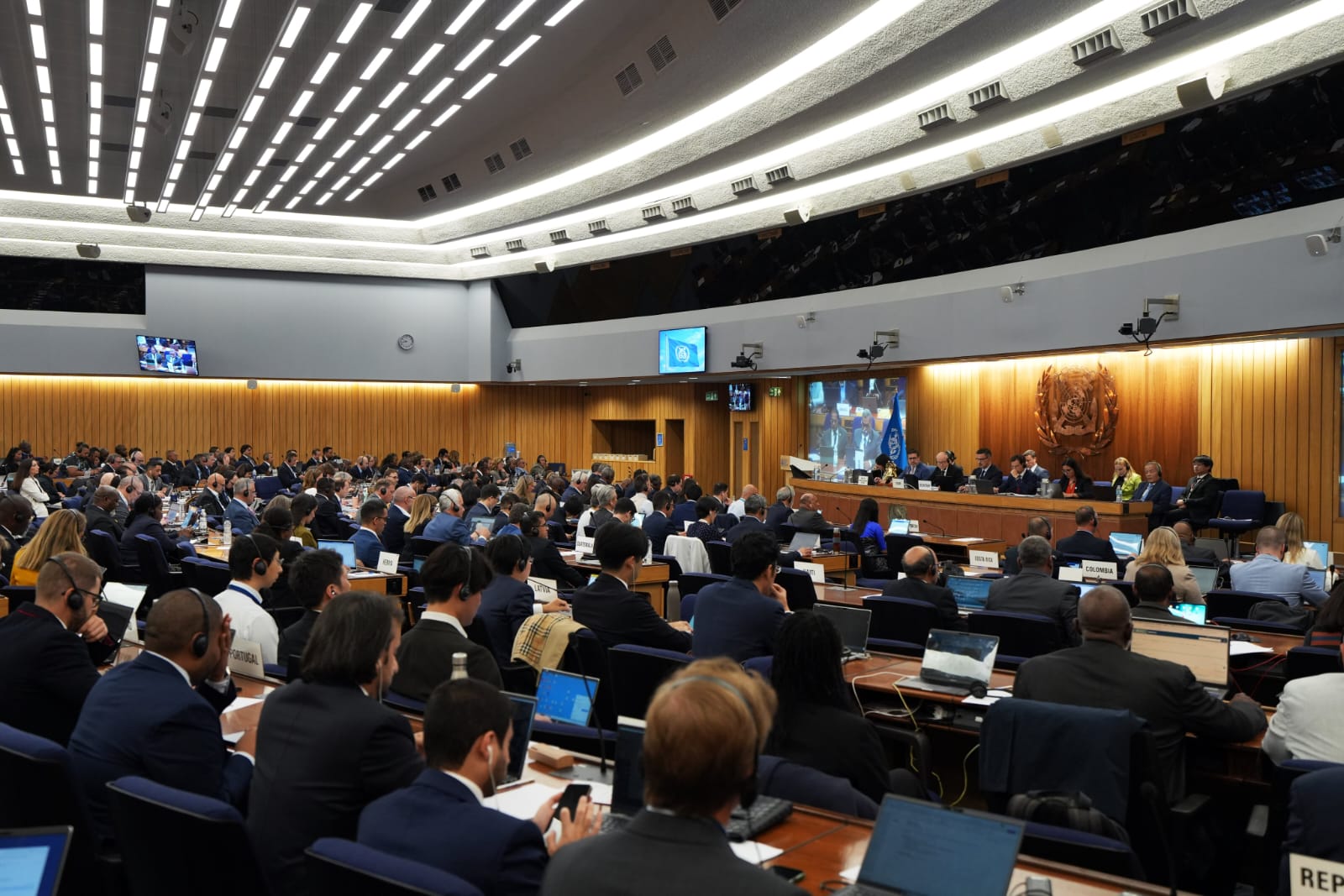
This week, more than a thousand delegates from nearly 180 countries, industry groups, and civil society organisations have gathered at the International Maritime Organization’s headquarters in London for the 22nd Intersessional Working Group on Reduction of Greenhouse Gas Emissions from Ships (ISWG-GHG 22). From 1 to 4 September, they are wrestling with the unfinished business of the IMO’s Net-Zero Framework—a combination of a global fuel standard and an economic measure approved in principle in 2025 but postponed for a year after intense opposition.
The stakes could hardly be higher. International shipping moves more than 80 per cent of global trade by volume and accounts for roughly 2–3 per cent of worldwide greenhouse gas emissions—comparable to the annual output of a major industrialised economy. Under the 2023 IMO GHG Strategy, the sector is supposed to reach net-zero “by or around” 2050, with interim checkpoints of at least 20–30 per cent reduction by 2030 and 70–80 per cent by 2040 relative to 2008 levels. The Net-Zero Framework was meant to turn those ambitions into enforceable rules for ships above 5,000 gross tonnes, which are responsible for more than 85 per cent of the sector’s emissions.
At its core, the Framework pairs a progressive greenhouse gas fuel intensity standard (measured on a well-to-wake basis) with a pricing mechanism. Ships that exceed intensity limits would face charges; those that outperform, especially by using zero- or near-zero emission fuels, could earn rewards. Revenues—potentially in the range of $10–15 billion a year in the early phase—would flow into a Net-Zero Fund to support the energy transition, reward clean fuels, and help climate-vulnerable countries, particularly Small Island Developing States and Least Developed Countries.
That architecture is now under pressure. Competing proposals on the table range from relatively modest phase-in delays (Brazil) to more radical redesigns that would strip out GHG pricing and the associated fund entirely (Liberia). Pacific island nations and others are pushing in the opposite direction, insisting on a robust economic element and an effective fund. European countries have stressed the need for stronger early incentives for genuine zero- and near-zero fuels. The United States and some fossil-fuel producers have long resisted market-based measures they characterise as a “global carbon tax.”
Further delay or dilution would be costly. Every year of uncertainty freezes investment decisions on dual-fuel vessels, alternative fuel production, and port infrastructure. Regional measures, already in force in the European Union through the Emissions Trading System, will continue to proliferate, creating a patchwork of compliance burdens that favours larger operators and complicates trade. Developing countries that depend on maritime transport for food, energy, and export earnings risk higher costs without the compensatory finance a well-designed global fund could provide. And the climate arithmetic is unforgiving: shipping emissions have continued to rise even as carbon intensity has improved, and business-as-usual trajectories point to further growth as trade expands.
The arguments against ambitious action are familiar and, in the main, overstated. Claims that pricing will devastate trade ignore the fact that freight costs are a small fraction of the final price of most goods and that efficiency gains and cleaner fuels will eventually lower operating costs. Concerns about competitiveness are better addressed by a single global standard than by a fragmented landscape of national and regional rules. Equity concerns are real, but the solution is not to abandon the polluter-pays principle; it is to design the Fund so that revenues genuinely flow to those who need them most and support a just transition for seafarers and maritime communities.
ISWG-GHG 22 will not produce a final deal. Another working group session is scheduled for late November, followed by MEPC 85 at the end of November and the possible resumption of the extraordinary session on 4 December. The real test is whether this week’s discussions narrow the gaps enough to make adoption of a credible package possible before the year ends. That requires defending the essential architecture of the Net-Zero Framework: a fuel intensity pathway consistent with the 2023 Strategy, a meaningful price signal, and a Fund that delivers both transition support and climate justice.
Shipping is a global industry. It can only be decarbonised through global rules. The delegates in London this week have the chance to move the sector off the path of incrementalism and onto one that matches the scale of the climate challenge. They should take it. The alternative is more delay, more fragmentation, and a steadily rising contribution from the world’s merchant fleet to a crisis that no nation—least of all the most vulnerable—can afford.