


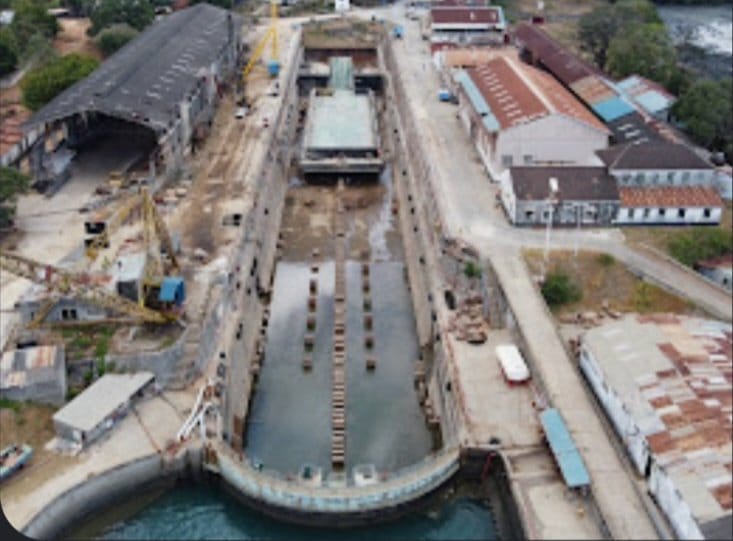
Kenya Shipyards Limited has placed a bold bet on Mombasa. The state-owned corporation has proposed a specialised graving dock at the Port of Mombasa capable of handling vessels between 185 and 285 metres, with the capacity to process up to 32 repair contracts a year. The plan, presented to the National Assembly Committee on Defence, Intelligence and Foreign Relations during an inspection of the Kisumu yard on 6 November 2026, aims to convert a recognised regional shortage into a commercial and strategic advantage.
This is more than incremental capacity expansion. It is an attempt to reposition Kenya from a peripheral player in Indian Ocean maritime services into a credible maintenance hub for the commercial fleets that move East African trade, energy, and bulk cargo.
The Gap Is Real
Larger commercial vessels operating in the western Indian Ocean currently face limited options for dry-docking and major hull work. Established yards in the Middle East, South Africa, and parts of Asia absorb most of the traffic. East Africa’s existing facilities are constrained. Kenya Shipyards’ own Mtongwe slipway, commissioned in 2021, handles vessels up to roughly 150 metres and 4,000 tonnes—useful for regional ferries, naval craft, and smaller commercial ships, but inadequate for the mid-to-large container vessels, bulkers, and tankers that dominate long-haul routes.
A graving dock—essentially a watertight basin that can be flooded, closed, and pumped dry—allows full access to the hull, propeller, and underwater systems. Capacity for 185–285-metre ships would place Kenya in the range of many of the vessels that call at Mombasa, Lamu, and neighbouring ports, or that transit the region. The projected jump from a handful of simultaneous repairs to 32 contracts annually signals an intent to capture recurring maintenance work rather than occasional emergency calls.
The timing coincides with broader port pressures. World Bank assessments have flagged congestion and operational inefficiencies at Mombasa. Simultaneously, the Kenya Ports Authority continues expansion—new berths, digitisation, and private investment through public-private partnerships. Repair capacity that reduces vessel downtime and keeps ships in the region rather than diverting them thousands of miles is a logical complement.
Existing Private Capacity in Mombasa
Any serious discussion of Mombasa’s ship-repair ecosystem must recognise the two long-established private marine engineering companies already operating in the port area.
African Marine and General Engineering Company Limited (AMGECO), founded in 1928 and based at Mbaraki Creek, is the oldest shipyard in the region. It operates what it describes as the only ISO-certified dry dock facility on the East African coast (established in 1977). The main repair dock measures approximately 180 metres and can accommodate vessels of up to around 20,000 tons. AMGECO provides full dry-docking, hull and machinery repairs, steelwork, conversions, shipbuilding of smaller craft, bunkering, berthing, and related marine engineering services. It has long served international owners, regional fleets, and naval clients.
Southern Engineering Company Limited (SECO), established in 1957 and located at Mbaraki Wharf near the Likoni Ferry, is another major Mombasa-based marine and general engineering firm. Its facilities include a dry dock, slipways, extensive steel fabrication and machine shops, blast-and-paint operations, and a 160-metre jetty. SECO specialises in shipbuilding (barges, pilot boats, tugs, ferries, and workboats), dry-docking, major repairs, conversions, and class-approved surveys (including Bureau Veritas accreditation). It has delivered vessels for the Tanzania Ports Authority and other regional operators and undertakes significant marine construction and heavy engineering work.
Together, these two companies already provide the core private-sector platform for ship repair and marine engineering in Mombasa. The proposed Kenya Shipyards graving dock would not start from a blank slate; it would expand the upper end of the size spectrum that local industry can currently handle—moving beyond the roughly 160–180 metre range into the 185–285 metre category needed for many modern commercial vessels.
This private capacity is an asset, not a competitor to be sidelined. A successful large-scale dock will need skilled labour, supply chains, subcontractors, and institutional knowledge that AMGECO and SECO already possess. Collaboration—whether through joint ventures, shared training, complementary specialisation, or subcontracting arrangements—would accelerate readiness and reduce the risk of the new facility becoming an isolated state project.
Strategic and Economic Logic
A successful facility would generate several layered benefits. First, foreign exchange retention and job creation in skilled trades—welding, coating, systems engineering, and project management—plus demand for local steel, coatings, and logistics. Second, reduced costs and turnaround times for Kenyan and East African operators who currently send vessels abroad. Third, greater resilience for the Blue Economy agenda: fishing fleets, coastal shipping, and the growing passenger services that already use both public and private yards in Mombasa. Fourth, dual-use value for Kenya’s naval and coast-guard assets, consistent with Kenya Shipyards’ origins under defence-related oversight.
Kenya Shipyards has demonstrated technical progress since its 2020 establishment. It completed the 100-metre MV Uhuru II for Lake Victoria, invested in fibre-laser cutting and robotic welding, and has attracted commercial work from across the region. Pairing that public capability with the deep private experience embodied by AMGECO and SECO strengthens the overall proposition.
The Hard Questions
Ambition alone does not deliver dry docks. Critical details remain undisclosed: capital cost, financing structure, precise location within or adjacent to the port, environmental and dredging requirements, construction timeline, and operating model. Lawmakers have already noted the corporation’s continued reliance on government funding even while managing a portfolio of projects valued at approximately KSh 6.22 billion. One member pressed for financial independence within two fiscal years—an entirely reasonable demand.
Competition will be fierce. Middle Eastern and Asian yards offer scale, established supply chains, and often more competitive labour or material costs. South African facilities retain regional reputation. Attracting international owners will require not only physical capacity but also predictable quality, classification society approvals, competitive pricing, reliable schedules, and transparent commercial practices. State ownership can help mobilise capital and land; it can also introduce bureaucratic drag and political risk if not carefully managed.
Integration with the broader port ecosystem matters. Repair work must not exacerbate congestion or conflict with commercial berthing priorities. Coordination with the Kenya Ports Authority, clear prioritisation rules, and possibly dedicated access channels will be essential. Environmental safeguards—dredging impacts, sediment management, and waste handling from hull cleaning and coating—cannot be afterthoughts in a sensitive coastal zone.
Skills and institutional capacity form another constraint. Scaling from current operations to industrial volumes of larger vessels demands a deeper bench of certified technicians, project managers, and commercial staff. Partnerships with the experienced local operators already present—AMGECO and SECO—technology-transfer arrangements, or joint ventures may accelerate readiness more effectively than pure organic growth inside a single state entity.
A Realistic Path Forward
Parliament and the executive should treat the proposal as a serious opportunity that still requires rigorous scrutiny. Independent feasibility work covering market demand, competing capacity (both regional and the two established Mombasa private yards), capital and operating costs, and risk allocation is the necessary next step. Financing should lean toward a blend of government seed capital, development finance, and private or strategic partnership equity rather than pure fiscal absorption. Performance-based contracts and clear milestones for commercial viability would align incentives.
If structured correctly—and if it deliberately builds on the existing capabilities of Mombasa’s two main private marine engineering companies, AMGECO and SECO—the dock could become a genuine regional asset. It would support Kenya’s ports, reduce dependency on distant yards, create skilled employment, and reinforce the country’s claim to a larger share of the Indian Ocean maritime economy. If rushed, under-capitalised, or developed in isolation from the private sector already operating in Mombasa, it risks becoming another expensive under-utilised facility.
The Indian Ocean repair market will not wait indefinitely. Vessels will continue to need dry-docking somewhere. Kenya has correctly identified the gap. The test now is whether the country can convert a parliamentary presentation into a bankable, well-executed project that actually captures the work—by combining public ambition with the private engineering depth that already exists on the Mombasa waterfront. Execution will decide whether Mombasa becomes a preferred stop for larger ships—or merely another place that almost was.