


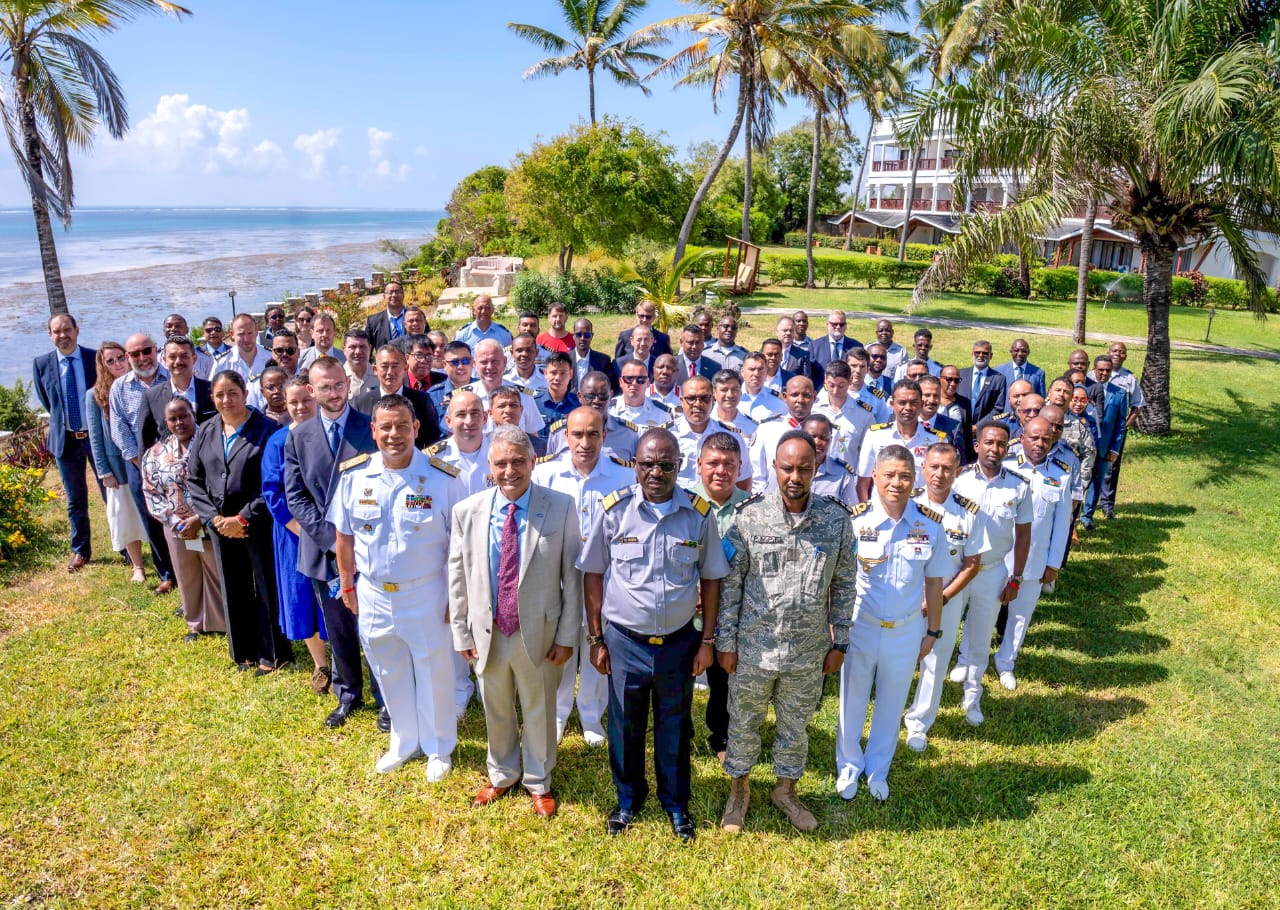
Mohamed Jama’s recent note from the 4th Indo-Pacific Regional Information Sharing (IORIS) Steering Committee Policy Board and Working Groups Meeting in Mombasa is understated in the way serious maritime professionals often are. It records participation, lists the familiar agenda items—Maritime Domain Awareness, operational procedures, port and ship security, Search and Rescue, and the fight against Illegal, Unreported and Unregulated (IUU) fishing—and closes with the ritual hope of stronger partnerships. Yet the gathering, co-hosted by the Kenya Coast Guard Service and the EU’s CRIMARIO project, is not routine. It is a quiet test of whether a region that lives by the sea can finally treat maritime security as a shared operating system rather than a collection of national claims and donor projects.
IORIS began in 2018 as a Western Indian Ocean tool under the EU-funded Critical Maritime Routes Indo-Pacific (CRIMARIO) programme. It has since grown into a neutral, secure, web-based platform used by more than 150 organisations across five continents and over 50 countries. Its purpose is deceptively simple: give maritime centres, navies, coast guards, and agencies a common picture and a common language so that one country’s outgoing threat does not become another’s surprise. In practice, it supports real-time coordination against piracy, illicit trafficking, IUU fishing, and Search and Rescue. Documented results include the accompaniment of more than 130 vessels in the Red Sea, multiple narcotics interdictions (including a Latin American operation that seized over 3,500 kg of cocaine), and several life-saving SAR cases. Technology alone does not produce these outcomes. Trust and routine use do.
Kenya’s decision to host the fourth high-level meeting is therefore strategic rather than ceremonial. The country’s coastline, ports, and exclusive economic zone sit astride critical shipping lanes that have already felt the shock of Red Sea disruptions and the persistent risks of piracy resurgence, asymmetric threats, and resource theft. Interior Cabinet Secretary Kipchumba Murkomen and Kenya Coast Guard Service Director General Bruno Shioso have both framed the problem correctly: the waters are a shared commons and therefore a shared problem. Kenya has integrated its own agencies—navy, coast guard, ports authority, maritime authority—into the IORIS network and has even embedded a local innovation, the Usalama Baharini mobile application, so that fisherfolk become an additional sensor layer. That is the right direction. Local ownership and practical tools matter more than polished communiqués.
Yet the deeper challenge is structural. Maritime domain awareness remains uneven. Many coastal states still struggle with capacity, legal frameworks for information sharing, and the political will to treat data as a collective asset rather than a national secret. Deceptive shipping practices and vessel identity manipulation continue to outpace enforcement. Governance of the platform itself is still maturing through successive Steering Committee, Policy Board, and Working Group cycles that address legal templates, standard operating procedures, technical interoperability, and sustainability. The shift from a project tool to a regionally owned system is unfinished business. Without clear sustainability arrangements and genuine user ownership, even the best platform risks becoming another under-used donor platform once project funding softens.
The Mombasa meeting’s focus on regional leadership, technology against deceptive practices, and platform sustainability is therefore well chosen. Information sharing is not a technical luxury; it is the precondition for timely action. A vessel of interest spotted off one coast can be tracked, interrogated, or interdicted only if the next jurisdiction already sees the same picture and trusts the source. The alternative is the familiar pattern of fragmented responses, delayed warnings, and losses that compound—economic, environmental, and human.
Critics sometimes dismiss these gatherings as talk shops. That critique is only half fair. Talk without operational follow-through is empty. But operational capacity without trusted channels is equally blind. IORIS has already demonstrated that when agencies actually use a shared platform, measurable results follow. The task now is to deepen that habit across the Western Indian Ocean and the wider Indo-Pacific, to close the remaining legal and technical gaps, and to ensure that African and Indian Ocean states are not merely users but co-owners of the architecture.
Jama’s post ends on a note of constructive engagement. That is the right posture. The seas will not become safer because of any single meeting. They become safer when officials leave Mombasa with clearer procedures, stronger personal networks, and a practical commitment to make IORIS part of daily business rather than an occasional exercise tool. In an era of contested sea lanes and rising asymmetric threats, the quiet work of information sharing is one of the few genuinely collective goods available. The question is whether the region will treat it as such.