


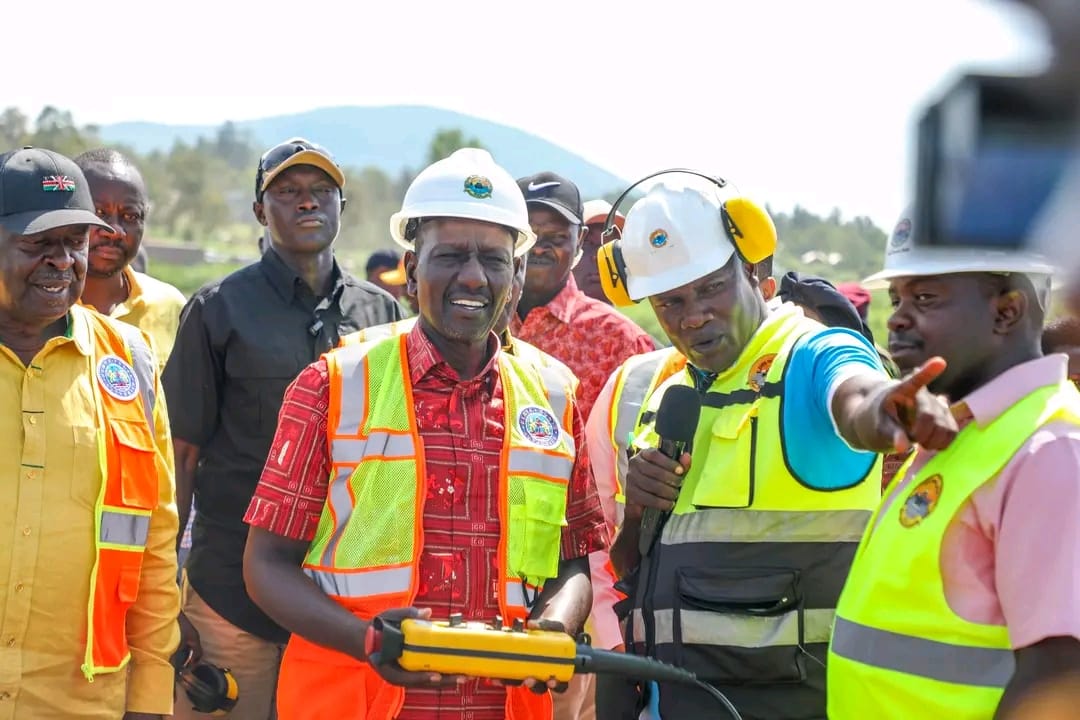
President William Ruto’s recent inspection of the Sh400 million Sio Port project in Funyula, Busia County, was more than a routine progress check. It signals a deliberate shift in how Kenya approaches its western frontier and the shared waters of Lake Victoria. What was once a neglected shoreline is being reimagined as a working artery of regional commerce, fisheries, and connectivity.
The project, implemented by the Kenya Ports Authority with Kenya Shipyards Limited as contractor, began in February 2026. Major civil works are underway, with completion targeted for 2027. At its core is a 250-metre jetty, reclamation works, and supporting infrastructure designed to handle goods, passengers, and the region’s fishing industry. The design includes separate berthing for small boats and commercial vessels, cargo handling and storage facilities, a passenger waiting area, and space for border and trade agencies. These are not cosmetic upgrades. They are the basic plumbing of a functional inland port.
Sio Port does not stand alone. It builds on the revival of Kisumu Port, which has re-emerged as a meaningful gateway after years of underuse. Cargo volumes at Kisumu have climbed sharply in recent years, with petroleum products, agricultural produce, and industrial inputs moving across the lake. The government is also advancing plans for other strategic piers and ports: Kendu Bay, Asembo Bay, Homa Bay, Sena on Mfangano Island, Muhuru Bay, and Sori-Karungu Bay. Together, they form an emerging network intended to link fishing communities, local markets, industrial centres, and cross-border corridors.
The strategic logic is sound. Lake Victoria is Africa’s largest freshwater lake by surface area and sits at the heart of the East African Community. Road transport between Kenya, Uganda, and Tanzania remains congested, costly, and vulnerable to delays at borders and poor infrastructure. Water transport offers a lower-cost, lower-emission alternative for bulk cargo and can dramatically shorten journey times. For lakeside communities long dependent on artisanal fishing and informal trade, modern landing facilities mean safer operations, better market access, reduced post-harvest losses, and new opportunities in logistics, storage, and services.
Ruto framed the investment correctly: it is part of a broader effort to position the lake as a pillar of Kenya’s transport and logistics network and to reconnect communities and markets across the basin. This aligns with the Blue Economy agenda under the Bottom-Up Economic Transformation Agenda. Inland waterways have historically been under-exploited relative to their potential. Restoring them is both economically rational and environmentally preferable to over-reliance on roads.
Yet ambition alone does not guarantee results. Several conditions will determine whether Sio Port and its sister facilities deliver lasting value.
First, the physical works must be matched by reliable vessel services, navigation aids, dredging where needed, and consistent security. Lake Victoria has long suffered from underinvestment in these enablers. Without scheduled, safe, and commercially viable shipping, a new jetty risks becoming an expensive landmark.
Second, the port must integrate with the wider transport system. Road and eventual rail links to the hinterland, efficient border processes, and coordination with Ugandan and Tanzanian counterparts are essential. Nearly 85 percent of transit cargo through the Busia border serves East and Central Africa; lake options that complement rather than compete with road corridors will matter.
Third, local economic inclusion cannot be an afterthought. Fishing communities, youth, and small traders must see tangible gains—jobs during construction and operation, access to improved facilities, and support for value addition in fish processing and related trades. Without this, the project risks being perceived as another top-down intervention.
Fourth, environmental stewardship is non-negotiable. Reclamation, piling, and increased vessel traffic must be managed to protect water quality, fisheries, and shoreline ecosystems already under pressure from invasive vegetation, pollution, and climate variability. Sustainable design and ongoing monitoring will separate genuine blue-economy progress from short-term extraction.
Finally, regional diplomacy and policy coherence will shape outcomes. East African integration works best when infrastructure investments on one side of the lake are matched by complementary efforts on the others, and when regulatory barriers to the cross-border movement of goods and people are reduced.
The Sio Port project is modest in absolute cost by the standards of mega-infrastructure, yet its significance is outsized. It represents a bet that Kenya can expand its port system beyond the Indian Ocean coastline and that Lake Victoria can once again function as connective tissue rather than a barrier. The resurgence of Kisumu offers encouraging early evidence that sustained investment yields results. Extending that logic to a network of smaller, strategically located facilities is the logical next step.
If executed with discipline—on time, to quality, with complementary services and genuine local benefit—Sio Port will not merely facilitate trade. It will help rewrite the economic geography of western Kenya and strengthen the practical foundations of East African integration. That is a goal worth pursuing with clarity and persistence. The piling works now underway are a start. The real test will be whether the completed facility becomes a living node in a revitalised lake economy rather than a completed project file.