


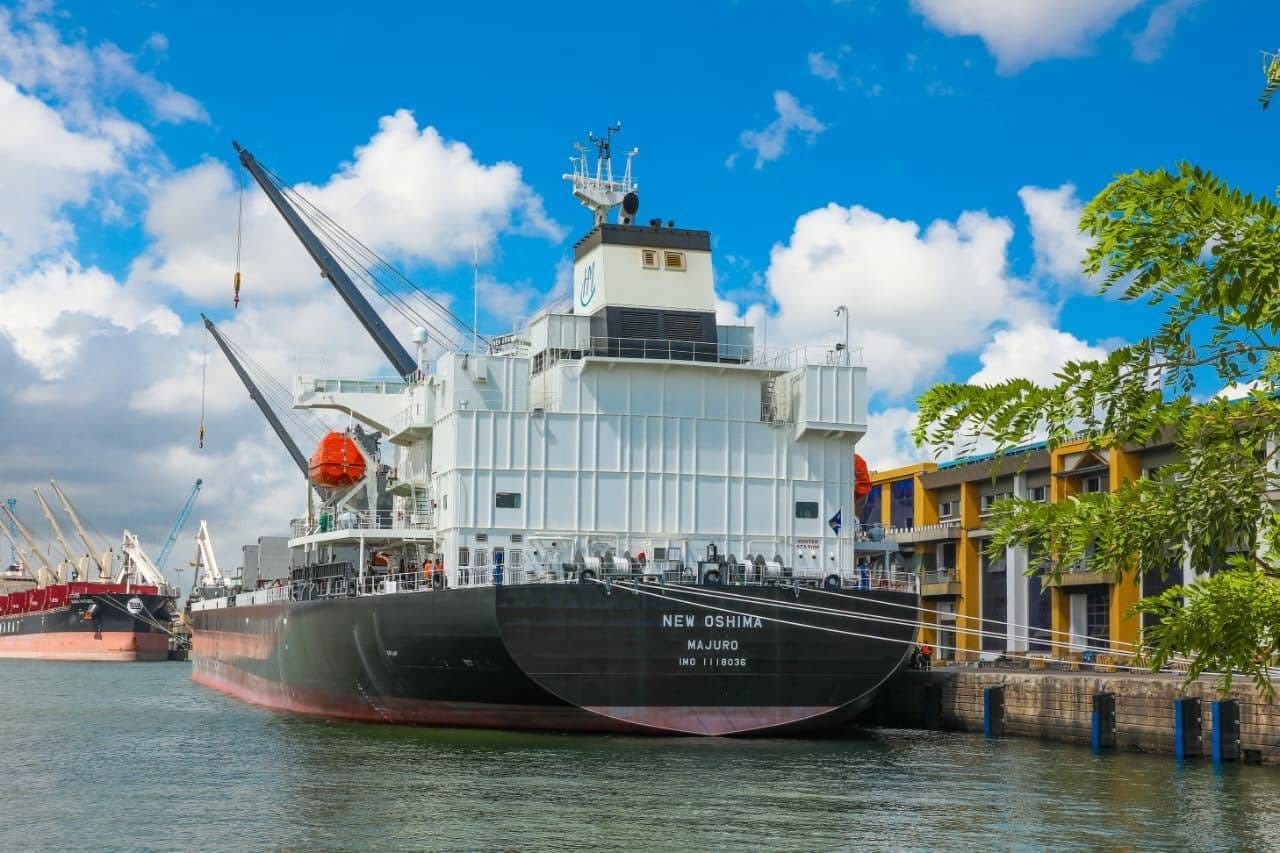
The maiden African call of MV New Oshima at the Port of Mombasa this month was, on its surface, a routine maritime milestone. A two-month-old bulk carrier sailing under the Marshall Islands flag, laden with steel coils, chose Kenya’s principal gateway for its first docking on the continent. The Kenya Ports Authority marked the occasion with the customary Certificate of First Call, and the vessel’s master, Captain Chen Ting Zhan, accepted it with appropriate ceremony.
But beneath the protocol lies a more revealing story—one that cuts to the heart of where Mombasa stands in the fiercely competitive landscape of East African maritime logistics, and what it will take to stay there.
The Symbolism and Its Limits
A maiden call is a vote of confidence, however modest. That a newly commissioned vessel operated by New Oshima Shipping chose Mombasa for its African debut signals that the port remains visible, functional, and commercially attractive to international operators. In a region where Dar es Salaam has been aggressively courting transit cargo and where Djibouti has posted dramatic efficiency gains, such signals matter. They are the small, cumulative indicators that determine whether shipping lines keep Mombasa on their rotation or quietly redirect their tonnage elsewhere.
Yet symbolism has a short shelf life. The steel coils MV New Oshima carried will be discharged, the certificate will be framed, and the vessel will sail on. What endures is the question the call implicitly poses: Is Mombasa’s recent growth a durable trajectory or a temporary surge that will erode as regional competition intensifies?
The numbers suggest grounds for both optimism and anxiety. The port closed 2025 with a record 45.45 million tonnes of cargo, a 10.9 percent jump from the previous year . Container volumes crossed 2.11 million TEUs. Lamu Port, long dismissed as a white elephant, recorded a tenfold increase in tonnage. These are genuine achievements. But they coincide with a sobering reality: in the latest World Bank Container Port Performance Index, Mombasa fell to 396th globally, while Dar es Salaam climbed 105 places to 255th, and even Lamu entered the rankings ahead of Mombasa at 345th . Volume growth, in other words, has not translated into proportional efficiency gains.
The Capacity Race and Its Discontents
The Kenya Ports Authority is not standing still. Berth 19B is nearing completion, expected to add some 300,000 TEUs to annual container capacity . Plans for Berths 23 and 24 are advancing. The Dongo Kundu Berth One at the Mombasa Special Economic Zone, a $314 million multipurpose facility with a 300-metre quay and 15-metre draft, is under construction and scheduled for completion in 2028 . The KPA’s broader ambition is to push container capacity from roughly 2.3 million to over 3 million TEUs, with nearly $1 billion in planned investment, a portion of which is expected to come through concessions to private operators .
These are necessary investments. But they expose a structural tension that Mombasa has yet to resolve. The port is expanding its physical footprint while its operational efficiency, by international benchmarks, is slipping. Bigger berths and deeper drafts matter little if containers sit idle in yards, if truck queues stretch for kilometres, and if transit cargo diverts to competing corridors because predictability—not capacity—has become the decisive variable.
The KPA’s own leadership appears to recognise this. At the International Association of Ports and Harbors conference in London this year, KPA Chief Executive Officer Captain William Ruto argued that “a competitive port is not necessarily the one with the biggest quay—it is the gateway that provides the most reliable end-to-end service” . That is the right diagnosis. The question is whether the institutional and operational reforms required to deliver on it are moving at the same pace as the concrete pouring.
The Governance Question Nobody Wants to Answer Directly
Mombasa’s future is increasingly entangled with decisions about KPA’s corporate structure and the role of private capital. The Treasury has been advancing a policy shift toward domestic financing of port infrastructure through public-private partnerships, with seven additional KPA assets—including container terminals and inland depots—lined up for PPP deals . The stated rationale is to mobilise pension funds and local institutional capital, reducing dependence on external borrowing while anchoring projects in national ownership.
This is a defensible strategy in principle. But it has been accompanied by a fog of misinformation and political posturing that threatens to undermine public trust. A viral document purporting to show KPA listed on the Nairobi Securities Exchange with senior officials as shareholders was dismissed by the Treasury as entirely fake . Meanwhile, a separate controversy over claims that KPA’s assets had been valued at a token KSh 10 billion—when official financial statements show total assets of approximately KSh 350 billion—revealed how easily legitimate questions about transparency can be hijacked by bad-faith actors .
The real issue is not whether KPA should remain entirely state-owned or be partially privatised. It is whether the governance framework for whatever model emerges will be robust enough to attract private capital, enforce performance standards, and protect the public interest simultaneously. The German landlord-port model, which a Tanzanian delegation recently studied in Bremen and Hamburg, offers a tested template: public ownership of land and core infrastructure, private operation of terminals under long-term concessions, and a clear separation between regulatory and operational functions. Tanzania is grappling with the same questions. Mombasa’s advantage lies in its existing depth of private-sector engagement—but only if that engagement is structured transparently and governed competently.
What the Maiden Call Actually Demands
MV New Oshima’s arrival is a reminder that Mombasa’s customer base is global, mobile, and unsentimental. Shipping lines allocate vessels based on reliability, cost, and turnaround time. A maiden call is an opening bid, not a marriage. If the port’s efficiency rankings continue to slide, if truck congestion around the port remains unresolved, if empty-container backlogs persist, the next new vessel may choose Dar es Salaam or Djibouti for its African debut instead.
The KPA’s capacity expansion is necessary but insufficient. The harder work is operational and institutional: faster truck turnaround through the planned marshalling yard, expanded empty-container storage, genuine coordination between county and port authorities, and a governance structure that can withstand political transitions without losing strategic direction. The recent collaboration between the County Government of Mombasa and maritime stakeholders on these practical bottlenecks is encouraging. It needs to become systematic rather than episodic.
There is also a story here about Kenya’s broader economic trajectory. Ports handle 95 percent of the country’s international trade and contribute 2–3 percent of GDP through trade-related activities . KPA is one of the state’s leading revenue generators, with projections of profits exceeding KSh 35 billion this financial year . Those figures represent both an asset and a responsibility. A port that grows volumes while losing efficiency is a port that is borrowing against its own future competitiveness.
The Test Ahead
The maiden call of MV New Oshima will be forgotten within a year. What will not be forgotten is whether Mombasa used the breathing room provided by its current volume growth to fix the structural weaknesses that its competitors are already exploiting. Dar es Salaam’s improvement in the CPPI rankings is not an anomaly; it reflects deliberate investment and operational discipline. Lamu’s entry into the rankings ahead of Mombasa is a warning that even newer, less-established facilities can outperform on the metrics that shipping lines actually care about.
Mombasa’s strategic position as the gateway to Uganda, Rwanda, South Sudan, and the eastern Democratic Republic of Congo remains a formidable advantage. But geography is not destiny. The port’s future will be determined by the quality of its institutions, the transparency of its partnerships, and the discipline of its execution. A certificate of first call is a pleasant gesture. A certificate of sustained competitiveness would be worth far more.