


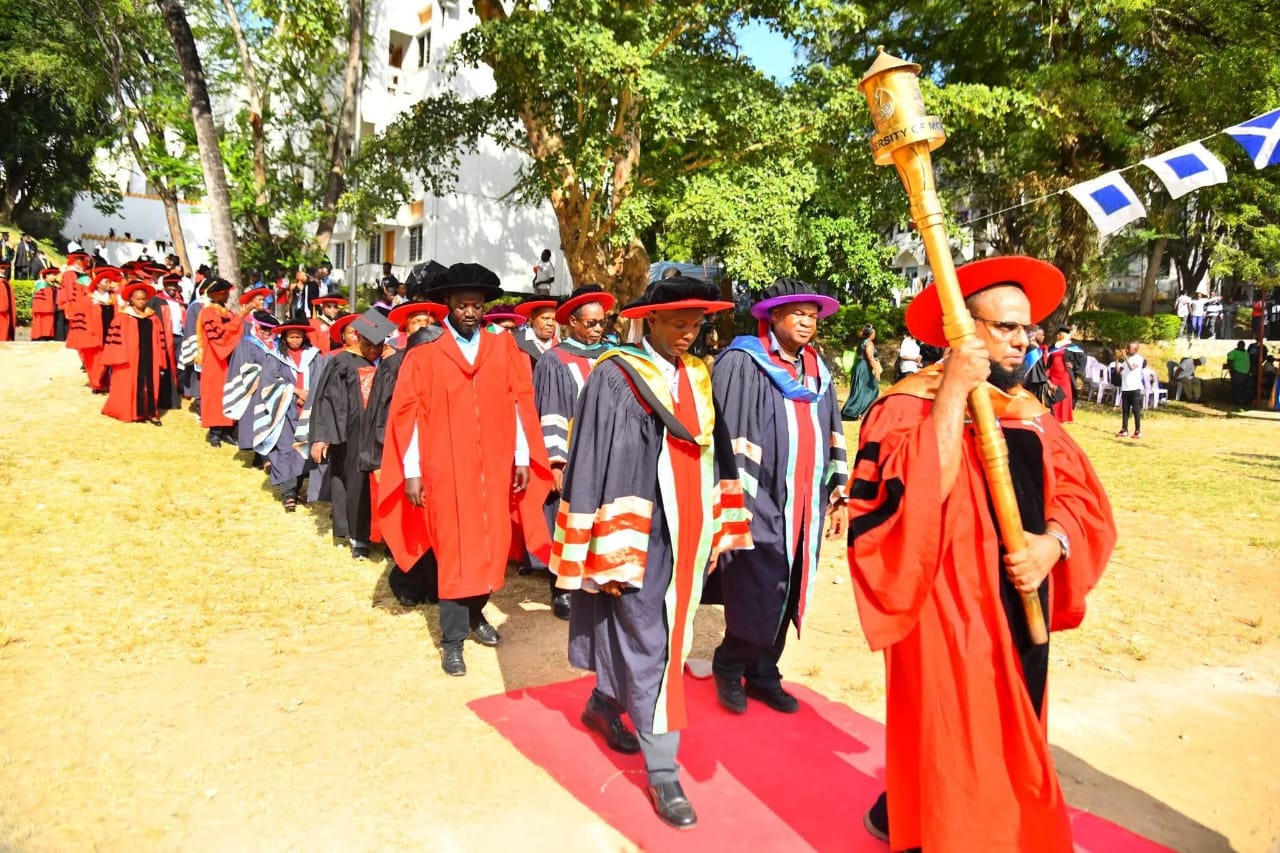
On 25 November 2026, the Technical University of Mombasa (TUM) held its 13th graduation ceremony under the theme “From Knowledge to Innovation: Harnessing AI, Science and Technology for Sustainable Development.” Among the nearly 3,000 graduands were 92 Deck and Engine Cadets and six Maritime Management graduates. The mace bearer was drawn from the Institute of Maritime and Seafaring Studies (IMSS), a detail that underscored the institute’s growing institutional stature.
This is more than a ceremonial footnote. It is a quiet but consequential marker of Kenya’s slow, determined effort to convert its coastline, ports and Exclusive Economic Zone into a genuine engine of employment, skills export and industrial capability.
A Strategic Location Meets Institutional Continuity
TUM’s maritime pedigree is not new. Its institutional ancestor, the Mombasa Institute of Muslim Education, already offered seamanship and navigation training. The modern IMSS has systematised and expanded that inheritance into a coherent suite of programmes: craft and diploma certificates, BSc Nautical Science, BTech Marine Engineering, and a Bachelor’s in Maritime Management with specialisations in transport/logistics and shipping/port operations. Postgraduate offerings in maritime policy, ocean governance and port management are coming online, with a PhD pathway under accreditation.
The 92 cadets and six management graduates sit at the sharp end of this pipeline. Deck and engine officers remain the backbone of the global merchant fleet. Kenya currently fields far fewer seafarers than its coastal position and youth demographics would suggest. Government targets—tens of thousands of trained seafarers, placement of thousands more into international shipping, and programmes such as Vijana Baharia—make the production of STCW-compliant officers and ratings a national priority rather than a niche academic activity.
The Broader Context: Shortage, Opportunity and Leakage
Globally, the industry faces projected shortfalls of officers and ratings. Kenya’s response has been multi-pronged: expanded training capacity at Bandari Maritime Academy and other approved institutions, construction of a major survival training and certification centre, partnerships for sea-time (including with international operators), and regional outreach such as TUM’s training of marine pilots for the Mogadishu Port Authority.
Yet structural bottlenecks persist. Sea-time remains difficult to secure because Kenya lacks a substantial national fleet. Certification integrity, simulator capacity, and the translation of classroom competence into shipboard employment still require sustained attention. The annual economic leakage through foreign shipping lines that carry the bulk of Kenya’s trade is frequently cited in the hundreds of billions of shillings—money that skilled Kenyan officers, ratings and maritime managers could help retain or repatriate.
The Blue Economy contributes a modest but growing share of GDP while supporting large numbers of coastal livelihoods in fisheries, tourism, port services and logistics. Maritime education is one of the higher-skill, higher-mobility segments of that value chain. A deck or engine officer who sails internationally earns hard currency, builds networks and often returns with expertise that can feed local ship management, pilotage, survey and training capacity.
What the Numbers Represent
Ninety-two cadets in a single cohort is not yet transformative at national scale. It is, however, evidence that a public university located at the country’s principal port is deliberately aligning its output with industry standards and national policy. The presence of Maritime Management graduates alongside the operational cadets is equally significant: ports, shipping agencies, logistics firms and regulatory bodies need shore-based professionals who understand both the technical and commercial realities of the industry.
IMSS has also moved beyond pure pre-sea training into specialised programmes—marine pilot training that has already produced regional graduates—and digital infrastructure such as the Seafarers Training Portal. These steps reduce friction for continuous professional development and strengthen the credibility of Kenyan certificates in an industry that is intensely regulated and reputation-sensitive.
The Road Ahead
Three priorities stand out if Kenya is to convert ceremonial success into structural advantage.
First, sea-time must be treated as a national capacity issue rather than an individual student problem. Bilateral arrangements, cadet berths on foreign vessels, and eventual growth of a Kenyan-flagged or Kenyan-managed fleet are all necessary.
Second, quality assurance and industry feedback loops must remain tight. STCW compliance is non-negotiable; simulators, practical training and continuous assessment need consistent investment and external validation.
Third, the maritime skills ecosystem must be deliberately linked to the wider Blue Economy agenda—port modernisation, coastal shipping, fisheries value addition, marine spatial planning and emerging sectors such as offshore energy. Officers and managers trained at TUM and peer institutions should find pathways not only into deep-sea shipping but into the full range of coastal and ocean-related economic activity.
The 13th graduation at TUM was, in the official narrative, a celebration of knowledge turning into innovation. For the maritime cohort, the more immediate translation is knowledge turning into competence that can be deployed on the world’s oceans. In a country where 95 percent of trade moves by sea and where youth unemployment remains stubborn, that competence is not a luxury. It is a strategic asset.
The mace may have been carried by a maritime academic, but the real procession is the one these cadets are about to begin—from the graduation square in Tudor to the bridges and engine rooms of the global fleet, and, one hopes, eventually back to a stronger, more self-reliant Kenyan maritime sector.