


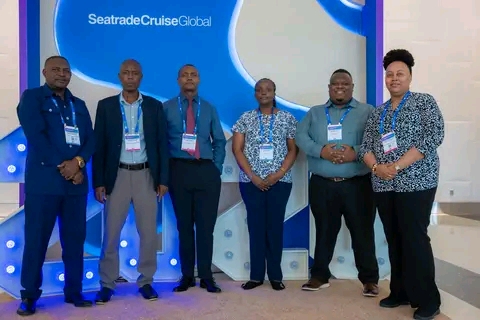
As the global maritime community gathers at the Sea trade Cruise Global Conference in Miami, a clear message echoes through boardrooms and exhibition halls – that the future of cruising will be defined not merely by scale, but by sustainability, resilience, and strategic collaboration.
This is a timely and necessary recalibration for an industry that has long thrived on expansion, yet now finds itself at the crossroads of environmental responsibility and shifting consumer expectations.
Voices like Pier Francesco Vago of MSC Group have articulated this transformation with clarity, emphasizing the delicate balance between rapid growth and environmental stewardship. This is not corporate rhetoric—it is an operational imperative.
The cruise industry, perhaps more than any other maritime segment, faces intense scrutiny to prove that its growth trajectory can align with global climate goals and sustainable tourism frameworks.
Yet, while the world debates the future, Kenya is quietly positioning itself within it.
Back home, the narrative unfolding at the ports of Mombasa,Shimoni and Lamu signals more than a recovery—it suggests the early stages of a renaissance. The reported rise in cruise ship arrivals is no accident. It reflects deliberate policy choices, targeted marketing, and a growing recognition among global cruise liners that East Africa offers an untapped frontier of cultural richness and natural beauty.
The Kenya Ports Authority’s role in this resurgence cannot be overstated. Its renewed focus on cruise infrastructure, passenger experience, and international partnerships signals a strategic pivot from traditional cargo dominance toward a more diversified port economy. This is a welcome evolution.
For decades, Kenya’s maritime discourse has been disproportionately anchored on container throughput and bulk cargo volumes, often overlooking the high-value, low-volume opportunities that cruise tourism presents.
Crucially, Kenya’s presence at Sea trade is not symbolic—it is strategic, personified by a delegation of senior officials actively engaging global stakeholders. The team includes Edward Kamau, Geoffrey Kavate, Mohamed Mwazuzu,Mercy Lagat ,Mohamed Juma and Miriam Mwakundia. Their participation reflects a coordinated institutional effort to reposition Kenya as a competitive cruise destination and secure meaningful partnerships that translate into increased vessel calls and passenger traffic.
Cruise tourism is not just about ship calls; it is about ecosystems. Each vessel docking at Mombasa carries a floating economy—thousands of passengers seeking authentic experiences, local cuisine, cultural immersion, and seamless logistics.
The multiplier effect on local economies—from tour operators and transport providers to artisans and hospitality businesses—is profound. When properly harnessed, cruise tourism can become a cornerstone of coastal economic transformation.
However, optimism must be tempered with realism.
The global cruise industry is intensely competitive. Ports are no longer mere destinations—they are products. From the Caribbean to the Mediterranean, port authorities are investing heavily in infrastructure, digitalization, and environmental compliance to attract and retain cruise lines. Kenya, therefore, cannot afford complacency. Incremental improvements will not suffice in a market where excellence is the baseline.
The presence of Kenyan officials at Seatrade underscores an understanding of this reality. Engagement with global partners is essential, but it must translate into tangible outcomes: long-term berthing agreements, inclusion in marquee itineraries, and integration into global cruise networks. Networking alone does not build an industry; execution does.
Moreover, the sustainability conversation dominating Miami must find resonance in Mombasa and Lamu. Cruise tourism, if poorly managed, can strain local ecosystems, overwhelm infrastructure, and alienate communities. Kenya has a unique advantage: it is entering this space at a time when best practices are already well established.
There is no need to repeat the mistakes of overcrowded ports elsewhere. Instead, Kenya can leapfrog into a model of sustainable cruise tourism—one that prioritizes environmental protection, community inclusion, and cultural preservation.
This will require more than port upgrades. It demands inter-agency coordination among maritime authorities, tourism boards, county governments, and environmental regulators. It calls for investment in shore power facilities to reduce vessel emissions at berth, robust waste management systems, and clear guidelines on passenger flows to prevent congestion in heritage sites.
Equally important is the human element.
The success of any cruise destination ultimately hinges on the quality of people-to-people interactions. Training programs for tour guides, hospitality workers, and port staff must be scaled up to meet international standards. Kenya’s famed warmth and hospitality are natural assets, but in a competitive industry, they must be complemented by professionalism, efficiency, and cultural intelligence.
There is also a narrative dimension that Kenya must actively shape. For too long, Africa has been marketed through narrow lenses that fail to capture its diversity and dynamism. Cruise tourism offers an opportunity to tell a different story—one of vibrant coastal cities, rich Swahili heritage, and unique marine ecosystems. This narrative must be curated and communicated consistently across global platforms.
The stakes are high, but so is the potential.
If current trends are sustained, cruise tourism could emerge as one of Kenya’s most dynamic economic sectors, bridging maritime trade and tourism in ways few other industries can. It offers a pathway to inclusive growth, particularly for coastal communities that have historically been marginalized in national development frameworks.
But success will not come by default.
It will require strategic clarity, sustained investment, and an unwavering commitment to global standards. It will require Kenya to see itself not as a peripheral player, but as a serious contender in the global cruise landscape.
As discussions continue in Miami, one thing is clear: the future of cruising is being shaped now. Kenya has a seat at the table. The question is whether it will seize the moment with the urgency and ambition it demands.
The tide, indeed, is turning. Whether it becomes a wave of lasting transformation or a fleeting current will depend on the choices made today.