


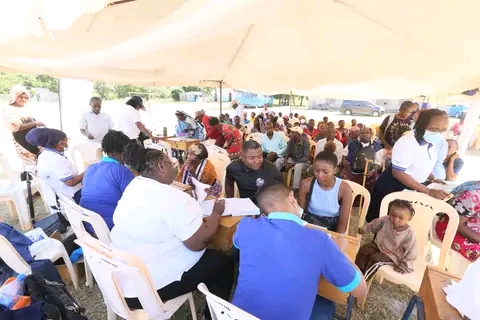
In a small primary school in Matsangoni, Kilifi County, something remarkable happened. More than 1,000 residents—men, women, and children—walked through the gates of Matsangoni Primary School not for lessons, but for healing.
They came with ailments untreated for months, eyes clouded by cataracts that could have been removed long ago, and bodies carrying the silent burden of undetected diseases. They left with prescriptions, referrals, and—for the first time in a long while—hope.
This was not a political rally. It was not a development conference. It was a free medical camp organised by the Kenya Ports Authority (KPA) under its Corporate Social Investment (CSI) programme, in partnership with the Kilifi County Government.
And it was nothing short of a lifeline.
THE SILENT CRISIS IN COASTAL KENYA
Let us not mince words: healthcare in Kenya’s coastal region is in crisis. Public hospitals are understaffed, underfunded, and overwhelmed. Essential medicines run out. Specialists are scarce. For rural communities like Matsangoni, even the cost of transport to a county referral hospital can be prohibitive—to say nothing of consultation fees, lab tests, and prescription costs.
Against this backdrop, the KPA medical camp was not merely a charitable gesture. It was a direct intervention into a system that has failed too many for too long.
Residents received:
· Treatment for common illnesses —the everyday maladies that become chronic when left unchecked.
· Eye care —restoring sight, dignity, and the ability to work and learn.
· Cervical cancer screening —a potentially life-saving service in a region where cancer awareness and early detection remain critically low.
· General health checks and medical consultations —the first point of contact for many with a qualified health professional in years.
Local leaders described the initiative as “timely and crucial,” and they were right. But it also raises an uncomfortable question: why should a State Corporation—established to manage ports and maritime logistics—have to fill the gaps left by the healthcare system?
CSR OR SYSTEMIC FAILURE?
The Kenya Ports Authority deserves commendation. This is not its first such outreach; it follows a similar camp in Lukore, Shimba Hills in Kwale County. The Authority is demonstrating that corporate social investment, when done thoughtfully, can have an immediate, tangible impact on lives.
But let us be clear: healthcare is not charity. It is a constitutional right.
Article 43 of Kenya’s Constitution guarantees every citizen the right to the highest attainable standard of health. Yet, for millions of Kenyans, that right remains a distant promise—available only if a well-meaning corporation or NGO decides to set up camp in their village.
We must not allow CSR to become a substitute for state responsibility. KPA is stepping up, but it should not have to. County governments must ensure that primary healthcare facilities are functional, well-stocked, and accessible. The national government must honour its fiscal commitments to the health sector. And all of us—as citizens—must demand accountability for the resources already allocated.
THE BLUE ECONOMY AND SOCIAL RESPONSIBILITY
KPA’s involvement in community health is not accidental. As the steward of Kenya’s maritime gateway, the Authority understands that its success is inextricably linked to the wellbeing of the communities that surround its operations.
Mombasa and the wider coastal region are the engines of Kenya’s blue economy—a sector with immense potential for job creation, trade, and national prosperity. But that prosperity means little if the people who live and work in these communities cannot access basic healthcare.
Corporate Social Investment, when integrated into a broader vision of sustainable community development, becomes more than just goodwill. It becomes an investment in stability, productivity, and social cohesion. KPA’s medical camps are a model of what CSR can achieve—but they should be the beginning, not the end, of a comprehensive community health strategy.
A CALL TO ACTION
The 1,000 residents of Matsangoni who benefited from this camp are fortunate. But what of the thousands more in Kilifi, Kwale, Lamu, and Tana River who have no such camp on their horizon?
We call on:
· County governments to prioritise primary healthcare funding and ensure that facilities at the grassroots are equipped and staffed.
· The national government to increase health sector allocations and enforce the standards required by law.
· Private sector and State Corporations to follow KPA’s lead—not only with medical camps but with sustained, long-term health interventions.
· Civil society and the media to keep the spotlight on healthcare inequities and hold duty-bearers accountable.
A FINAL WORD
The Matsangoni medical camp was a testament to what is possible when institutions take their social responsibility seriously. It brought relief to over a thousand people—and perhaps saved lives that would otherwise have been lost to preventable diseases.
But relief is not the same as solution. And charity, however generous, is not a substitute for justice.
Let us celebrate KPA’s initiative. Let us thank the Kilifi County Government for its partnership. And let us remember the faces of those who queued for hours, hoping for a consultation that might change their lives.
Then, let us ask ourselves: what must we do to ensure that no Kenyan has to wait for a corporate camp to access their constitutional right to healthcare?
Andrew Mwangura is a Mombasa-based Public Intellectual and Maritime Affairs Analyst.