


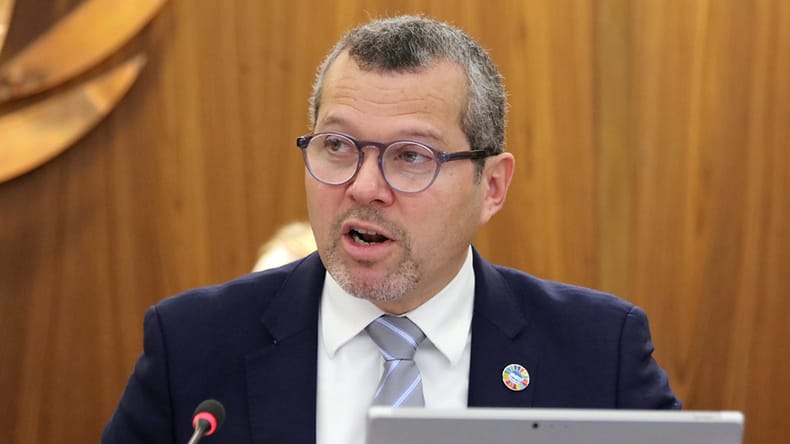
Arsenio Dominguez secured a second four-year term as Secretary-General of the International Maritime Organization this week, but the manner of his victory reveals more about the institution’s deepening fractures than any formal endorsement of his leadership. In a closed-door ballot of the 40-member Council on 4 November, Dominguez prevailed 24–6, with 10 abstentions. The United States and the United Arab Emirates led the opposition, joined by Cyprus, Malta, Greece and Morocco. China, Japan, South Korea and Liberia were among those who sat on their hands.
What should have been a routine renewal of mandate for the Panamanian naval architect—elected in 2023 and in office since January 2024—became an unprecedented challenge. Insiders have called it a vote of no confidence. The official IMO statement offered the usual diplomatic niceties and gratitude. The reality is colder: Dominguez remains, but he has been wounded, and the organisation he leads is more divided than at any point in recent memory.
The Numbers Tell the Story
A 24–6 result with substantial abstentions is not a ringing endorsement. In an organisation that prizes consensus and rarely airs its dirty laundry in public, the fact that a significant minority was prepared to vote openly against the incumbent—and that major flag states and industrial powers chose to abstain—marks a rupture. The Council is the IMO’s executive body between Assemblies. Its willingness to stage this contest signals that the usual norms of institutional continuity no longer hold.
The opposition list is instructive. The United States has spent the past year aggressively opposing the IMO’s Net-Zero Framework, the centrepiece of Dominguez’s first term. The UAE, a major oil producer and bunkering hub, has aligned with that resistance. The presence of traditional European shipping powers such as Greece, Cyprus and Malta among the “no” votes points to quieter dissatisfaction with the pace, design or political handling of decarbonisation rules that will fall heavily on their fleets and registries. Morocco’s participation adds a North African dimension that may reflect broader developing-country concerns about cost and equity.
Abstentions from China, Japan, South Korea and Liberia—major shipowning and shipbuilding nations or open-registry powers—suggest calculated distance rather than enthusiastic support. These states are not prepared to remove Dominguez, but neither are they prepared to expend political capital defending him.
Decarbonisation as the Flashpoint
Dominguez’s first term has been defined by the Net-Zero Framework. Agreed in principle in April 2025 with a majority that included the EU, China, India and Brazil, the package combines a global fuel standard with greenhouse-gas emissions pricing. Its formal adoption was postponed for a year in October 2025 after intense US-led opposition, including reported threats of trade measures, port restrictions and other retaliatory tools. The extraordinary session became a diplomatic brawl. Saudi Arabia proposed the adjournment, which passed narrowly. Dominguez has spent 2026 trying to rebuild momentum ahead of critical meetings at the end of November and early December.
The Secretary-General’s background made him both the natural and the vulnerable figure for this fight. A naval architect by training, he rose through Panama’s maritime administration, served as Panama’s Ambassador and Permanent Representative to the IMO, and chaired the Marine Environment Protection Committee from 2014 to 2017—the very body that has driven the GHG agenda. He later joined the Secretariat as Chief of Staff, Administrative Director and then Director of the Marine Environment Division. Few people know the file better. That expertise has not insulated him from the geopolitical backlash.
Critics on the climate side have pressed him to be more ambitious and less accommodating of fossil-fuel interests. Opponents on the other side see the Framework—and, by extension, its stewards—as an illegitimate exercise in global economic management that threatens energy security, raises costs for consumers and disadvantages oil-producing states. The leadership challenge is the political expression of that unresolved conflict. Dominguez is being held accountable for an agenda that the membership itself has not been able to settle.
Geopolitics Intrudes
The contest cannot be separated from the wider deterioration of the maritime security environment. Attacks on commercial shipping in the Red Sea, the Persian Gulf and the Black Sea have forced costly diversions, raised insurance premiums and endangered seafarers. Dominguez has repeatedly spoken on freedom of navigation and the need to protect the workforce that keeps global trade moving. Yet the same great-power rivalries that disrupt sea lanes also play out inside the IMO’s chambers. The United States under the current administration has treated multilateral climate instruments with open hostility. Other major players calculate their positions accordingly. The result is an organisation that struggles to maintain the technocratic consensus that once allowed it to regulate an inherently international industry.
Panama’s outsized role in the global fleet adds another layer. As the world’s largest open registry, Panama’s interests are not identical to those of traditional maritime powers or pure flag-of-convenience users. Dominguez’s nationality has always been both an asset—bringing the perspective of a major registry state—and a potential liability when registry politics or Canal-related issues intersect with broader agendas.
What Comes Next
The Council decision still requires formal approval by the IMO Assembly in late 2027. That is normally a formality, but the precedent of contestation has been set. Dominguez will enter his second term—running from 1 January 2028 to 31 December 2031—with diminished political capital and a membership that has publicly demonstrated its willingness to challenge him. The immediate test arrives within weeks: the Marine Environment Protection Committee meetings that will revisit the Net-Zero Framework. A failure to advance, or another procedural ambush, will reinforce the narrative that the organisation is gridlocked under his watch.
For the industry, the implications are practical. Regulatory uncertainty delays investment decisions on alternative fuels, dual-fuel vessels and energy-efficiency technologies. Regional measures—most notably the EU’s extension of its emissions trading system to shipping—fill the vacuum, creating a patchwork that shipowners and charterers must navigate. Seafarers continue to face elevated risks in conflict zones while the institutional machinery meant to protect them is distracted by internal power struggles.
Dominguez has the technical knowledge, the institutional memory and the formal mandate. What he lacks is the broad, unambiguous political backing that previous secretaries-general could take for granted. The 24–6 vote keeps him in office. It does not restore the authority that the challenge has eroded. The real question is whether the IMO can still function as the global standard-setter for shipping when its own membership is prepared to treat the leadership of the organisation as another front in the wider contest over climate policy, energy security and geopolitical influence. On the evidence of this week, that capacity is in doubt.