


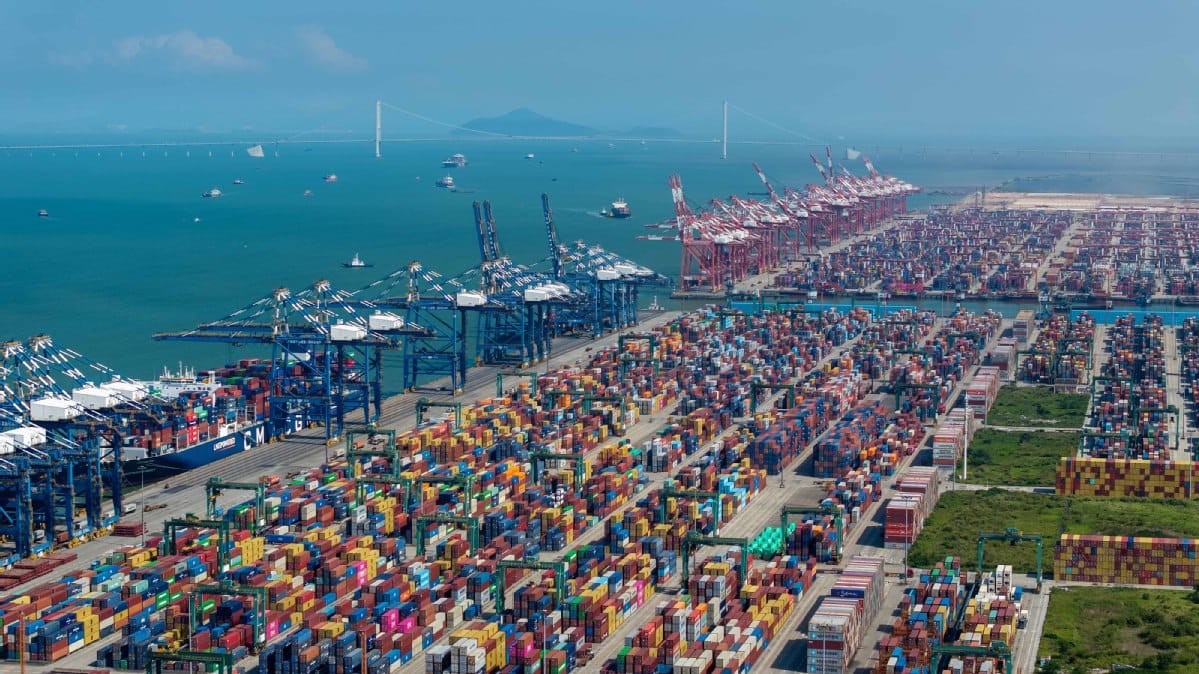
Seven of the world’s most efficient container ports are Chinese—and six of the ten largest by throughput typically are as well. This dominance is not destiny or sheer scale alone, but rather the product of a deliberate institutional shift toward autonomous, competitive management.
In recent World Bank and S&P Global Container Port Performance Index rankings, which measure vessel time in port as a proxy for efficiency, Chinese facilities have repeatedly claimed the majority of top spots. Ports such as Fuzhou, Dalian, Yangshan, Mawan, Chiwan, Ningbo, and Guangzhou have consistently occupied multiple positions in the global top 10, alongside a handful of strong performers from the Middle East, North Africa, and East Asia. By container throughput, Shanghai leads the world with over 51 to 55 million TEUs in recent years, followed closely by Ningbo-Zhoushan, while Shenzhen, Qingdao, Guangzhou, and Tianjin routinely complete the top tier. Singapore, Busan, Jebel Ali, and Port Klang round out the list. Asia’s export engine and infrastructure investment matter, but the decisive edge is institutional.
China’s Model: Autonomy, Competition, and Commercial Discipline
China moved decisively away from pure central bureaucratic control. Port enterprises were corporatized, shifting day-to-day operations toward commercial entities. While often state-owned, these entities operate with private-sector incentives, joint ventures with international operators such as Hutchison, PSA, and A.P. Møller, and intense competition among terminals and neighboring ports.
Local governments and port groups gained operational autonomy while the central state retained strategic oversight, planning, and regulatory power. Terminals now compete for volume, invest aggressively in automation, digital systems, deep-water berths, and hinterland connectivity, and face real performance pressure. The result is rapid turnaround, high crane productivity, and a remarkable ability to absorb global supply-chain shocks better than many peers.
This is not pure privatization. It is a hybrid that combines state direction with market discipline and inter-port rivalry. Ports that underperform lose cargo; successful ones expand. Heavy capital spending is matched by operational accountability. That combination produced the world’s busiest and, by measured vessel time, most efficient facilities.
The Outdated Parastatal Model
Many developing-country ports, including Kenya’s, still operate under classic parastatal arrangements. The Kenya Ports Authority has long combined infrastructure ownership, operations, regulation, and commercial activity under one state corporation. This structure invites political interference in appointments and procurement, soft budget constraints, bureaucratic inertia, and weaker incentives for cost control or service quality.
Audits have repeatedly flagged irregularities, overtime abuses, procurement weaknesses, and skewed staffing. Congestion, inter-agency friction—notably with customs and rail—and slower adaptation to larger vessels or digital systems have been recurring complaints. The cost of these inefficiencies is ultimately borne by Kenyan businesses and consumers through higher logistics expenses and delayed trade.
Kenya has begun moving in the right direction. The Government Owned Enterprises framework aims to reincorporate entities such as KPA under company law with clearer commercial mandates. Landlord-style arrangements and public-private partnerships for specific berths or terminals in Mombasa and Lamu are under discussion or early implementation. These steps recognize that the pure parastatal model is no longer compatible with modern logistics demands. Global shipping lines expect reliable, competitive turnaround times measured in hours, not days of delay.
What Reform Should Look Like
KPA should be elevated to a pure regulator and landlord role: owner of the land, basic infrastructure, and strategic assets; setter of safety, environmental, competition, and performance standards; collector of rents and fees; and guardian of national interest. Day-to-day terminal and berth operations should be handed to professional management entities—whether specialized private operators, joint ventures, or ring-fenced commercial subsidiaries—that compete for cargo, invest their own capital, and face commercial consequences for poor service.
Different ports or terminals can operate under different management setups tailored to their traffic mix, including containers, bulk, multipurpose, and inland facilities. Competition between operators, transparent concession terms, independent performance monitoring, and clear separation of regulation from operations are the practical lessons from the Chinese experience and from successful landlord ports elsewhere. Political appointments to operational posts should end; professional boards and performance contracts should replace them.
This is not ideological privatization for its own sake. It is institutional modernization so that East Africa’s gateway can compete on reliability and cost rather than rely on geography alone. China’s ports did not become dominant merely because China manufactures a large share of the world’s goods. They became dominant because management structures aligned incentives with performance. Countries that cling to outdated parastatal monopolies will continue to pay the price in higher logistics costs, lost trade, and slower growth.
The evidence from the global rankings is clear. The policy choice is now Kenya’s.
Andrew Mwangura is a maritime analyst and commentator based in Mombasa.