


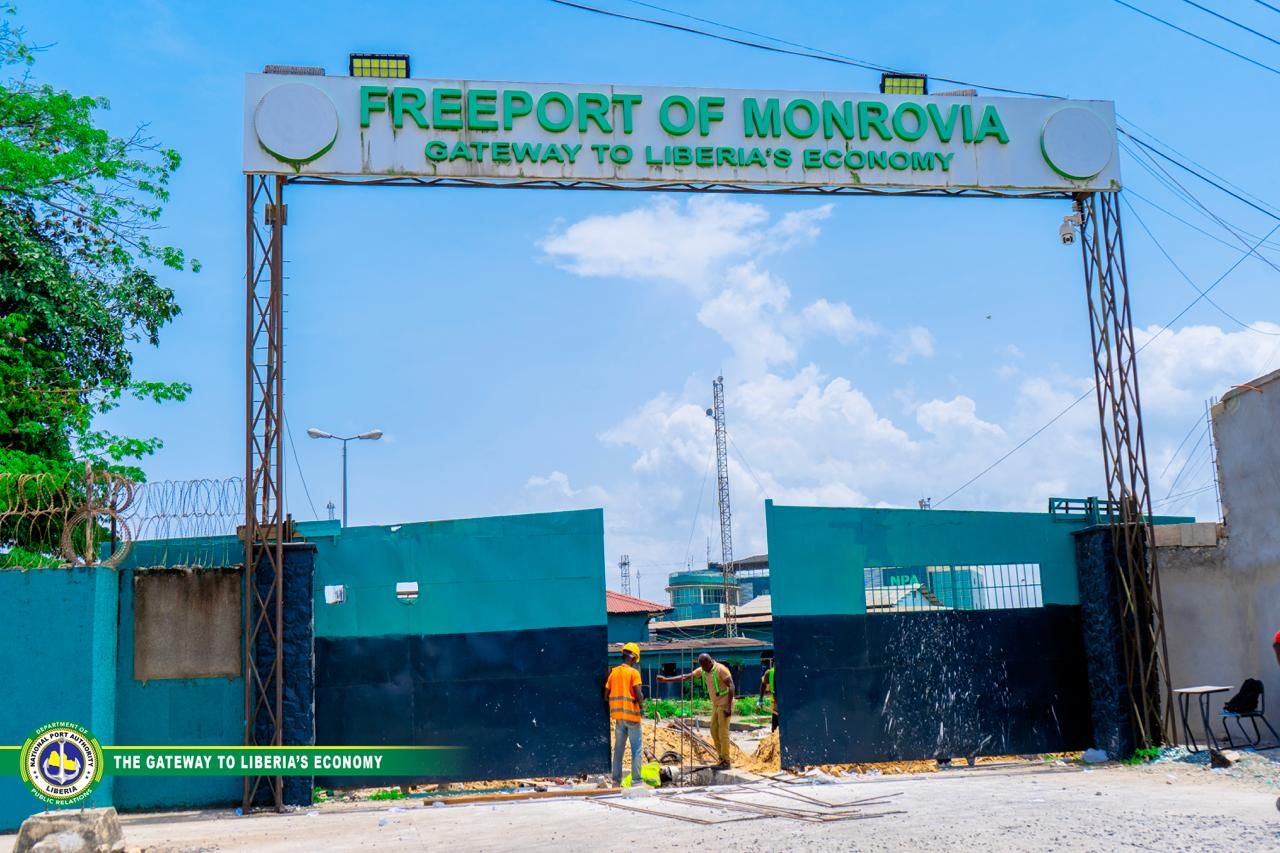
In August 2026, the Freeport of Monrovia handled a record 18,012 TEUs at an average productivity of 17.2 crane moves per hour (CMPH). APM Terminals Liberia presented the figures as evidence of greater speed and reliability—faster vessel turnarounds, more predictable cargo flows, and a stronger link between Liberian businesses and global markets. The numbers are real and meaningful. They also illuminate a larger story about Liberia’s economic trajectory, the limits of terminal efficiency alone, and the unfinished work of turning port gains into broadly shared prosperity.
The milestone in context
The Freeport of Monrovia is Liberia’s primary maritime gateway. It handles the overwhelming majority of the country’s imports—food staples such as rice, petroleum products, construction materials, machinery—and a significant share of containerised trade. APM Terminals has operated the multi-purpose terminal under a long-term concession since 2011, after a major upgrade that brought paved yards, reefer capacity, security systems, and modern equipment. Annual container capacity stands at roughly 200,000 TEU; recent years have seen volumes climb toward and beyond the 130,000–160,000 TEU range amid broader recovery in trade and mining-related activity.
August’s 18,012 TEUs represent a clear monthly high. The accompanying 17.2 CMPH reflects operational discipline after successive investments in mobile harbour cranes, pilot and tug boats, night-navigation systems, and 24-hour marine operations launched in 2025. Earlier in 2026 the terminal also recorded a 40 percent surge in overall activity, handled Liberia’s largest-ever cargo vessel (the CMA CGM Springs) in two days at nearly 60 moves per hour, and introduced pre-slung rice discharge that cut handling fees by more than one-third while roughly doubling discharge speeds. These are tangible improvements in a port that once struggled with congestion, long vessel waits, and high demurrage costs that ultimately raised consumer prices.
Productivity metrics matter because time is money in shipping. Faster turns reduce carrier costs, improve schedule reliability, and lower the risk that demurrage and detention charges cascade into higher landed costs for rice, cement, and other essentials. For a small, import-dependent economy whose growth is projected around 5 percent, smoother port operations support business planning and help keep inflationary pressures in check.
Economic significance beyond the quay
Liberia’s economy remains heavily trade-oriented. Mining (especially iron ore), agriculture, and services drive recent growth, with exports rising sharply and the Freeport collecting a large share of customs revenue. The National Port Authority has framed efficiency gains as part of a broader repositioning of the maritime sector, including a US$550 million modernisation agenda that covers dredging, infrastructure, and connectivity across Monrovia, Buchanan, Greenville, and Harper. Partnerships—such as the GLS Group export-processing facility and cooperation with regional ports—signal an ambition to move beyond pure volume toward value addition and regional logistics roles.
Yet the August record also underscores structural realities. Container throughput remains modest by West African standards. Inland transport is constrained by limited paved roads and a rail network still oriented primarily toward bulk mineral exports. High handling charges relative to some neighbours, residual concerns about transparency, and the dominance of imports over higher-value exports mean that terminal productivity improvements, while necessary, are not sufficient. A ship that discharges quickly still faces the challenge of moving goods efficiently to inland markets or processing facilities. Without complementary investments in roads, rail multi-user access, digital trade facilitation, and skills, the benefits of higher CMPH risk remaining concentrated at the port rather than diffused through the broader economy.
The rice reforms illustrate both the promise and the remaining gaps. Lower discharge fees and faster handling reduce one layer of cost. Whether those savings fully reach consumers depends on competition among importers, trucking rates, storage, and retail margins—areas where policy and private-sector coordination still lag.
Risks and the path forward
Operational excellence is fragile if not matched by institutional depth and strategic foresight. Concession renegotiations, draft restoration through dredging (critical for larger vessels), and diversification of cargo handling (bulk, project cargo, potential short-sea shipping within ECOWAS) will test the partnership between the National Port Authority, APM Terminals, and other stakeholders. Global shipping disruptions, commodity price swings, and competition from better-connected regional hubs remain external risks. Domestically, the concentration of trade through a single primary gateway creates systemic vulnerability: prolonged disruption at Monrovia would ripple through the entire economy.
The constructive agenda is clear. First, sustain and deepen productivity gains through continuous equipment renewal, workforce development, and data-driven operations while ensuring transparency in tariffs and performance metrics. Second, accelerate inland logistics—road corridors, multi-user rail access linked to the ArcelorMittal expansion, and digital platforms that reduce dwell times and paperwork. Third, deliberately shift the trade profile toward higher-value exports and light processing, using the new export-processing initiatives as a beachhead. Fourth, embed local content and skills transfer so that rising volumes generate more Liberian jobs and capabilities rather than remaining largely enclave operations.
APM Terminals’ August announcement is correctly framed as customer-centric: faster turns and greater reliability help businesses plan with confidence. For Liberia, the larger opportunity is to treat the Freeport not merely as a throughput machine but as a strategic national asset whose efficiency multiplies the returns on mining, agriculture, and manufacturing. Record TEUs and solid CMPH are welcome evidence of progress. They become transformative only when paired with the harder, slower work of connecting the quay to the rest of the economy—roads, rules, skills, and markets—so that Liberia’s growing trade volumes translate into broader, more resilient prosperity.
The numbers from August 2026 show the port can move cargo with greater speed and reliability. The test ahead is whether Liberia can move its economy with equal purpose.
Andrew Mwangura is a maritime safety and logistic analyst.