


The global maritime industry stands at an inflection point. Ships are evolving at a pace that traditional training frameworks were never designed to match. Alternative fuels, automation, cybersecurity demands, remote operations, and advanced propulsion systems are no longer distant prospects—they are entering service now. Yet the foundational international standard governing how seafarers are trained and certified, the STCW Convention, is still catching up.
The International Maritime Organization’s comprehensive review of the STCW Convention has identified more than 400 gaps. That figure is not bureaucratic noise; it is a stark measure of how far the regulatory baseline has fallen behind technological and operational reality. An engineer trained primarily for conventional fuel-oil systems does not automatically possess the risk vocabulary, emergency procedures, or systems understanding required on an ammonia-fuelled vessel. The same applies across methanol, hydrogen, fuel cells, batteries, LPG, and wind-assisted propulsion.
The IMO has recognized the urgency. In July 2026, it issued dedicated interim training guidelines for ships using methanol/ethanol and ammonia as fuel, building on earlier generic guidelines for alternative fuels and new technologies. Work continues on hydrogen, fuel cells, LPG, batteries, and wind propulsion. Parallel efforts address cybersecurity, digitalisation, automation, and advanced training technologies. The broader STCW review aims to bring a revised treaty to the Maritime Safety Committee for approval around 2029–2030. These are necessary steps. They are not yet sufficient.
The Human Element Remains Central
As the IMO itself states, seafarers are central to maritime safety and the sustainable operation of ships. Decarbonisation targets will be measured in tonnes of carbon avoided, but operational success will depend on whether the person standing the watch truly understands the system in front of them. New fuels require new ships; new ships require new skills; and those skills must arrive before the technology scales—not after incidents force the issue.
This is not merely a technology upgrade. It is a workforce transformation. Training systems built for a relatively stable era of residual fuel oil and conventional machinery must now accommodate toxic, corrosive, or cryogenic fuels with fundamentally different fire, toxicity, and handling characteristics. They must prepare crews for highly automated bridges and engine rooms that demand new vigilance and intervention skills, and for cyber-physical systems that blur the line between operational technology and information technology. Mental health, psychological safety, violence and harassment prevention, and gender and cultural diversity have also rightly entered the gap analysis—recognising that competence is not only technical.
Kenya’s Example: Building Capacity Early
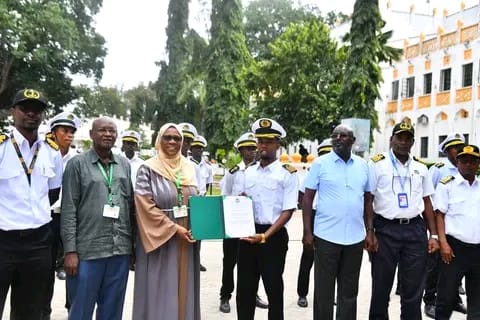
Kenya offers a useful illustration of both progress and the scale of opportunity. Bandari Maritime Academy launched a Green Hydrogen course in February 2026, integrating alternative-energy knowledge with vessel operations and safety. The academy is also investing in simulation and maritime survival training. This is the correct direction: building local capacity early rather than waiting for global standards to fully mature.
Countries that treat seafarer training as strategic infrastructure—not just a compliance cost—can position themselves as regional hubs for simulator-based training, alternative-fuel certification, instructor development, remote-operations skills, and related technical services. In doing so, they export more than labour; they export competence and credibility.
The Cost of Delay
The risk of delay is uneven. Flag states, training institutions, and shipping companies that move early will supply the crews preferred by owners of next-generation vessels. Those that treat the STCW review as a distant regulatory exercise risk producing seafarers whose certificates are formally valid yet practically outdated.
The interim guidelines provide a bridge, but the full revision will take years. In the meantime, industry and administrations must use the available tools—simulator time, company-specific training, voluntary certifications aligned with the new guidelines, and close collaboration with classification societies and fuel suppliers—to close the competence gap in real time.
Three Practical Priorities
First, training must become more modular and technology-specific while remaining grounded in core safety principles. Generic awareness is useful; vessel-specific and fuel-specific competence is essential.
Second, simulation and shore-based training should be expanded thoughtfully as partial substitutes for traditional sea time where appropriate, without eroding the irreplaceable value of real operational experience.
Third, developing maritime nations should view the energy transition as an opportunity to leapfrog. Investment in modern simulators, instructor upskilling, and partnerships with technology providers can create comparative advantage faster than legacy systems allow.
Conclusion
The maritime energy transition will succeed or falter on the quality of the people who operate the ships. Carbon metrics matter. So does the quiet competence of the watchkeeper who recognises an anomaly in an unfamiliar fuel system at 0300 hours. The ships are already changing. The training rulebook must not only catch up—it must, for once, get ahead.
New fuels need new ships. New ships need new skills. And new skills need to arrive before the technology does.