


For centuries, the history of the Indian Ocean has been narrated as a story of Arab dhows, Persian merchants, Indian textiles, and Chinese porcelain. In this telling, East Africa appears as a peripheral supplier of ivory, gold, and human cargo. This narrative is not just incomplete; it is a distortion. The coast from Somalia to Mozambique was home to one of the world’s most continuous and adaptive maritime traditions—one that forged its own ocean-going technology, sustained vast trade networks, and left a distinctive vessel, the mtepe, as its final emblem. To recognize this history is not to add African names to an existing map, but to redraw the map itself: to see the Swahili coast not as a periphery, but as a generative center of seafaring knowledge.
The documentary trail begins early. The mid-first-century Periplus of the Erythraean Sea describes the coast of Azania and its southernmost market, Rhapta—a name derived from the Greek for “sewn boats.” Inhabitants used sewn vessels and dugout canoes for fishing and turtle hunting, while ivory and tortoise shell moved northward. Though South Arabian merchants from Muza dominated formal trade and intermarried locally, the boats themselves were already part of the coastal repertoire. Farther north, Aksumite ships of the same era were likewise sewn rather than nailed. These references establish a technical continuum: flexible, coir-lashed plank construction, perfectly suited to coral reefs and monsoon seas, a method that would persist for nearly two millennia.
By the late first millennium, Bantu-speaking communities along the coast had developed the cultural and economic foundations of what became Swahili society. They worked iron, produced distinctive ceramics, and participated in exchange networks linking the hinterland to the Persian Gulf. Islam arrived from the eighth century; stone towns and coral architecture expanded after roughly 1000 CE. Some scholars argue that a fully maritime orientation—regular deep-water fishing, long-distance voyages, and architecture deliberately turned toward the sea—crystallized mainly in the early second millennium. Whether that break was sharp or gradual, the outcome is clear: Swahili city-states from Mogadishu to Sofala became nodes in a monsoon-driven system that moved gold from the Zimbabwe plateau, ivory, timber, and later slaves, while importing cloth, beads, and ceramics. By the thirteenth century, patricians financed and sometimes owned ships that reached southern Arabia and, in later centuries, western India. Regional coasting traffic remained enormous even in the nineteenth century; local vessels often outnumbered foreign ones in ports such as Mombasa.
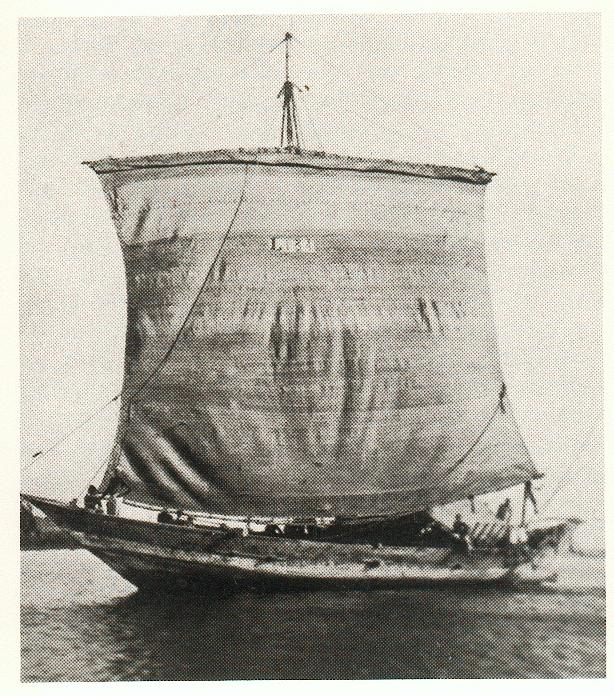
The mtepe stands as the most distinctive expression of this tradition. Built primarily in the Lamu Archipelago, it was a double-ended, sewn-plank vessel whose hull flexed rather than shattered on reefs. Planks of mangrove or similar timber were lashed with coir through edge holes and secured with wooden pegs; seams were caulked with fiber and bark paste. It carried a large square or near-square sail of palm-leaf matting, not the lateen sail that later became iconic of the “dhow.” Some examples reached substantial size—nineteenth-century accounts record vessels of roughly thirty meters and more than 180 tons. They were reportedly fast and surprisingly weatherly. Cargoes included grain, mangrove poles, salt, pottery, and livestock. The last traditional mtepe was built around 1930; the final known hull was wrecked in 1935. A half-scale reconstruction, Shungwaya, was completed in Zanzibar in 2003, preserving craft knowledge that had nearly vanished.
The mtepe was never the only Swahili craft. The more widespread dau (the linguistic ancestor of the English word “dhow”) and later nailed vessels coexisted with it. Linguistic evidence suggests the specific name and form of the mtepe may be relatively late and northern (Bajuni) in origin, even if sewn construction itself is ancient. Ship graffiti on medieval Swahili ruins show square-sailed vessels that may be ancestors. What matters is continuity of method and local mastery of materials. The same coir, mangrove, and palm resources that supported the Periplus-era boats still supported the last mitepe. Flexibility on coral was not a romantic survival; it was a practical engineering choice repeatedly validated by the environment.
This history challenges several persistent assumptions. First, the idea that African participation in the Indian Ocean was largely passive. Swahili sailors and shipowners conducted regional transshipment on a large scale and, at times, undertook longer voyages. Second, the notion that sewn construction was merely a borrowed or primitive technique. It was a sophisticated, context-specific technology that outlasted many nailed alternatives in the same waters. Third, the tendency to treat the Portuguese arrival after 1498 as an absolute rupture. Disruption was real, yet local shipbuilding and coasting trade continued, and the mtepe itself survived into the twentieth century.
The broader significance is both historical and contemporary. For African historiography, the seafaring record supplies concrete evidence of technological innovation, commercial agency, and cultural synthesis that cannot be reduced to external imposition. For maritime studies, it demonstrates that the western Indian Ocean was not a one-way transmission belt but a zone of mutual adaptation. For heritage work, the mtepe and its predecessors offer a rare case of documented technical continuity across nearly two thousand years. Museums in Mombasa, Lamu, and Zanzibar hold models and the 2003 reconstruction; further documentation, oral history, and experimental archaeology remain urgent before remaining knowledge disappears.
East African seafaring was never a footnote. From the sewn boats of Rhapta to the last mtepe on a Lamu beach, it formed a coherent tradition of skill, risk, and exchange. Recovering that tradition does not require inventing a golden age. It requires reading the sources—classical, archaeological, linguistic, and ethnographic—without the prior assumption that the real sailors always came from elsewhere. The keel was local. The voyage was shared. The history belongs on the main chart.