


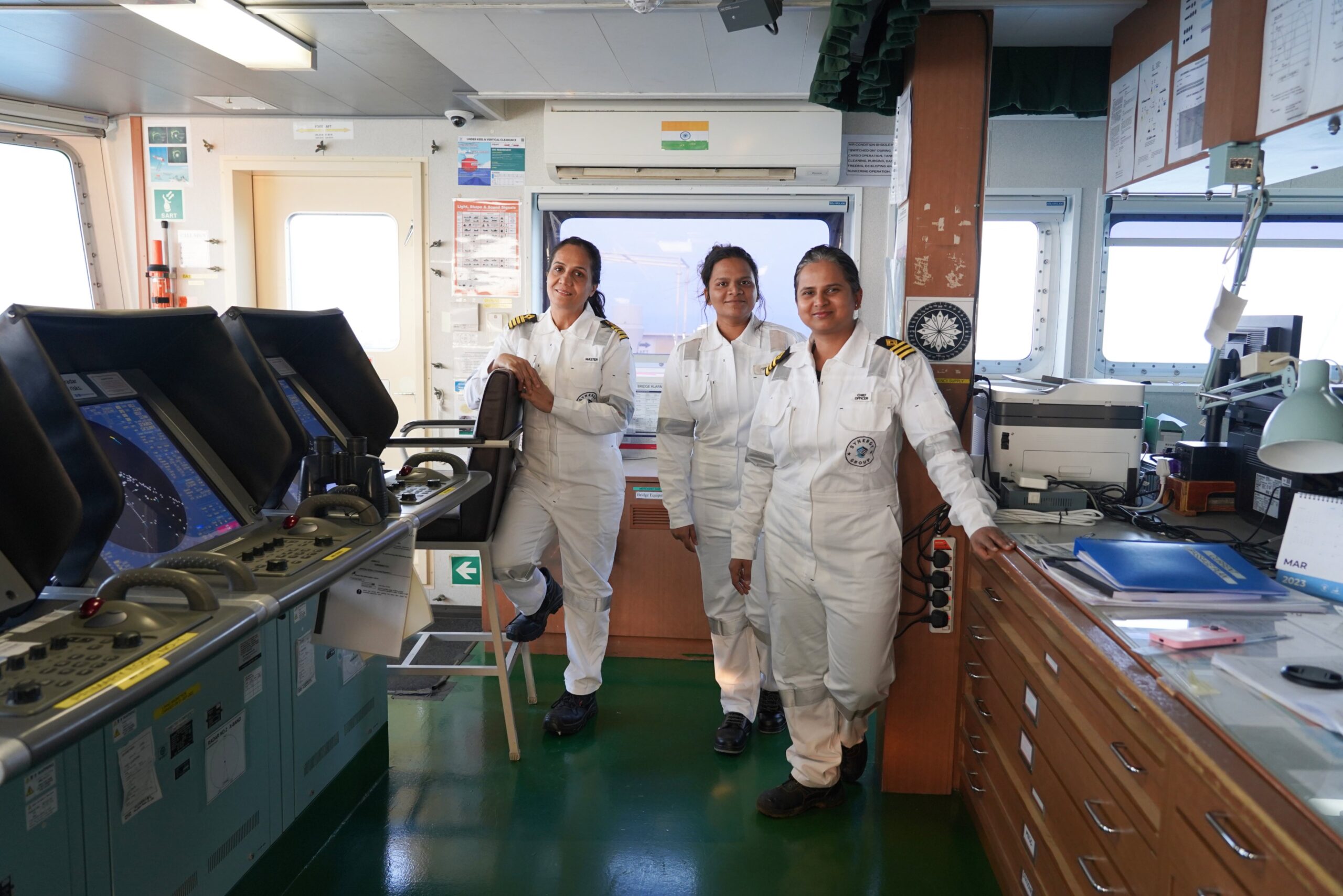
On the gleaming deck of a modern cruise ship, a female crew member in a crisp uniform balances a tray of drinks against a backdrop of sparkling pool and open sky. The image is polished, professional, quietly powerful. It also conceals a starker reality: women make up only about 1–2% of the global seafaring workforce—roughly 24,000 out of nearly 1.9 million seafarers. The overwhelming majority serve in the cruise sector. For them, life at sea often means isolation among few peers, heightened vulnerability to harassment and abuse that can remain invisible, facilities not designed for their needs, and the same punishing separation from family that all seafarers endure—compounded by gender-based barriers.
Missions to seafarers—organisations such as The Mission to Seafarers (MtS), Stella Maris, and similar welfare networks—have long provided practical, emotional, and spiritual support in ports worldwide. In recent years they have sharpened their focus on the distinctive needs of female seafarers. Their efforts deserve close attention, not as charity but as a necessary corrective to an industry still struggling with deep structural inequities.
The hidden life at sea
Female seafarers confront the universal hardships of the profession—long contracts, isolation, fatigue, limited shore leave, mental-health strain—while navigating additional layers of difficulty. Studies and reports consistently document gender discrimination in recruitment and promotion, inadequate or absent private facilities, and a culture in which abuse can go unseen because women often lack peers who can witness or corroborate what occurs. Many live a “hidden life,” as one MtS analysis put it, with few colleagues who share their experience. When harassment or assault happens, the closed environment of a ship can make reporting feel risky or futile.
Industry data reinforces the picture. Women remain heavily concentrated in cruise hospitality and service roles rather than deck or engine ranks. Career progression is slower; certification recognition can be uneven, especially for women from certain nationalities; and transitions to shore-based roles often bring fresh bias. Broader maritime surveys show women identifying gender discrimination as a major employment barrier at rates far higher than men. These are not abstract statistics. They translate into higher attrition, lost talent in an industry facing crew shortages, and real human cost.
From general care to targeted support
Missions to seafarers have historically offered ship visits, seafarers’ centres with Wi-Fi and rest spaces, transport, emergency advocacy, and pastoral care to anyone in need, regardless of nationality, rank, or gender. MtS alone operates in roughly 200 ports across 50 countries, conducting tens of thousands of ship visits annually and maintaining more than 100 Flying Angel centres. That general infrastructure already reaches many women. Yet the organisations have recognised that “one-size-fits-all” is insufficient when numbers are so low and risks so specific.
MtS’s 2022 report, Beyond the 2% – Women Seafarers and their Lives at Sea: Reflecting on Our Call to Care, marked a deliberate pivot. It examined challenges across vessel types—cargo, cruise, and yachts—and called for tailored responses. Follow-up research on the port-based welfare needs of women seafarers reinforced the findings. In response, MtS committed concrete resources: appointing and equipping specialist female chaplains, particularly in major cruise ports where women are more numerous; training them in counselling and psychology so they can empower survivors and challenge abusive cultures; pioneering digital chaplaincy to maintain contact across oceans; and developing printed, taught, and online resources for women experiencing abuse or other difficulties.
Practical adaptations have followed. In Tilbury, UK, MtS developed a cruise-focused service using converted containers next to the berths and ensured female staff availability in busy spaces. Similar models are being explored in Southampton and elsewhere. Recruitment has emphasised female ship visitors and chaplains; recent postings in Piraeus (Greece) and Tilbury explicitly prioritise support for female seafarers, especially those on cruise ships. Regional funds and campaigns continue to seek resources for more female visitors where cruise traffic is high. Other networks, including Stella Maris centres, provide complementary shelter, counselling, rights education, and family support that benefit women seafarers and their households.
These steps matter because they address both visibility and safety. A female chaplain or visitor can create a safer space for disclosure. Digital follow-up can reduce the isolation that follows a difficult voyage. Advocacy that challenges onboard cultures contributes to longer-term change. Centres and transport services give women practical options for rest, communication, and medical or dental care during limited shore leave.
Impact, gaps, and industry parallel efforts
The impact is still emerging, but the direction is clear. Specialist roles and adapted services increase the likelihood that women will be seen, heard, and supported rather than remaining invisible. Family support networks in places such as the Philippines and India help the households that rely on seafarers’ earnings—an often-overlooked dimension of welfare. Partnerships with other maritime welfare providers amplify reach.
Yet significant gaps remain. Specialist female chaplains are still few relative to the global footprint of shipping. Coverage is strongest in cruise ports and weaker elsewhere. Cultural and language barriers, company policies that limit shore leave or shore access, and the sheer scale of the industry mean many women still sail without reliable local support. Funding for sustained specialist posts and resources is never guaranteed. And while missions can respond to abuse and isolation, they cannot single-handedly reform hiring practices, shipboard cultures, or the design of vessels and facilities.
Parallel industry initiatives illustrate both progress and its limits. Programmes such as CMA CGM’s “She Sails” have more than doubled the number of women seafarers in that company in a short period and set ambitious targets for further growth, paired with mentoring, training, and equal-pay principles. Cruise lines employ the large majority of female seafarers and have expanded opportunities in certain roles. These efforts show that targeted recruitment and support can move the numbers. They also underline that welfare organisations and commercial actors must work in concert if the 1–2% ceiling is ever to rise meaningfully.
A call worth answering
The image of the composed cruise-ship worker is not false; it simply does not tell the whole story. Behind the uniform lie the same courage and competence that have always characterised seafarers, plus the additional resilience required of a tiny minority in a male-dominated environment. Missions to seafarers have begun to answer that reality with specialist chaplains, adapted centres, digital reach, advocacy, and resources aimed specifically at women. Those steps are practical, evidence-based, and humane.
They are also incomplete. Sustained funding, more female welfare staff in more ports, stronger collaboration with companies and regulators on culture and facilities, and continued research into women’s actual port and onboard experiences will determine whether the current momentum becomes lasting change. The industry needs more women at sea—for reasons of equity, talent, and resilience. Missions to seafarers cannot create that increase alone, but they can ensure that the women already there, and those who follow, are not left unseen, unsupported, or unprotected.
Seeing those at sea has always been the mission. For female seafarers, that commitment is now more focused, more urgent, and more necessary than ever. The work of these missions is not peripheral welfare. It is an essential part of making the maritime world fit for every person who keeps global trade moving.
Andrew Mwangura is a maritime safety analyst