


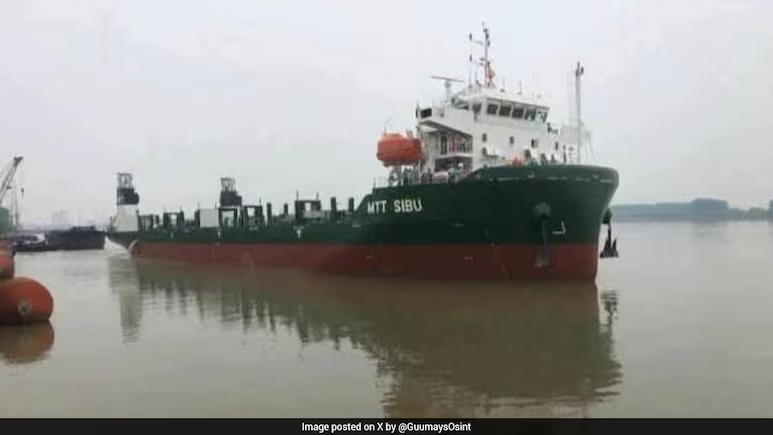
The oil products tanker Sibu 1 spent roughly five weeks as a floating hostage off the Somali coast before Puntland’s maritime police freed it on September 25. Six armed men had boarded the vessel on August 20 about 136 nautical miles east of Al-Mukalla, Yemen, in the Gulf of Aden. They diverted it toward Somalia with its 20 crew members—16 of them Indian nationals—and a cargo of roughly 228,000 barrels of gasoil reportedly bound for Port Sudan. The ship’s AIS destination field briefly flashed a desperate message—“PIRATE ONBOARD HEL”—before communications fell silent.
On paper, Sibu 1 flew the Eritrean flag. In reality, it did not. Eritrea’s government has flatly denied any registration or affiliation. International Maritime Organization records list the flag status as “false.” The tanker, built in 2001 and previously known as Seamull, had hopped flags and names in classic shadow-fleet fashion. The U.S. Treasury sanctioned it in December 2025 for allegedly transporting Iranian petroleum products and calling at Houthi-controlled ports in Yemen. Its management was linked to a UAE-based company, Qatrat Alnada Almasi Ship Management.
This is not merely another piracy story. It is a case study in how sanctions evasion, flag-of-convenience abuse, regional instability, and opportunistic crime now reinforce one another in one of the world’s most critical maritime corridors.
The Shadow Fleet Meets the Pirate Economy
Iran’s “shadow fleet”—a loose network of aging tankers that obscure ownership, switch identities, disable transponders, and fly flags of convenience—exists to move oil and products past U.S. and allied sanctions. Sibu 1 fit the pattern: opaque corporate structures, repeated reflagging, and a history that U.S. authorities said included Iranian cargoes. When such vessels operate in the Gulf of Aden and western Indian Ocean, they enter waters already contested by Houthi attacks, residual Al-Shabaab activity, and a revived Somali pirate network.
The 2026 surge is real. Sibu 1 was at least the 13th vessel attacked that year off Somalia or in the Gulf of Aden, according to International Maritime Bureau data and UK Maritime Trade Operations reports. Several earlier hijackings had already produced ransoms or prolonged captivity. The classic 2008–2014 Somali piracy wave cost the global economy billions and generated hundreds of millions in ransom payments before naval coalitions, armed guards, and better industry practices suppressed it. That suppression has eroded. Naval assets are stretched by Red Sea threats, coastal governance in Somalia remains fragmented, and the economic incentives for young men in Puntland and Galmudug have not disappeared.
Pirates do not need ideological affinity with Tehran or the Houthis to target a sanctioned tanker. They need a ship that is relatively isolated, lightly protected, and valuable enough to hold for ransom or leverage. An Iran-linked vessel may even be seen as lower risk for certain forms of international intervention—though the eventual Puntland operation showed local forces can and will act.
False Flags and the Erosion of Accountability
Flag states are supposed to exercise effective jurisdiction and control. When a ship sails under a false Eritrean flag, two problems arise simultaneously. First, legitimate open registries and responsible flag administrations are undermined by association. Second, the vessel becomes harder to track, insure, and hold accountable. Eritrea’s prompt denial was both factually correct and politically necessary; it also highlighted how easily fraudulent flags can be asserted on commercial platforms that simply reflect AIS data.
This is not a new problem, but it is intensifying. Sanctioned tonnage needs cover. False or lightly regulated flags provide it. The result is a growing population of vessels that are, in practical terms, stateless for regulatory purposes while still moving commercially valuable cargoes through contested waters. When those vessels are seized, the legal and diplomatic picture becomes messy: whose crew is to be protected, whose cargo is at risk, and which government has standing to demand action?
Local Capacity Versus International Drift
Puntland’s Maritime Police Force ultimately freed the ship after a two-day operation, reporting one pirate killed, four wounded, and fifteen captured. The crew and cargo were reported safe. This outcome is significant. It demonstrates that local security forces, when motivated and resourced, can still deliver results in their own littoral. It also stands in contrast to earlier releases that appear to have involved ransom payments or external naval intervention.
Yet one successful recovery does not reverse the broader trend. Piracy thrives where the expected reward exceeds the risk. As long as the Gulf of Aden and Somali Basin remain under-policed relative to the volume of traffic and the density of high-value, poorly governed vessels, opportunistic groups will continue to test the waters. The presence of Iranian shadow-fleet traffic adds another layer of complexity: these ships are already operating in a gray zone of legality, which can reduce the political urgency of protecting them while simultaneously increasing the strategic stakes if their cargoes or movements are linked to wider regional conflicts.
Wider Implications
Three conclusions follow.
First, sanctions enforcement and maritime security are no longer separate domains. The same vessels that evade petroleum sanctions are often the ones most vulnerable to, or most likely to attract, criminal interference. Better tracking of ownership, beneficial control, and AIS integrity is a sanctions tool and a security tool at the same time.
Second, flag-state responsibility cannot be allowed to become optional. International maritime organizations and major registries need clearer mechanisms to challenge and strike fraudulent flags in near real time, rather than leaving commercial databases to propagate false information for weeks.
Third, the Horn of Africa’s maritime domain requires sustained, realistic attention. Naval coalitions and industry best practices suppressed piracy once; they can do so again. But they will be less effective if the underlying drivers—weak coastal governance, economic desperation, and the availability of high-value, poorly regulated targets—remain unaddressed. Local forces such as Puntland’s deserve support that strengthens accountability rather than simply outsourcing risk.
The Sibu 1 episode ended with the crew free and the pirates in custody. That is the preferred outcome. It should not obscure the larger picture: a sanctioned tanker flying a phantom flag was seized in one of the world’s busiest energy corridors by a criminal network that has rediscovered its business model. The ship was a symptom. The disease is a maritime system in which opacity, weak enforcement, and regional disorder continue to feed one another. Until that system is tightened, the next Sibu 1 is already at sea.