


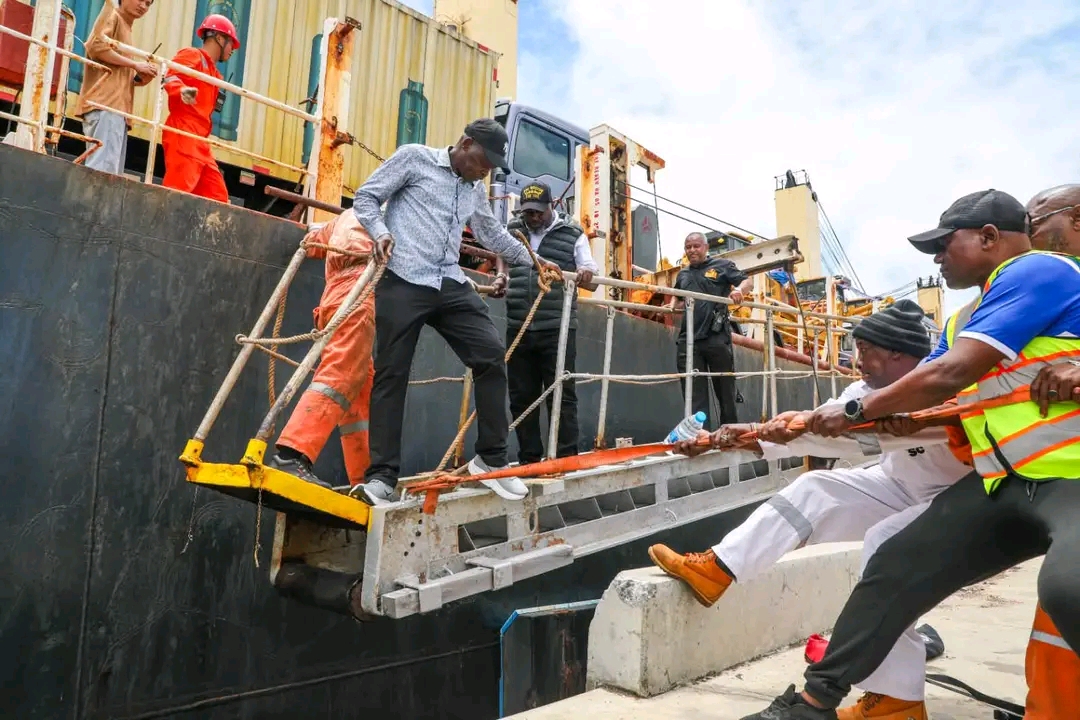
The docking of MV Da Yang at the Port of Lamu this week, laden with 2,930 metric tons of heavy machinery, is more than a routine port call. It is the tangible first step in what could become one of the most consequential industrial projects in modern East African history: the Dangote East Africa Refinery, a roughly KSh 2 trillion (approximately $15–17 billion) facility designed to process 700,000 barrels of crude oil per day.
Kenya Ports Authority Chief Executive Officer Captain William Ruto’s welcome of the vessel’s master, Captain Wang Shengli, and the presentation of a certificate of first call and plaque underscored the moment’s symbolism. “The arrival of this vessel is very critical and shows the Government’s commitment to ensuring this project succeeds. It will be a game changer for the entire region,” Ruto said. Groundbreaking is scheduled for next week, positioning Lamu—not Mombasa or Tanzania’s Tanga—as the site of East Africa’s first major oil refinery north of the equator and the largest refining complex the region has ever contemplated.
This is no ordinary infrastructure announcement. For a region that imports nearly all its refined petroleum products after the closure of Kenya’s last operating refinery in 2013, the project represents a structural shift from dependency to potential self-sufficiency and export capacity. The refinery is intended to process crude from Kenya’s own South Lokichar fields in Turkana, as well as supplies from Uganda, South Sudan, the Democratic Republic of Congo, and seaborne imports, then distribute products across East and Southern Africa and beyond. Lamu Port’s deep-water capabilities—able to handle large crude tankers that struggle at shallower regional ports—will be central to both inbound crude and outbound product movements.
The Strategic Logic of Lamu
Dangote Industries’ selection of Lamu over competing sites was driven by commercial, technical, and logistical realities. Lamu’s natural harbour, drafts of up to 18 metres, and its position as the coastal anchor of the Lamu Port–South Sudan–Ethiopia Transport (LAPSSET) Corridor give it structural advantages that older ports cannot easily match. The project is expected to inject life into a corridor that has long promised connectivity but delivered limited industrial cargo. A mega-refinery provides the missing anchor tenant: steady tanker traffic, storage demand, pipeline throughput, and associated petrochemical and power investments.
Kenya consumes roughly 100,000 barrels per day of refined products. A 700,000-bpd plant is therefore sized for the region from day one—Uganda, Tanzania, South Sudan, Rwanda, Burundi, the DRC, and potentially markets further afield. Officials project 50,000 to 60,000 jobs across construction and operations, plus secondary employment in logistics, services, and downstream industries. Foreign-exchange savings from reduced fuel imports could ease chronic pressure on the shilling. Regional equity offers—reportedly a combined 30 percent stake for East African governments, with Kenya eyed for around 10 percent—aim to create shared ownership and political buy-in.
Captain Ruto’s assurance that Lamu is “fully prepared to handle current and future cargo volumes” is not empty rhetoric. The port has been expanding capacity, acquiring modern equipment, and marketing itself aggressively as a transshipment and bulk-handling alternative. The arrival of construction materials for the refinery tests and validates that readiness in real time.
The Hard Realities Ahead
Optimism must be tempered by realism.
Kenya’s own crude production remains embryonic. South Lokichar is targeting first commercial oil by late 2026 or early 2027, beginning at around 20,000 barrels per day and scaling toward 50,000. Even optimistic regional aggregates fall short of filling a 700,000-bpd plant without substantial imports or accelerated upstream development in neighbouring countries. Pipelines from Turkana to Lamu and connections to Ugandan and South Sudanese fields are discussed but not yet fully financed or timed. Without reliable feedstock, the refinery risks under-utilisation—the very problem that has plagued other African refining ambitions.
Financing remains fluid. Earlier estimates hovered near $17–20 billion; more recent figures from Dangote point to $15–16 billion, with a proposed 30:70 equity-to-debt mix drawing on internal cash, bonds, and IPO proceeds. Kenya is exploring National Infrastructure Fund participation and regional co-investment. Yet large-scale industrial projects in Africa have a history of cost overruns and delays. Lessons from Dangote’s own Lagos refinery—itself a hard-won success after years of challenges—will be relevant, but the Kenyan context of limited domestic crude and nascent supporting infrastructure is different.
Environmental and social concerns cannot be dismissed. Lamu’s mangroves, coral reefs, seagrass beds, and fisheries support livelihoods and form part of a UNESCO World Heritage landscape. Greenpeace Africa and local voices have warned of pollution risks, oil-spill threats, habitat loss, and the danger of locking Kenya into long-term fossil-fuel infrastructure at a time when global energy transitions are accelerating. Past LAPSSET experiences have left some communities sceptical about job quality, land compensation, and equitable benefit-sharing. A rigorous, independent environmental and social impact assessment, genuine public participation, and transparent mitigation plans are not optional extras; they are prerequisites for legitimacy and long-term viability.
A Regional Test Case
If executed well, the Lamu refinery could do more than replace imports. It could catalyse a regional energy value chain under the African Continental Free Trade Area, reduce the vulnerability that comes with long supply lines from the Middle East and Asia, and demonstrate that large-scale private capital—paired with public facilitation—can deliver transformative infrastructure. It would also test whether East African governments can move beyond competition (Kenya versus Tanzania for the site) to genuine co-ownership and coordinated upstream development.
If executed poorly, the project risks becoming another expensive, under-utilised asset, straining public finances through equity contributions or guarantees, and leaving environmental and community grievances that outlast any temporary construction boom.
The MV Da Yang has delivered the first physical tools. Next week’s groundbreaking will turn political commitment into dirt and steel. Between those two moments and the projected completion around 2029–2030 lies the real work: securing feedstock, closing financing, managing environmental risks, building local capacity, and ensuring that the benefits of refined product flows and industrial employment reach ordinary Kenyans and their neighbours—not just balance sheets and ceremonial plaques.
Lamu is no longer waiting for its industrial moment. The moment has arrived. Whether it becomes a genuine game-changer for the region will depend less on the size of the investment and more on the quality of execution, the honesty of the risk assessments, and the willingness of all parties to treat the project as a regional public good rather than a national trophy.
The ship has docked. The harder voyage is just beginning.