


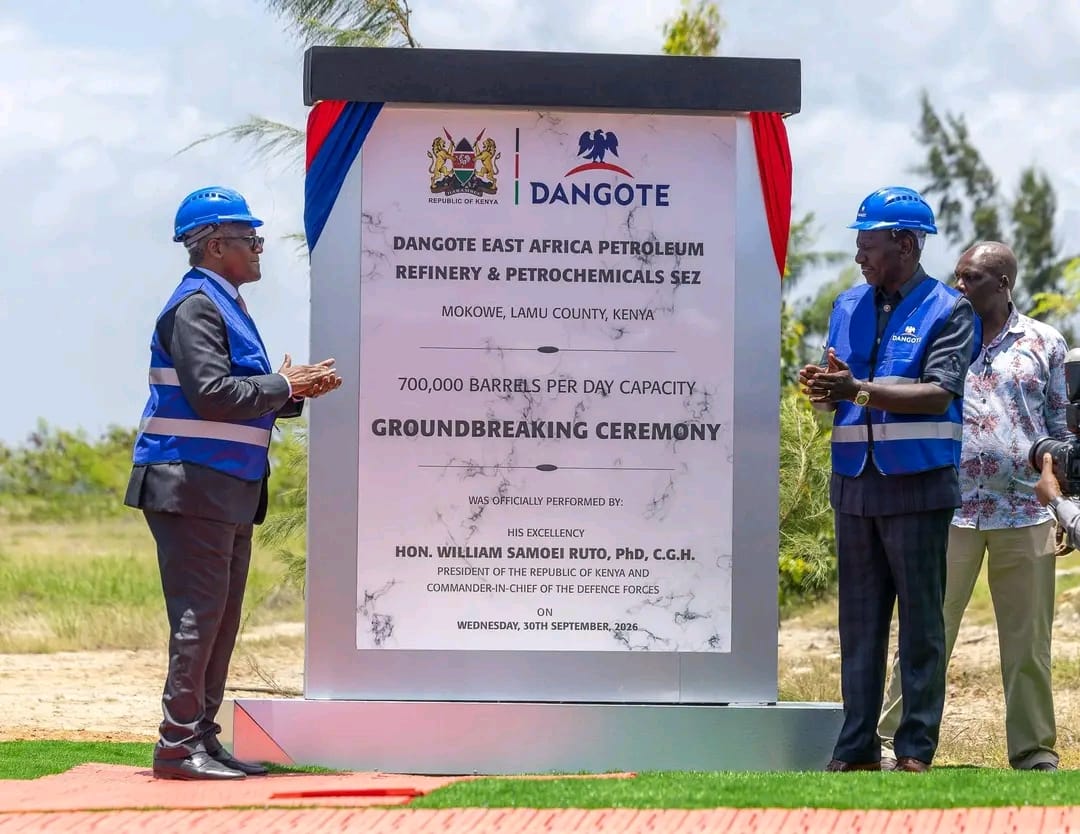
On 30 September 2026, as Aliko Dangote and President William Ruto broke ground on the Dangote East Africa Petroleum Refinery in Lamu, the Coast Development Authority (CDA) issued a pointed statement from its chairman, Mzee Mwinyi Mzee. Its message was unambiguous: Lamu has made history; Africa must industrialise Africa; do not merely chase the refinery—follow the money.
The project is Kenya’s largest private-sector investment since independence: roughly US$15–16 billion, a planned 700,000 barrels per day (bpd) capacity, a 40-month construction target, and projections of up to 60,000 construction-phase jobs. Equipment is already arriving. A 1,000 MW power plant is planned. Downstream talk of jet fuel, polyethylene, and broader petrochemicals is on the table. Regional governments have been offered a combined 30 percent stake. For a coast long treated as peripheral, and for a continent that exports crude only to re-import refined products at a steep premium, the symbolism is powerful.
Yet symbolism is not strategy. The real test is whether this becomes an industrial ecosystem or another enclave that extracts value while leaving the host region with residual jobs, environmental costs, and inflated expectations.
The Economic Logic Is Sound—on Paper
Africa produces substantial crude while remaining a major importer of refined products. The CDA statement cites 6.8 million bpd of African crude production against 4.5 million bpd of refined output in 2024, and a Kenyan petroleum import bill of KSh 530 billion in 2025. Independent trade data confirm Kenya’s heavy reliance on refined petroleum imports, running into the billions of dollars annually. A large, modern refinery at a deep-water port on the LAPSSET corridor can cut foreign-exchange leakage, improve energy security, and anchor downstream manufacturing, logistics, and services.
The “follow the money” framing is the strongest part of the CDA’s message. Construction alone will draw in cement, steel, engineering, transport, warehousing, housing, food, water, security, ICT, professional services, training, logistics, manufacturing, agriculture, fisheries, hospitality, and finance. Once operational, the prize shifts to petrochemicals, value addition, and regional trade. A port without industries is just a harbour; a refinery without a dense local supply chain is just a processing plant. The planned training school, land-use and urbanisation planning, and talk of a new town are the right instincts. So is the recognition that 60,000 construction jobs are temporary; the lasting gain lies in the ecosystem of businesses that can form around them.
The Constraints That Will Decide Success
Three hard constraints dominate.
Feedstock. Kenya is not Nigeria. Commercial oil production remains limited; Turkana volumes and timelines are uncertain, and moving crude to Lamu requires pipelines and storage that do not yet fully exist. Regional sources—Uganda, South Sudan—and seaborne imports will be necessary. Without reliable, competitively priced crude, the plant risks becoming a high-cost facility dependent on the very global markets it was meant to insulate the region against. Reuters and other reporting have repeatedly flagged this risk.
Infrastructure and power. A 1,000 MW captive plant is helpful, but the wider grid, roads, water, waste management, and housing must keep pace. Demand for one million tonnes of cement is both an opportunity and a logistics challenge. Land acquisition has already triggered protests over compensation. Environmental concerns around Lamu’s fragile ecosystem and UNESCO-listed heritage are real and will not vanish with groundbreaking ceremonies.
Local content and inclusion. History is littered with large projects that imported labour, materials, and profits while locals watched. The CDA is right that the Coast must not be a spectator. That requires enforceable local-content rules, transparent procurement, skills transfer that goes beyond short courses, and deliberate support for Coast-owned firms in construction, logistics, catering, and later downstream activities. “Innovative financing”—the National Infrastructure Fund, private sector, pension funds, SACCOs, development finance, diaspora, and investors—must be structured so that Kenyan and regional capital participates meaningfully rather than simply underwriting risk for external sponsors.
The Bigger African Story
The refrain “Africa must industrialise Africa” is more than rhetoric. For decades the continent has exported raw materials and imported finished goods, losing the bulk of value addition. Dangote’s model in Nigeria—building refining capacity at scale and forcing a rebalancing of the market—offers a template. Replicating it in East Africa, with regional equity participation, is a genuine attempt at collective industrial policy. If it works, Lamu becomes a node in a wider network of African processing capacity rather than another extractive outpost.
If it falters—through delayed construction, feedstock shortfalls, community alienation, or weak downstream linkages—it will reinforce the opposite lesson: that large African industrial projects remain vulnerable to the same coordination and governance failures that have frustrated earlier ambitions.
What Must Happen Now
The CDA statement is a useful starting point because it refuses to treat the refinery as an end in itself. The next steps are practical and political:
· Publish clear local-content targets and independent monitoring for construction and operations.
· Secure credible crude supply agreements and accelerate the supporting pipeline and storage infrastructure.
· Treat environmental and land-rights processes as core project risks, not public-relations afterthoughts.
· Design the training school and new-town planning as genuine capacity-building and urbanisation tools, not symbolic annexes.
· Ensure the 30 percent regional equity stake is structured for real influence and technology transfer, not passive rent collection.
Lamu has been placed on the international investment map. The question is whether the Coast and East Africa will capture the multiplier effects or merely host them. The refinery is not the opportunity; it is the catalyst. Turning that catalyst into lasting industrial capacity, skilled employment, and retained value will require the same seriousness that the CDA statement demands of everyone else: follow the money, build the ecosystem, and refuse to remain spectators in Africa’s own industrialisation.