


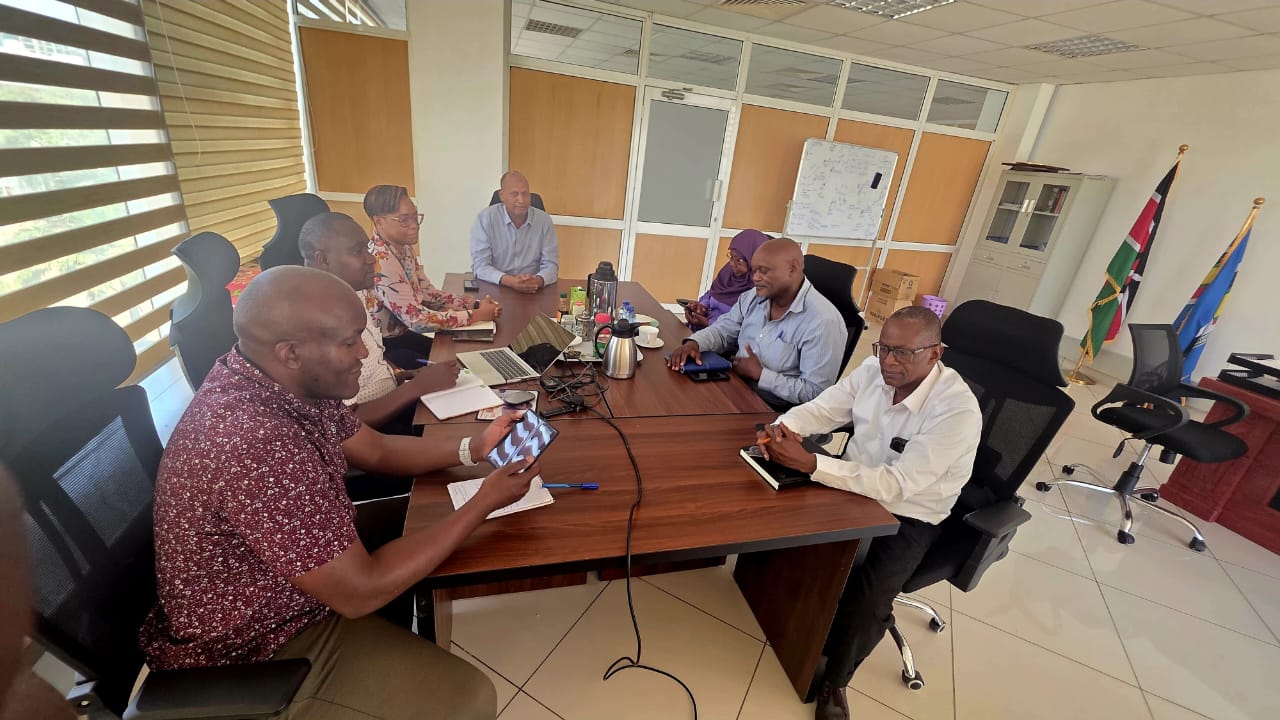
A recent strategic consultative meeting at the Kenya National Shipping Line (KNSL) offices in Mombasa—convened by the management team under Acting Managing Director Mrs. Fauzia Suleiman—offered a clear-eyed assessment of the company’s business prospects, operational challenges, and the government interventions required to transform it into a competitive national carrier. The State Department for Shipping and Maritime Affairs’ stated commitment to policy and structural support is both welcome and urgently needed. Kenya’s blue economy ambitions cannot succeed while the country continues to export billions in freight payments and cedes control of its maritime trade to foreign operators.
Kenya sits on a strategic maritime gateway. The Port of Mombasa handles tens of millions of tonnes of cargo annually and serves as a critical artery for landlocked neighbours. Maritime transport and trade already facilitate more than USD 3 billion in activity and contribute roughly 2.5–3 percent to GDP, with potential to rise substantially under the National Blue Economy Strategy 2025–2030. Yet Kenya owns a negligible share of the global merchant fleet. The result is an estimated annual outflow of USD 1.5–3 billion in freight payments to foreign shipping lines—capital that could instead support local jobs, insurance, logistics services, ship repair, and broader economic multipliers.
A Troubled Institutional History
KNSL was established in the late 1980s and early 1990s as the national carrier through joint ventures involving the Kenya Ports Authority and international partners. Its history has been defined by structural weaknesses: limited or no owned vessels, heavy reliance on slot chartering (notably with Mediterranean Shipping Company, which has held a significant stake), accumulated losses, debt, and repeated revival attempts that faltered. Earlier ambitions to generate billions in economic value and thousands of jobs through partnerships—including proposed roles linked to Mombasa’s second container terminal—encountered resistance over competitiveness concerns, governance questions, and the inherent difficulty of competing without owned tonnage or containers. Cabinet decisions in early 2025 to dissolve certain parastatals, including references to KNSL on grounds of high operating costs and outdated mandates, reflected these long-standing difficulties. Subsequent auditor-general reporting, leadership transitions, and continued official engagement indicate the entity has not simply vanished from the policy landscape.
Diagnosing the Operational Hurdles
The Mombasa briefing rightly focused on current prospects alongside challenges. Operational hurdles for a national line typically include the capital intensity of vessel acquisition or long-term chartering, high crewing and maintenance costs, competition from global giants with scale advantages, regulatory and licensing frictions, limited access to affordable finance, and the need for reliable cargo volumes—particularly government and parastatal cargo that could provide an anchor. Broader sector constraints compound these: funding gaps for maritime training and infrastructure, skills shortages despite seafarer placement efforts, port efficiency issues, and the dominance of foreign operators in both deep-sea and regional trades.
The Case for Strategic Intervention
These are not reasons for resignation. They are reasons for disciplined, realistic intervention. A highly competitive, robust, and resilient national shipping capability—whether through a restructured KNSL, public-private partnerships, or hybrid models involving owned and chartered tonnage—would advance several national priorities. It would retain a greater share of freight value locally, create pathways for Kenyan seafarers and maritime professionals, strengthen supply-chain resilience, support regional cabotage and intra-African trade aspirations under frameworks such as the African Integrated Maritime Strategy, and reinforce Kenya’s positioning as a maritime hub linking Mombasa, Lamu, and inland waterways. Discussions on regional shipping lines and cabotage protocols already signal recognition that individual African states struggle in isolation against global carriers. Collective approaches can help, but national capacity remains foundational.
From Rhetoric to Concrete Action
Effective government support must move beyond rhetoric. Priority interventions include:
· Clear policy direction on the future institutional form and mandate of the national carrier;
· Prioritised allocation of government cargo to build volume and cash flow;
· Facilitation of vessel acquisition or long-term chartering through innovative financing, guarantees, or partnerships that avoid repeating past slot-charter dependency;
· Regulatory streamlining that levels the playing field without creating new barriers;
· Accelerated investment in seafarer training, certification, and placement so that Kenyan crews become a competitive advantage; and
· Integration with port modernisation, digital logistics systems, and maritime spatial planning.
Fiscal realism is essential—capital-intensive shipping cannot be sustained on underfunded mandates—yet so is strategic patience. Short-term cost concerns must be weighed against the long-term cost of permanent foreign dominance.
The Road Ahead
Kenya’s blue economy strategy correctly identifies maritime transport as a pillar with room to grow. Turning that potential into retained value and jobs requires a national carrier that is commercially disciplined rather than a perpetual subsidy recipient. The consultative meeting in Mombasa represents the right approach: candid diagnosis followed by targeted structural support. The State Department’s commitment must now translate into concrete policy instruments, governance reforms, and enabling conditions that allow KNSL—or its successor model—to compete. Only then will Kenya move from being primarily a consumer of maritime services to an owner, operator, and beneficiary of its own blue economy.
About the Author
Andrew Mwangura is a maritime analyst and the founder of Maritime Business Review.