


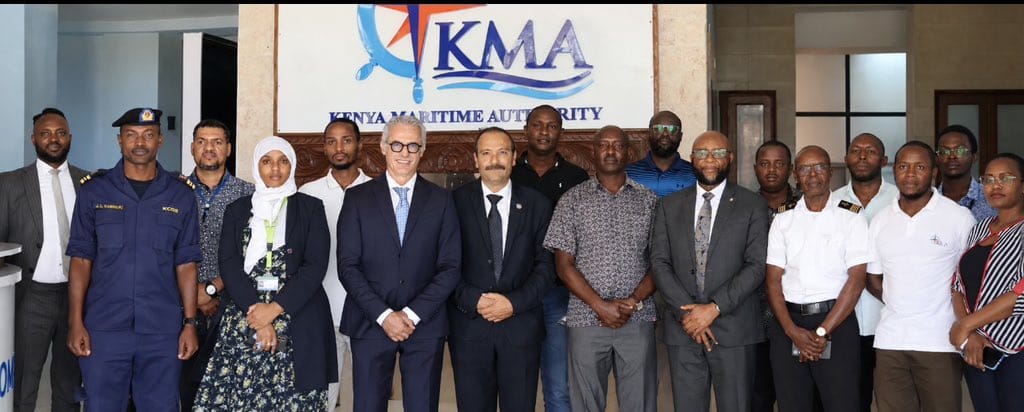
When the Kenya Maritime Authority convened maritime stakeholders and regional delegates for a National Consultation Workshop on Port Security and Safety of Navigation in the Eastern and Southern Africa–Indian Ocean (ESA-IO) region, it was more than a routine gathering. It was a deliberate exercise in diagnosing the strengths and gaps in Kenya’s maritime security architecture—and translating those insights into the foundations of a coherent regional policy.
The workshop systematically assessed national legal, institutional, human resource, and technical capacities through stakeholder consultations and site visits. It concluded with the validation of preliminary findings and the collection of priorities and recommendations intended to shape a regional policy on port security and safety of navigation. In doing so, it advanced a broader European Union-funded Port Security and Safety of Navigation Programme that supports nine countries—Angola, Comoros, Kenya, Madagascar, Mauritius, Mozambique, Namibia, Seychelles, and Tanzania—in aligning with the 2050 Africa’s Integrated Maritime Strategy.
This is not abstract bureaucracy. Ports are the arteries of Kenya’s economy and the wider region’s trade. The Port of Mombasa handles the bulk of East African cargo, serving landlocked neighbours and linking the continent to global markets. Any vulnerability—whether from terrorism, smuggling, residual piracy, cyber threats, or inadequate navigational safety—carries immediate economic, security, and humanitarian costs. A single major incident can disrupt supply chains, inflate insurance premiums, deter investment in the blue economy, and undermine public confidence.
A Strategic Focus on Four Pillars
The workshop’s focus on four interlocking capacity areas is therefore strategic. Legal frameworks determine whether international instruments such as the International Ship and Port Facility Security (ISPS) Code and SOLAS Chapter XI-2 are effectively domesticated and enforceable. Institutional arrangements decide whether the Kenya Maritime Authority, Kenya Ports Authority, Kenya Coast Guard Service, Kenya Navy, National Intelligence Service, and other agencies operate in silos or as a coordinated system. Human resources determine whether Port Facility Security Officers and related personnel possess the skills to conduct risk assessments, develop security plans, run drills, and respond to incidents. Technical capacity covers the hardware and systems—surveillance, information-sharing platforms, navigational aids—that turn policy into operational reality.
By combining consultations with site visits, the process grounded abstract gap analysis in the lived realities of Kenyan ports and waterways. Validation of findings ensured national ownership rather than externally imposed prescriptions. The resulting priorities and recommendations now feed into a regional policy that can harmonise standards, facilitate information exchange on cargo and passengers, and strengthen collective response mechanisms across the ESA-IO region.
A Theatre of Evolving Threats
The timing and context amplify the stakes. The Western Indian Ocean remains a theatre of evolving threats: residual piracy risks, trafficking of drugs and weapons, illegal fishing, and the growing spectre of cyber attacks on port systems. Geopolitical tensions in the Red Sea and Gulf of Aden have already demonstrated how distant disruptions ripple into East African trade routes. At the same time, Kenya and its neighbours are investing heavily in the blue economy—fisheries, coastal tourism, offshore energy, and maritime transport—as engines of growth under Vision 2030 and continental strategies. Security is not a constraint on this ambition; it is the precondition.
Building on Existing Foundations
Kenya has already made measurable progress. Earlier workshops under the same programme have trained personnel in port facility security assessments, security planning, drills and exercises, legal drafting for ISPS domestication, and inter-agency incident response. The Merchant Shipping (Maritime Security) Regulations provide a domestic legal basis. The country hosts the Regional Maritime Rescue Coordination Centre and participates actively in the Djibouti Code of Conduct architecture. These are solid building blocks. The consultation workshop’s value lies in stress-testing them, identifying residual weaknesses, and ensuring that national efforts contribute to—rather than lag behind—a regional standard.
From Assessment to Action
Yet capacity assessments only matter if their recommendations are acted upon with urgency and resources. Several priorities stand out.
First, sustained investment in human capital is non-negotiable. Training must move beyond one-off workshops to continuous professional development, including scenario-based exercises that test inter-agency coordination under pressure.
Second, information-sharing mechanisms—both national and regional—require operationalisation. Real-time data on cargo, passengers, vessel movements, and threat indicators can transform reactive security into proactive risk management.
Third, legal and regulatory frameworks must keep pace with emerging threats, particularly cyber and hybrid risks that traditional port security models were not designed to address.
Fourth, technical modernisation of navigational aids, surveillance systems, and port infrastructure must be treated as security investments, not merely operational upgrades.
The Regional Imperative
Regional policy development offers an opportunity to lock in these gains. A coherent ESA-IO framework can reduce duplication, enable mutual recognition of security standards, support joint exercises, and create predictable conditions for shipping lines and insurers. It can also strengthen Africa’s collective voice in international maritime governance, ensuring that the continent’s security concerns and developmental aspirations are reflected in global frameworks.
Kenya’s role as host of this consultation is significant. It signals a recognition that national security and regional stability are inseparable—that the safety of Mombasa’s port is bound to the safety of Lamu, Dar es Salaam, Maputo, and beyond. The workshop’s outcomes must now be translated into sustained political will, adequate funding, and institutional accountability.
The Road Ahead
The Indian Ocean is not merely a backdrop to Kenya’s economic ambitions; it is the arena in which those ambitions will succeed or fail. Port security is the foundation on which trade, investment, and regional integration rest. The National Consultation Workshop has provided a roadmap. The question now is whether Kenya and its regional partners will follow it with the urgency and coordination that the moment demands.
For East Africa’s maritime gateway, security is not an afterthought. It is the strategy.
About the Author
Andrew Mwangura is a maritime analyst and the founder of Maritime Business Review.