


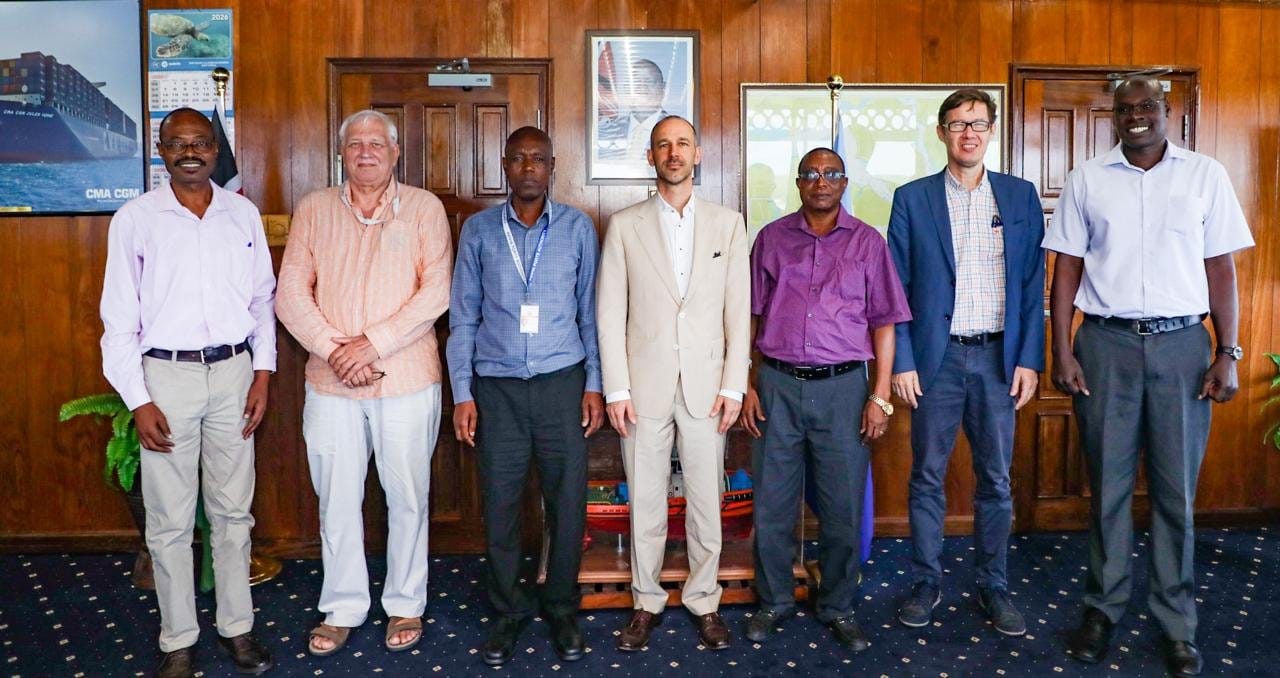
When Belgium’s Ambassador to Kenya, Tom Neijens, stood at the Port of Mombasa this week, his pledge was simple but significant: Belgium will continue using Mombasa as a primary gateway for its imports and exports while deepening collaboration on port efficiency, cold-chain infrastructure, and technology-driven logistics.
The meeting with Kenya Ports Authority General Manager for Finance and Commercial Services Geoffrey Kavate, representing CEO Capt. William Ruto, was more than diplomatic courtesy. It signals a deliberate alignment between a European logistics powerhouse and East Africa’s busiest deep-water port at a moment when both face intensifying competitive pressures.
This is not a new relationship, but the timing and emphasis matter. President William Ruto has already floated the idea of a “Nairobi-Antwerp Green Produce Corridor”—a seamless cold chain from Kenyan farms to European shelves—and invited the Port of Antwerp and Belgium New Fruit Wharf into a sister-port partnership focused on reefer handling and pre-cooling. Ambassador Neijens’ visit operationalizes that vision at the working level. Belgium is not merely a customer; it is positioning itself as a knowledge and technology partner in the very capabilities Mombasa needs to stay competitive.
Why Mombasa, Why Now?
The Port of Mombasa remains the indispensable gateway for Kenya and more than a dozen landlocked countries in East and Central Africa. It has posted record volumes, expanded reefer capacity (over 1,300 charging points across Mombasa, Nairobi, Lamu, and Naivasha), and invested in infrastructure to cut dwell times for perishables.
Yet it operates near capacity, faces competition from emerging corridors, and still loses too much value to post-harvest spoilage. Kenya’s horticulture, avocado, and flower exports—sectors where Europe is a critical market—depend on reliable temperature-controlled logistics. Air freight is expensive; sea freight with intact cold chains is the margin-maker.
Belgium brings precisely the expertise Mombasa needs. The Port of Antwerp-Bruges is one of Europe’s most sophisticated hubs for perishables, with deep experience in multi-temperature storage, cargo consolidation, and digital port community systems. Belgian operators and technology providers understand reefer logistics, pre-cooling, and the integration of port operations with inland rail and road networks. Knowledge exchange and capacity building in these areas—explicitly welcomed by Kavate—could accelerate Mombasa’s transition from a volume gateway to a high-value logistics platform.
The commercial logic is mutual. Belgian importers of Kenyan tea, flowers, avocados, and other perishables gain more reliable, lower-cost sea routes. Kenyan exporters gain access to European expertise that reduces losses and raises quality. Both sides benefit from technology transfer that modernizes gate operations, cargo tracking, and supply-chain visibility—areas where KPA is already partnering with players such as DP World on Port Community Systems.
The Broader Strategic Stakes
This partnership sits at the intersection of several larger currents.
First, Kenya’s ambition to position Mombasa and Lamu as competitive regional hubs capable of handling growing East and Central African trade volumes. Infrastructure programs underway—road interchanges, expanded terminals, digital systems—are designed precisely for that role. Belgian engagement adds credibility and specialized capability.
Second, Europe’s search for resilient, diversified supply chains. Geopolitical volatility, climate risks to agriculture, and the push for near-shoring or “friend-shoring” make reliable African partners more attractive. Belgium, as host to EU institutions and home to Antwerp, is well-placed to act as a bridge. The proposed green produce corridor is not just about flowers and avocados; it is about embedding Kenyan agriculture into European value chains with higher standards, lower emissions (sea freight versus air), and greater resilience.
Third, the competitive landscape among African ports. Mombasa does not operate in a vacuum. Dar es Salaam, Djibouti, and emerging facilities further south are all chasing the same transit and value-added cargo. Differentiating on cold-chain reliability, digital efficiency, and specialized partnerships with European operators is a smart defensive and offensive strategy.
Risks and Realities
Optimistic statements alone do not move containers. Execution will determine whether this remains a press release or becomes a structural advantage.
Cold-chain infrastructure requires more than plugging points; it needs consistent power, skilled operators, last-mile connectivity from farms, and commercial agreements that make sea freight competitive on both cost and reliability. Technology adoption can stall if systems are not interoperable or if users lack training and incentives. Capacity building sounds virtuous until budgets, timelines, and measurable KPIs are missing.
There is also the question of scale. Bilateral trade between Kenya and Belgium remains modest relative to the potential. Converting diplomatic goodwill into sustained cargo flows, joint ventures, and private-sector investment will require more than ambassadorial visits. Sister-port arrangements, specific reefer protocols, and pilot corridors for priority commodities would turn rhetoric into throughput.
Finally, Kenya must guard against over-reliance on any single partner while still extracting maximum value from those who bring genuine expertise. Belgium’s strengths in logistics, maritime technology, and European market access are real; they should complement, not displace, other partnerships already underway with global terminal operators and shipping lines.
A Partnership Worth Deepening
Ambassador Neijens’ visit and KPA’s receptive response are encouraging because they focus on the right bottlenecks: cold chain, technology, and operational efficiency. These are precisely the areas where incremental gains translate into disproportionate economic impact—reduced post-harvest losses, higher farm-gate prices, more competitive exports, and stronger regional hub status.
If followed by concrete agreements—joint training programs, technology pilots, commercial commitments on reefer volumes, and measurable targets for dwell-time reduction—this partnership can help Mombasa evolve from a high-volume transit port into a high-value logistics node. For Belgium, it secures a reliable African gateway and reinforces Antwerp’s position in global perishables trade. For Kenya and its hinterland, it strengthens the infrastructure that underpins growth.
The Port of Mombasa has long been East Africa’s gateway. Belgium’s renewed bet is that it can become something more: a model of how strategic partnerships can transform trade infrastructure into shared prosperity. The pledge has been made. Now comes the harder work of delivery.