


On 15 October 2026, ministers responsible for shipping, maritime affairs, trade and commerce will gather at the Johari Rotana Hotel in Dar es Salaam for the 10th Assembly of Ministers of the Maritime Organisation for Eastern, Southern and Northern Africa (MOESNA). Hosted by Tanzania’s Ministry of Transport, the meeting carries the theme “Strengthening Regional Maritime Cooperation for an Integrated, Competitive and Sustainable African Maritime Economy.” The agenda is precise: maritime trade, regional cabotage, shipping connectivity, human capital, safety, security, environmental protection, and the role of sea transport in regional integration.
The question is not whether the theme is correct. It is whether the Assembly will produce decisions that change the ownership structure of the vessels that already move the region’s cargo — or another carefully worded communiqué that leaves the freight bill largely unchanged.
The corridor is already voting with containers
The choice of Dar es Salaam is not ceremonial. In the 2025/26 financial year, transit cargo through the port rose 17 percent to 14.61 million tonnes. Cargo bound for the Democratic Republic of Congo jumped 30 percent to 7.77 million tonnes — more than half of all transit traffic. Rwanda-bound volumes grew 24 percent to 2.18 million tonnes; Zambia remained a major market at 3.41 million tonnes. Overall throughput reached 33.71 million tonnes, up 21.5 percent.
Mombasa, the other major gateway on this coast, handled 45.45 million tonnes in 2025, a 10.9 percent increase, with strong growth in transit to Uganda, Congo, Rwanda and Tanzania. The hinterland is expanding. The ships that carry the boxes, however, remain overwhelmingly foreign-owned and foreign-flagged.
A 1967 attempt that still casts a shadow
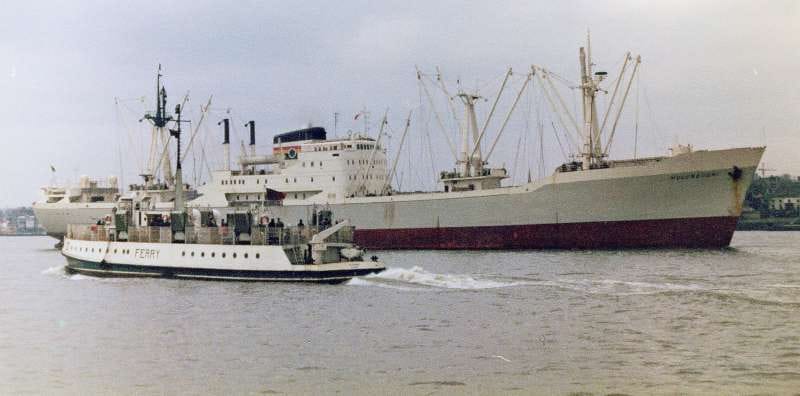
That imbalance is not new. In 1966–67, at the high tide of regional integration and decolonisation, Kenya, Tanzania, Uganda and Zambia pooled resources to create the Eastern Africa National Shipping Line (EANSL). The line was launched in 1966 in partnership with Southern Lines; its first cargo vessel, the Harambee, was inaugurated in 1967. The same four states established the Intergovernmental Standing Committee on Shipping (ISCOS) in 1967 to negotiate freight rates, challenge unjustified surcharges and give the region a collective voice in a sector dominated by foreign operators.
The EANSL was not merely a policy experiment. It owned and operated a fleet that included the SS Harambee, SS Mulungushi, SS Jogoo, SS Jitegemee, SS Ujamaa and SS Uganda. Those names carried the vocabulary of independence — harambee, ujamaa, jitegemee — and made the line a visible assertion of regional economic sovereignty.
The two initiatives were complementary: one tried to own ships, the other to regulate the terms of carriage. Both reflected the same diagnosis — that freight rates and shipping capacity were being set elsewhere, extracting value the new states could neither see nor bargain over.
The EANSL struggled with limited capital, dependence on external technical partners, membership of the Europe–East Africa Conference, and the political fractures that accompanied the collapse of the East African Community in 1977. It was wound up in 1980. ISCOS survived, evolving into a permanent secretariat in Mombasa in 1974, expanding its mandate to multimodal logistics in 2006, opening membership more widely in 2019, and relaunching as MOESNA in 2024. Full members now include the four founders plus the Democratic Republic of Congo, Ethiopia, Burundi, Botswana and Malawi. Mozambique is in active discussion. The organisation reports that 22 states have signed a broader cooperation framework.
The EANSL is therefore not a footnote. It is the region’s first serious attempt at collective ship ownership. Its failure does not invalidate the ambition; it defines the conditions under which a second attempt can succeed.
The money that still leaves the region
Maritime transport moves more than 80 percent of global trade by volume. For Africa, the share of international trade moving by sea is routinely placed near 90 percent. The continent’s participation in the ships, the flags and the freight accounts remains marginal.
Recent reporting around the mooted regional shipping-line project has put the annual cost of freight payments to foreign carriers in the order of several billion dollars for the Eastern, Southern and Northern African states alone, with wider continental estimates reaching tens of billions. Destination charges at major ports — delivery-order fees, container cleaning, deposits and administration — add further leakage. Kenya and Tanzania have both attempted in more recent decades to stand up national shipping lines and discovered the same constraint the EANSL faced: a line without competitive ships and sustained political and commercial discipline is little more than a letterhead.
Higher-than-average transport costs, landlocked geography, older and smaller vessels on thin routes, and lower-value cargo all compound the problem. Red Sea disruptions and shifting liner alliances have made the exposure more visible and more political. The African Continental Free Trade Area cannot deliver meaningful integration if coastal and land-linked states continue to rely almost exclusively on foreign capacity for the movement of each other’s goods.
What is actually on the table
In early 2026, MOESNA and COMESA convened a validation workshop in Nairobi that brought together regulators, financiers and private-sector operators. Stakeholders endorsed a feasibility study and a draft Regional Maritime Cabotage Protocol. The draft proposes reserving at least 40 percent of eligible intra-regional cargo for vessels flagged, owned and operated within member states, with requirements for local registration, insurance, a permanent office and renewable licensing under mutual recognition. The preferred commercial structure is a public-private partnership. The cautious first phase envisaged an initial fleet of five vessels at an estimated cost of around US$61 million over three years.
This is a more structured design than the 1967 venture. It is also the point at which the Assembly can fail. Cargo reservation without competitive ships becomes a queue. A 40 percent rule that coastal states apply while land-linked members merely applaud will fracture the coalition: Zambia, Uganda, Ethiopia, Burundi and Malawi need lower delivered costs and reliable sailings, not a flag of convenience with an African name. Five ships will not rewrite Indian Ocean trades, but they can, if routes are chosen against real coastal and feeder demand, prove a schedule. They cannot if every capital insists on a call.
Port competition adds another layer of risk. Dar es Salaam’s recent growth is partly the product of corridor rivalry as much as regional solidarity. A cabotage regime that does not settle priority berthing, pilotage and transparent slot policy will be read in one port as capture by the other. Overlapping institutions — PMAESA, COMESA, the African Union — are not the core problem. An Assembly that fails to assign who ratifies, who finances and who regulates will be.
The slower constraints
Safety, security and the marine environment are not secondary. A regional line that cannot meet international standards will simply be excluded from the trades it hopes to reserve. Human capital is the deeper bottleneck. Without ratings, officers, surveyors and repair capacity, the first five ships risk becoming bareboat charters in all but name. Discussions of a regional maritime centre of excellence with the World Maritime University are useful; they need numbered intakes and timelines attached.
What a useful Assembly would decide
A productive meeting on 15 October would do five things and refuse a sixth.
It would adopt a clear timetable for signature and ratification of the cabotage protocol, with a designated depository and a defined threshold for entry into force. It would mandate a financing term sheet for the first vessels — equity, debt and cargo guarantees — rather than another study. It would instruct ports, working through PMAESA, on priority berthing and published tariffs for qualifying cabotage vessels. It would link any training initiative to concrete targets for seafarers and surveyors within two years. And it would set baseline environmental and safety standards that regional ships must meet from the first day of operation.
It would not announce a regional carrier as if the fleet already existed.
The Eastern Africa National Shipping Line was launched in 1966–67 because freight rates and capacity were being set elsewhere. Nearly six decades later, the freight is still largely set elsewhere. Dar es Salaam, with a port that has just recorded its strongest transit year and a government investing in rail and gate infrastructure, is a credible place to stop describing that fact and begin contracting against it — this time with clearer commercial discipline, a legal cabotage framework, and the hard lessons of 1980 in view. The ministers will arrive with a draft protocol and a feasibility study. The ships remain someone else’s. The test of the Assembly is whether that begins to change.