


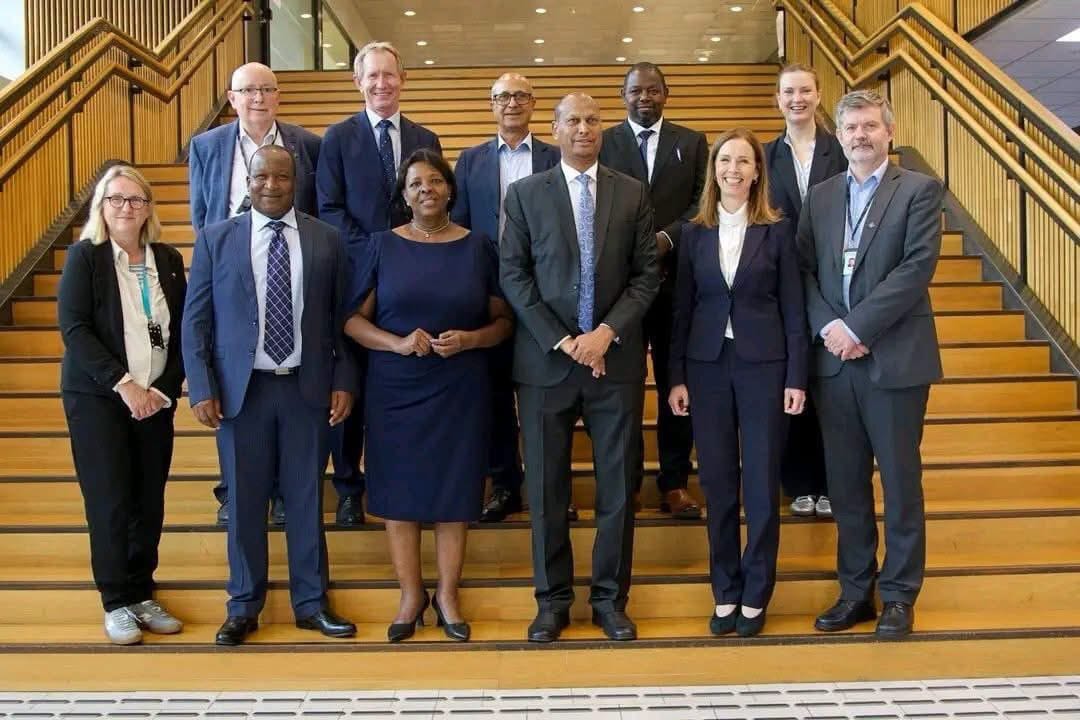
In the fjords of Bergen, far from the bustle of Mombasa’s port or the policy corridors of Nairobi, a small Kenyan delegation recently held a series of meetings that may prove more consequential than many splashier diplomatic spectacles. The Director General of the Kenya Maritime Authority (KMA), accompanied by Principal Secretary for Shipping and Maritime Affairs Aden A. Millah, engaged Bergen’s mayor, Corvus Energy, the Western Norway University of Applied Sciences, and the Institute of Marine Research. Their stated goal was straightforward: strengthen maritime cooperation and advance Kenya’s blue economy agenda through green shipping, maritime education and training, marine technology, research, and innovation.
On the surface, this is another bilateral visit in a year already dense with Kenya–Norway maritime activity. Dig deeper, and a more deliberate strategy emerges—one that moves beyond job pledges and ceremonial memoranda toward the harder work of technology transfer, skills alignment, and institutional learning. Whether Kenya can convert these engagements into durable competitive advantage will test the seriousness of its blue economy aspirations.
From Oslo Pledges to Bergen Practicalities
The Bergen visit did not occur in isolation. In June 2026, President William Ruto’s engagements in Oslo produced a headline commitment: Norwegian firms, led by Wilhelmsen Ship Management, pledged to employ 1,000 Kenyan seafarers by 2030, with an initial 120 placements targeted for the end of that year. Bandari Maritime Academy welcomed the deal as a “wake-up call” for Kenyan youth and as evidence of growing demand for internationally certified mariners. Parallel tracks included discussions on green shipping corridors, ocean sustainability, decarbonisation, and stronger links between Mombasa, Lamu, and Norwegian ports.
Bergen represents the operational follow-through. Corvus Energy, headquartered in the city after relocating from Canada, is a global leader in maritime energy storage systems. It has supplied batteries for more than 1,300 hybrid or all-electric vessels—roughly half of the world’s zero-emission fleet—and is expanding into hydrogen fuel cells. Visiting Corvus is not tourism; it is an attempt to understand the technology stack that will define competitive shipping in the coming decades. For a country whose ports handle the bulk of East Africa’s trade and whose own fleet remains modest, exposure to battery systems, energy management software, and hybrid propulsion architectures is strategic intelligence.
Equally important are the academic and research partners. Western Norway University of Applied Sciences has deep expertise in maritime education and applied technology. The Institute of Marine Research (IMR), one of Europe’s largest marine science institutes and a long-time partner of Kenya through the EAF-Nansen Programme and related blue food systems work, brings world-class capabilities in fisheries assessment, oceanography, and ecosystem monitoring. Kenya already benefits from IMR’s research vessel deployments and capacity-building with the Kenya Marine and Fisheries Research Institute. Formalising deeper ties in Bergen extends that relationship from data collection toward joint curriculum development, applied research, and technology adoption.
These choices signal prioritisation. Kenya is not merely seeking berths for its seafarers; it is mapping the knowledge and hardware required to participate in the decarbonising maritime economy as more than a labour supplier.
The Structural Opportunity—and the Binding Constraints
Kenya’s blue economy potential is frequently recited: a long coastline, a vast Exclusive Economic Zone, strategic ports, and a young population. Yet the sector remains under-realised. Domestic shipowning is limited, value addition in fisheries is constrained, and maritime training capacity—while improving through Bandari and other approved institutions—still faces gaps in sea-time placements, specialised green technologies, and scale. Funding shortfalls for academy masterplans and related programmes have been publicly acknowledged by the Principal Secretary’s office.
Norway offers complementary strengths: advanced green maritime technology, rigorous education and certification systems, patient capital, and a track record of successful technology transfer partnerships. The combination is logical. Kenyan seafarers already sail on international vessels; integrating them into Norwegian-managed fleets accelerates skills transfer. Exposure to Corvus-level technology could eventually support local innovation in hybrid ferries, port electrification, or support vessels for offshore renewable projects. Research collaboration with IMR strengthens evidence-based management of Kenya’s marine resources—an essential foundation if the blue economy is to be sustainable rather than extractive.
Yet ambition collides with execution risk. Job pledges require continuous pipelines of certified, English-proficient, STCW-compliant seafarers with the soft skills and technical readiness Norwegian operators demand. Training institutions must expand capacity without diluting quality. Technology partnerships need clear pathways from demonstration projects to local manufacturing, maintenance, or assembly—otherwise Kenya remains a technology consumer. Green shipping corridors sound compelling, but they require aligned regulation, port infrastructure investments, and commercial viability. Bureaucratic friction, financing gaps, and coordination failures across ministries and agencies have historically slowed maritime initiatives.
Leadership continuity at KMA itself has been uneven in recent years. The current Director General, CPA Justus Omae Nyarandi, brings substantial regional and ports experience. Sustained, professional leadership will be essential if the Bergen engagements are to produce more than reports and photographs.
What Success Would Actually Look Like
A serious reading of the Bergen agenda suggests several measurable tests over the next 24–36 months:
· Delivery on the 120 seafarer placements in 2026 and steady progress toward the 1,000 target, with transparent reporting on retention, rank progression, and skills gained.
· Concrete educational partnerships—joint programmes, faculty exchanges, or specialised short courses in battery systems, hybrid propulsion, and digital maritime technologies—between Kenyan institutions and Western Norway University of Applied Sciences or equivalent.
· Pilot technology projects, even small-scale, involving Corvus or similar firms: hybrid harbour craft, shore-power installations, or energy storage at Kenyan ports.
· Expanded research outputs and data-sharing protocols with IMR that feed directly into Kenya’s marine spatial planning, fisheries management, and climate adaptation strategies.
· Progress on regulatory and infrastructure enablers that make green corridors and increased Norwegian shipping interest commercially rational.
Anything less risks reducing the partnership to a series of high-level visits and press releases—politically useful, economically marginal.
Broader Stakes
Kenya’s blue economy strategy sits at the intersection of three national priorities: youth employment, climate-aligned growth, and regional logistics leadership. Norway’s partnership offers a high-quality on-ramp into the green maritime transition precisely when global shipping faces intensifying decarbonisation pressure from the IMO and cargo owners. Countries that position themselves early as reliable suppliers of skilled labour and adopters of cleaner technology will capture disproportionate value.
The Bergen engagements are therefore not a side trip. They are a test of whether Kenya can move from aspirational blue economy rhetoric to the unglamorous work of curriculum reform, technology absorption, institutional capacity, and commercial follow-through. The meetings with Corvus, the university, and the Institute of Marine Research were the right ones to have. The harder meetings—those that turn intent into contracts, curricula, and cargo—still lie ahead.
If Kenya succeeds, the quiet work done in Bergen will be remembered as an early chapter in a more competitive and sustainable maritime future. If it stalls, the fjords will have offered only another set of photographs.