


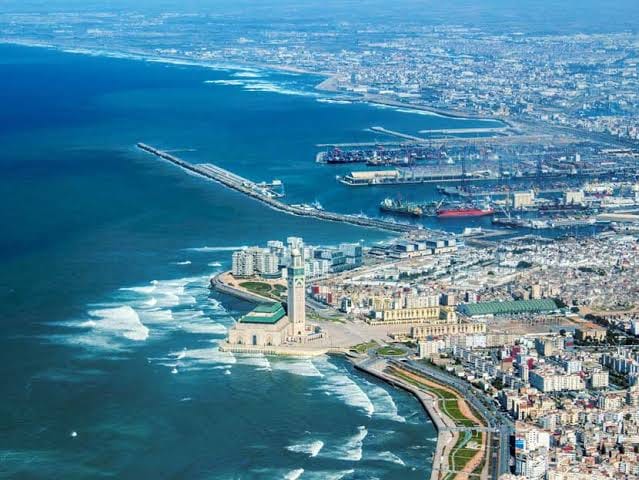
Morocco is quietly rewriting the rules of African port competitiveness. The arrival of Africa’s first Liebherr LPS 550 portal slewing crane at the Port of Casablanca is more than a piece of heavy machinery. It is a precise, deliberate signal that the Kingdom is treating bulk cargo handling as strategic infrastructure rather than an afterthought.
Marsa Maroc, the country’s leading terminal operator, has ordered a rail-mounted, electrically driven LPS 550 with a 48-metre boom specifically for bulk operations. The crane offers a maximum lifting capacity of around 144 tonnes (up to 154 tonnes in high configuration), combining outreach, precision, and the ability to keep quay space free beneath its portal structure. It arrives after the delivery of three Liebherr LHM 550 mobile harbour cranes in 2024 and sits within the broader Marsa 2030 investment programme. Additional Liebherr units are already scheduled for Nador and Tangier.
The scale of the operation is significant. In 2025, Marsa Maroc handled more than 19 million tonnes of cargo and nearly 1.1 million TEU at its Casablanca facilities alone. Across its network of 35 terminals in 21 ports, the operator moved roughly 67 million tonnes. The Port of Casablanca itself spans more than 450 hectares, offers over 8 kilometres of quay, and can accommodate up to 40 vessels simultaneously. It remains Morocco’s primary gateway for domestic trade, moving cereals, animal feed, minerals, steel products, vehicles and containers.
Why This Crane Matters
Portal slewing cranes of this type are not common in Africa. Most bulk terminals still rely on older mobile harbour cranes or ship-mounted gear that consume quay space and limit simultaneous operations. The LPS 550’s rail-mounted design preserves valuable apron area for trucks, stackers and other equipment while delivering the outreach needed for a wide range of vessel sizes, including larger bulk carriers. Its electric drive supports precise control and consistent performance under intensive cycles — an operational advantage in a port that already faces congestion pressures.
The investment is complementary rather than isolated. Marsa Maroc has already deepened sections of quay to 12 metres, allowing vessels of up to 60,000 tonnes where the previous limit was roughly 35,000 tonnes. Further deepening and extension works are under way, with multipurpose terminal capacity targeted to rise above 8 million tonnes. Parallel container investments aim to push Casablanca’s container handling toward or beyond 2 million TEU by 2030. The LPS 550 plugs a specialised gap in the bulk segment, reducing vessel turnaround times and improving berth productivity exactly where high-volume dry bulk moves.
Broader Strategic Context
Morocco’s National Port Strategy 2030 is not abstract policy. It is a calculated response to geography and economics. Casablanca sits on the Atlantic, serving the country’s industrial and agricultural heartland. Tanger Med has already established itself as a major Mediterranean transhipment hub. Nador West Med is approaching operational status. Dakhla Atlantique is under development further south. The goal is a balanced, multi-gateway system that reduces over-reliance on any single port while lowering logistics costs for Moroccan exporters and importers.
Bulk cargo — cereals, minerals, animal feed, steel — remains foundational to food security, industrial inputs and export competitiveness. Inefficient handling here translates directly into higher costs for farmers, manufacturers and consumers. By pairing deeper berths with modern, specialised equipment, Marsa Maroc is attacking both the physical constraints of vessel size and the operational constraints of productivity. The result should be shorter waiting times, lower demurrage exposure and more reliable schedules.
This also reflects a maturing commercial relationship with global equipment suppliers. Liebherr is not a newcomer to Moroccan terminals, but the LPS series is a first for the continent. The project demonstrates that African operators can specify and receive high-specification European technology tailored to local needs rather than accepting generic or second-hand solutions. It raises the performance bar for other North and West African ports that still operate with older fleets.
Risks and Realities
No single crane solves structural challenges. Congestion at Casablanca has been a recurring issue, driven by rising volumes, weather disruptions and the sheer density of activity. Equipment alone cannot compensate for landside bottlenecks, customs processes, or insufficient storage and intermodal connections. Success will depend on coordinated execution: the crane must be installed, commissioned and integrated into existing workflows without prolonged disruption. Operator training, spare-parts logistics and maintenance regimes will determine whether the advertised productivity gains materialise.
There is also the question of scale. One LPS 550 is a meaningful upgrade for a specific berth or cargo stream, not a transformation of the entire port complex. Marsa Maroc’s multi-billion-dirham investment plan across containers and bulk is the real story; the crane is one visible element of a larger programme. Critics may argue that resources could be better directed toward digital systems, hinterland rail links or green energy for shore power. Those are valid priorities, but they are not mutually exclusive. Efficient mechanical handling remains a prerequisite for any modern port.
Implications Beyond Morocco
For the rest of Africa, the installation offers a practical benchmark. Many continental ports still struggle with outdated bulk infrastructure, long vessel stays and high logistics costs that undermine regional trade and industrialisation. Morocco’s approach — combining concession reform (Marsa Maroc itself was created in the 2006 port sector reform), sustained capital expenditure and selective adoption of specialised technology — provides a replicable model. It shows that African operators can move beyond basic capacity expansion to performance differentiation.
The electric drive of the LPS 550 also aligns with longer-term decarbonisation pressures. While ports worldwide face growing scrutiny over emissions, equipment that reduces reliance on diesel and improves energy efficiency becomes an operational and reputational asset. Morocco’s broader energy transition and green industrial ambitions give this technical choice additional resonance.
Conclusion
The first Liebherr LPS 550 in Africa is not a headline-grabbing mega-project. It is a focused, high-specification investment in the unglamorous but essential work of moving bulk cargo efficiently. In a port that already handles nearly 20 million tonnes and a million TEU under Marsa Maroc’s management, that focus is precisely the point.
Morocco is treating its ports as competitive infrastructure rather than passive gateways. By pairing deeper berths, modern equipment and a clear multi-year investment horizon, it is positioning Casablanca — and the wider national port system — to support higher trade volumes at lower unit costs. The rest of the continent would do well to watch closely. Efficient bulk handling is not glamorous, but it is foundational to food security, industrial competitiveness and the ability of African economies to participate profitably in global supply chains. Casablanca has just taken a concrete step in that direction.
Andrew Mwangura is a maritime safety and labour analyst.