


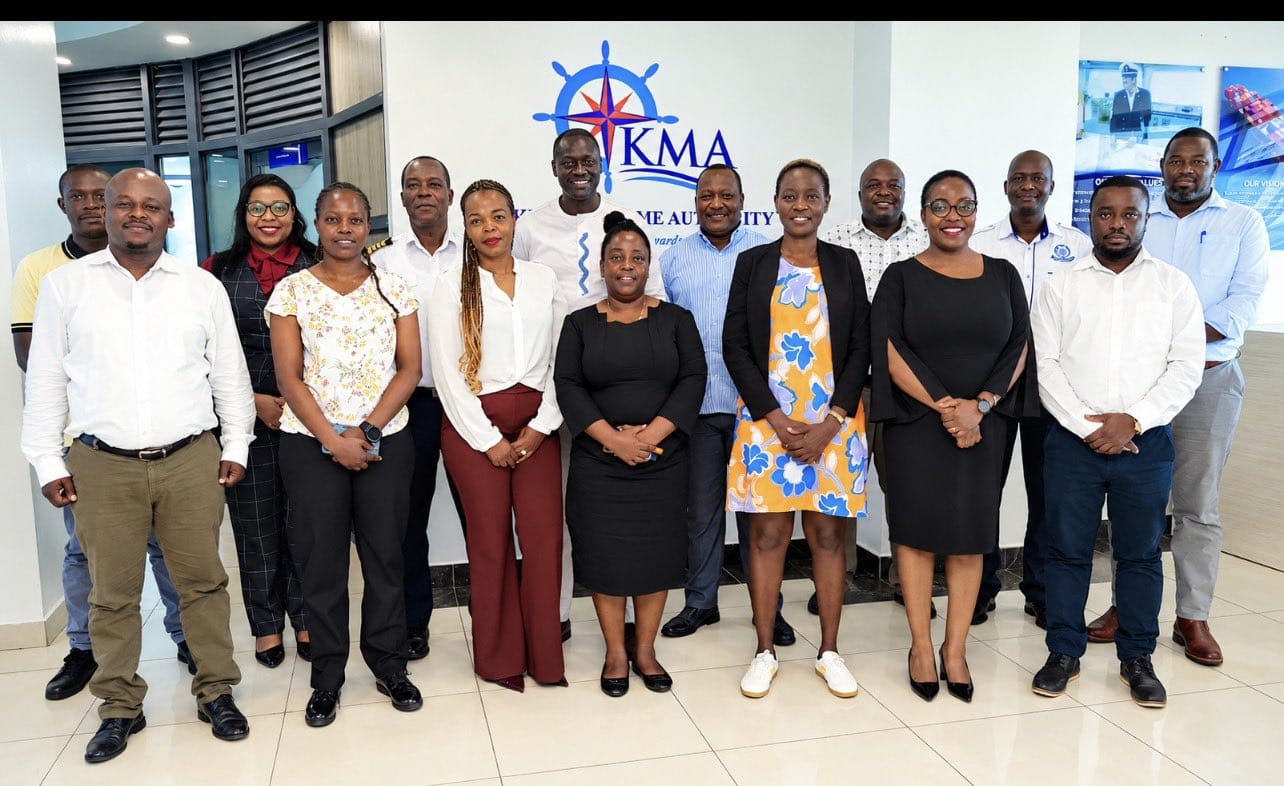
When Kenya Maritime Authority (KMA) Director General CPA Omae Nyarandi welcomed High Commissioner to the United Kingdom and Northern Ireland H.E. Ambassador Maurice Makoloo to Bahari Towers, the gathering was more than a courtesy call. It brought together Bandari Maritime Academy (BMA), Kenya Ports Authority (KPA), Kenya National Shipping Line (KNSL), the Maritime Technology Cooperation Centre at Jomo Kenyatta University of Agriculture and Technology (MTCC-JKUAT), and Women in Maritime in Eastern and Southern Africa (WOMESA). The meeting signalled a deliberate effort to align institutional muscle, diplomatic reach, and sector expertise behind Kenya’s maritime ambitions.
This is the kind of coordination the country has long needed. Kenya’s coastline stretches roughly 640 kilometres. Its Exclusive Economic Zone covers about 230,000 square kilometres. Around 95 per cent of the country’s international trade moves by sea. Maritime trade already exceeds US$3 billion annually and contributes meaningfully to GDP, yet the broader blue economy remains under-realised. Illegal, unreported and unregulated fishing alone drains an estimated KSh 90 billion each year. Skills gaps, fragmented governance, limited national shipping capacity, and insufficient sea-time opportunities for graduates continue to constrain growth. The National Blue Economy Strategy 2025–2030 and the recent KSh 156 billion coastal counties plan both recognise these realities and set ambitious targets for jobs, investment, and sustainable resource use. Progress, however, depends less on new documents and more on institutions that actually work together.
Ambassador Makoloo’s dual role is particularly relevant. As High Commissioner in London, he leads Kenya–UK political, commercial and diaspora engagement. As Permanent Representative to the International Maritime Organization (IMO), he sits at the centre of global shipping regulation, safety standards, environmental rules and seafarer training frameworks. London and the IMO remain critical nodes for any nation seeking to expand its shipping register, secure training berths, attract green-shipping investment, or influence the decarbonisation agenda that will reshape the industry over the next decade. Bringing that diplomatic capacity into direct conversation with KMA, the ports operator, the national shipping line, the premier maritime training academy, a technology cooperation centre, and a regional women’s maritime network is therefore strategic, not ceremonial.
Each institution at the table holds a distinct piece of the puzzle. KMA regulates and coordinates maritime activities. KPA manages the ports that serve as the Northern Corridor’s gateway and handle the bulk of regional transit cargo. KNSL is the vehicle through which Kenya can rebuild a national carrier presence and capture more of the freight value chain. BMA trains the seafarers, marine engineers and port professionals the industry needs; recent partnerships that place cadets with international lines such as CMA CGM show the academy is beginning to close the critical sea-time gap. MTCC-JKUAT brings technical capacity on energy efficiency, emissions reduction and technology transfer—areas that will determine competitiveness as global shipping moves toward net-zero. WOMESA ensures that gender inclusion is not an afterthought; women still constitute a tiny fraction of seafarers and senior maritime roles, and deliberate effort is required to change that.
The risks of continuing in silos are clear. Training institutions produce graduates who cannot easily access sea time. Ports modernise while national shipping capacity remains thin. Diplomatic missions open doors that domestic agencies are not ready to walk through. Technology centres develop solutions that never reach operators. Gender networks advocate without institutional leverage. The result is lost opportunity: fewer Kenyan seafarers on foreign vessels, less local content in port and logistics services, slower adoption of cleaner technologies, and a weaker voice in regional and global maritime forums.
The Bahari Towers meeting points toward a different model—one in which the High Commission becomes an active partner in maritime diplomacy, KMA provides the regulatory and coordinating spine, operational agencies deliver infrastructure and services, training institutions supply skills, technology centres drive innovation, and inclusion bodies ensure the benefits are broadly shared. Practical next steps could include joint missions to UK and European shipping companies, structured cadet placement programmes, collaborative work on green-port and alternative-fuel initiatives, support for a stronger Kenyan presence at the IMO, and deliberate efforts to increase women’s participation across the value chain.
Kenya’s maritime future will not be secured by any single agency or envoy. It will be secured by institutions that treat collaboration as a core operating principle rather than an occasional event. The gathering at Bahari Towers was a useful demonstration of that principle. The test will be whether the conversations continue, the partnerships deepen, and the results appear in more Kenyan seafarers employed, more cargo moved under national flags or agency arrangements, cleaner and more efficient ports, and a blue economy that delivers measurable jobs and growth for coastal communities and the country as a whole.
The tide is rising. Kenya’s maritime institutions must now decide whether to row together—or watch others capture the value.